 Tap AAC
Break cards: free printable “I need a break” cards
A break card is a card a person hands over, or points to, to ask for a short break without having to say it. When feelings or noise build up, showing a card can be much easier than finding words. This free PDF has two big “I need a break” cards, 12 small cards (break, help, quiet, all done and two blanks), two word-only cards for teens and adults, and a board of things to do on a break.
Download the free PDF US Letter, 2 pages, 668 KB
Portrait (tall page, 2 pages): US Letter PDF (668 KB) · A4 PDF (668 KB)
Landscape (wide page, 2 pages): US Letter PDF (668 KB) · A4 PDF (667 KB)
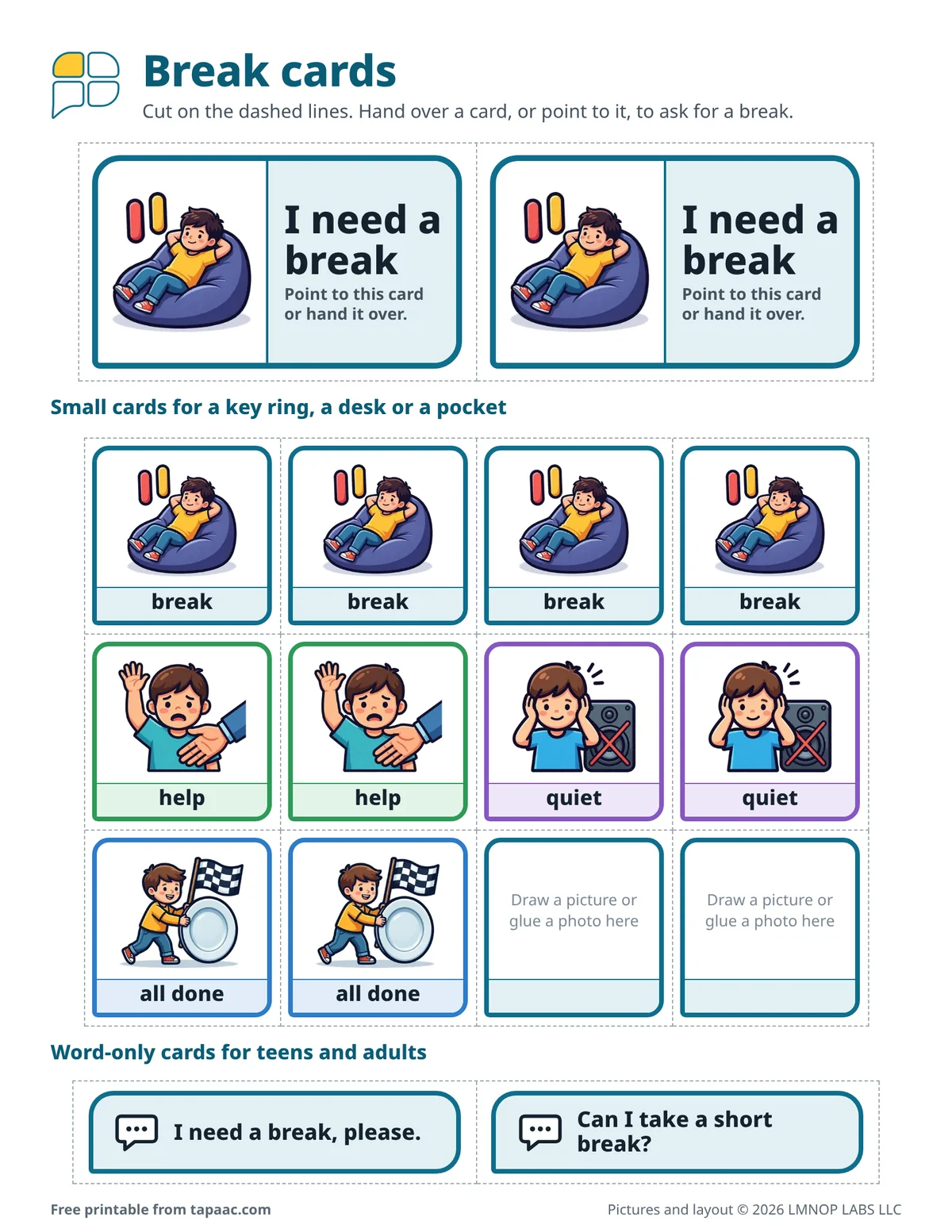
Edit this board in the free board maker: change the words and pictures, then print.
Have Tap AAC? Add to Tap AAC (.obz file, 568 KB) · How to add a board
- Free
- No sign-up
- Print as many as you need
Who it’s for
Children, teens and adults who get overwhelmed and then leave the room, shut down or push things away; people whose words go when they’re upset; and the parents, teachers and aides who would rather be asked than find out the hard way. Break cards work at home, at school and at work.
How to use break cards
- Keep a card within reach. On the desk, in a pocket, on a key ring or a lanyard. A card in a drawer can’t be handed over.
- Teach it when everyone is calm. Show what the card does, and practice: hand it over, go to the break spot, come back.
- Say yes every time at first. The person is learning that asking works. Thank them for asking.
- Keep the break short and calm. A few minutes in a quiet spot, with one of the things on the break choices board.
- End with what’s next. Show the next card before the break ends, so coming back isn’t a surprise.
For a step-by-step plan, read how to teach a child to use a break card.
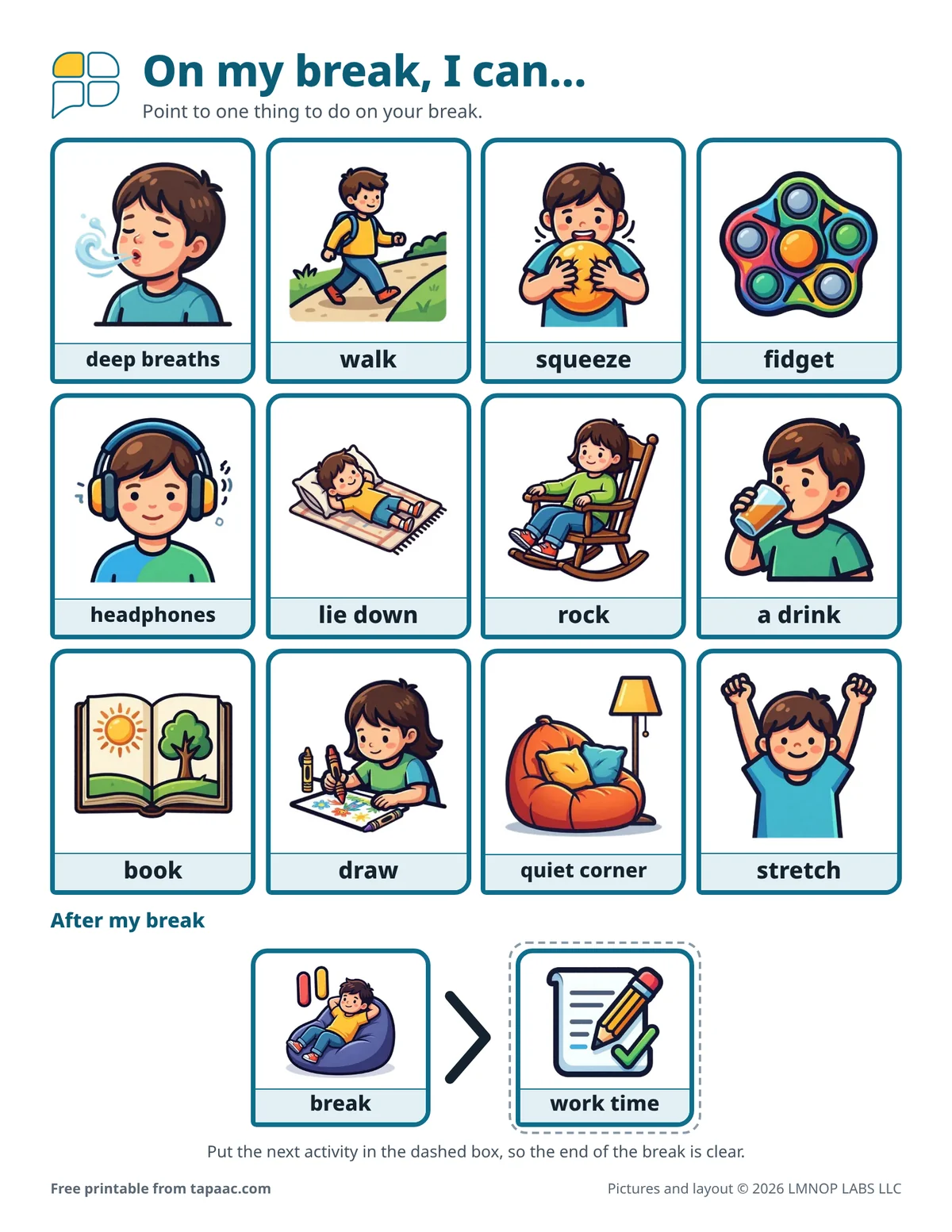
What to do on a break
Page 2 shows 12 things to do on a break: deep breaths, a walk, something to squeeze, a fidget, headphones, lying down, rocking, a drink, a book, drawing, a quiet corner and stretching. Cross out the ones that aren’t calming for this person, or aren’t possible where you are. The After my break row has a break card, an arrow and a dashed box: put the next activity there, so the end of the break is clear. Any of our 1.6 inch (4 cm) picture cards fits the box.
Break, help, quiet or all done?
The small cards say different things, and each one needs a different answer. Break means “I need to stop for a bit.” Help means “this is too hard.” Quiet means “it’s too loud.” All done means “I’m finished with this.” If the break card comes out every time the work gets hard, the help card may be the one the person really needs.
Math is getting loud. Zoe pulls the break card off the corner of her desk and hands it to her aide. “Thanks for telling me. Break.” On the choices board, Zoe points to headphones and squeeze. After a few quiet minutes in the corner, the aide shows the After my break row: work time. Zoe goes back and finishes the page.
What’s on the PDF
Cards
- I need a break
- break
- help
- quiet
- all done
- I need a break, please.
- Can I take a short break?
- 2 blank cards
On my break, I can…
- deep breaths
- walk
- squeeze
- fidget
- headphones
- lie down
- rock
- a drink
- book
- draw
- quiet corner
- stretch
Printing tips
- Print on card stock and laminate before cutting. Break cards get handled a lot.
- Make copies for every place the person spends time: home, the classroom, the car, a grandparent’s house. The same card everywhere means the same thing everywhere.
- Teens and adults often prefer the word-only cards at the bottom of page 1.
- Glue a photo of the real calm spot, like a beanbag or a bedroom, onto a blank card.
- To say how they feel, too, add the feelings board.
More free boards
-
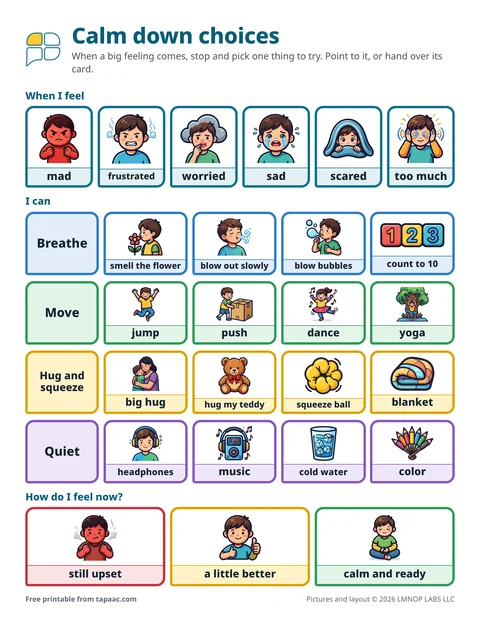 Calm down choices board16 calm down choices in four groups, a breathing square to trace, and calm down cards to cut out.
-
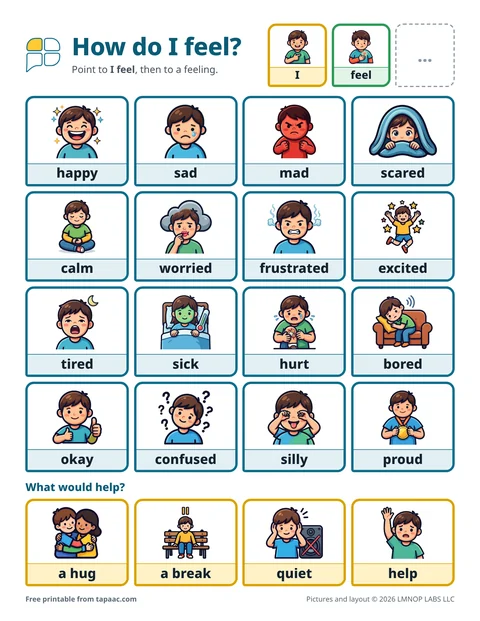 Feelings board16 feelings, from happy and calm to mad and worried, plus what would help.
-
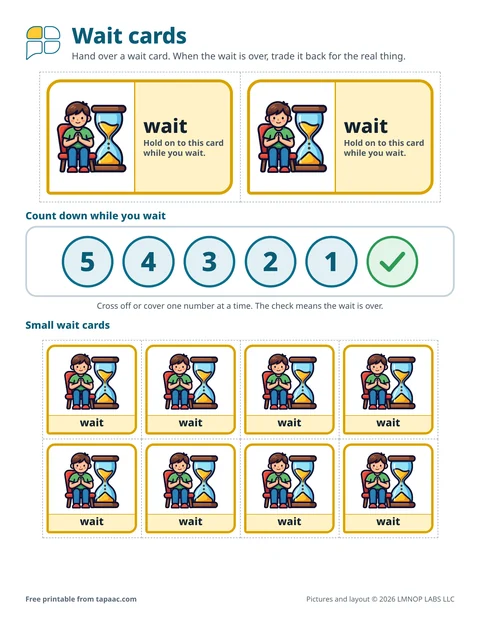 Wait cardsWait cards, a 5-to-1 countdown, and my turn and your turn cards with a Now and Next board.
-
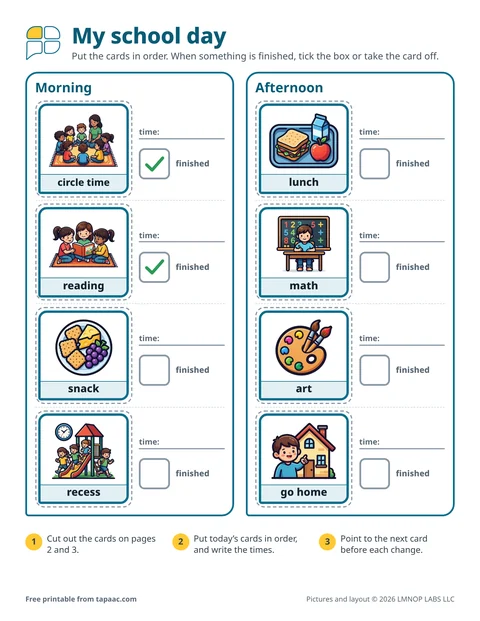 Classroom visual scheduleA school day schedule with times and tick boxes, and 38 picture cards from circle time to go home.
Need a different board? Make your own with the free AAC board maker.
These boards and guides are general information, not therapy or medical advice, and they don’t replace a speech therapist. A speech therapist who knows the person can help choose the right words, pictures and layout. The boards are free to print and share; please don’t sell them (terms of use). Questions about the boards? Email support@lmnoplabs.fun.