 Tap AAC
This guide describes the federal special education law, the Individuals with Disabilities Education Act (IDEA), its regulations and the US Department of Education’s guidance on assistive technology. States add rules of their own. For your child’s case, talk to the school team, and to an advocate or a lawyer if you need advice. Outside the US, ask your school or local education authority.
AAC is assistive technology
IDEA defines an assistive technology device as any item, piece of equipment or product system, bought off the shelf, modified or customized, that is used to increase, maintain or improve the functional capabilities of a child with a disability.1 The US Department of Education uses an AAC device for a child who doesn’t speak as one of its examples, and points out that assistive technology isn’t always high-tech: visual schedules and calendars can count too.2
An assistive technology service is any service that directly helps a child choose, get or use a device. The regulations list:3
- evaluating the child’s needs, including a functional evaluation in the child’s customary environment
- buying, leasing or otherwise providing the device
- selecting, designing, fitting, customizing, adapting, maintaining, repairing or replacing it
- coordinating it with other therapies and services
- training or technical help for the child and, if appropriate, the family
- training or technical help for the professionals and others who work with the child
What the school has to do
- Consider it at every IEP meeting. In developing the IEP, the team must consider the child’s communication needs, and whether the child needs assistive technology devices and services.4 The Department of Education stresses that this applies each time the team develops, reviews or revises the IEP.2
- Provide what the child needs. The school must make assistive technology available if the child needs it as part of their special education, related services, or supplementary aids and services.5 If the team decides it is needed, the school must provide and fully fund it; it can’t be skipped because there is no money for it.2
- Write it into the IEP. When assistive technology is part of the child’s services, it must be included in the written IEP, so the people carrying out the IEP know what to provide.2
- Train people. The school is responsible for making sure that the child, the parents and the educators know how the device works, through assistive technology services.2
- Let it go home when the child needs it there. Case by case, a child must be allowed to use a school-purchased device at home or in other places if the IEP team decides the child needs it to receive a free appropriate public education (FAPE).5 A child who needs a communication device needs it at all times of day, the Department notes.2
- Don’t leave the child waiting. Services in the IEP must be made available as soon as possible after it is written. If a device will take time to order and set up, the team should consider other supports until it arrives, and the IEP can say which ones.2
Ask for an assistive technology evaluation
The law doesn’t require an assistive technology evaluation before every device; many tools can be provided without one. But an evaluation may be needed to find the right device for something the child will use all day, and it can be part of a first evaluation, a reevaluation or an evaluation of its own. The school must have your consent first. It may include watching how your child communicates in different places at school and at home.2 What happens in an AAC evaluation explains what it looks at and how to prepare.
Evaluations must look at every area related to the suspected disability, including communication where appropriate. Tests must be given in the child’s own mode of communication, in the way most likely to show what the child knows and can do, and chosen so that, for a child with impaired speech, the results show the child’s ability rather than the speech difficulty, unless speech is what the test measures.6
Trying devices is a normal part of finding the right AAC: whether a particular device will work often can’t be judged at the first assessment.7 Every state and territory has an assistive technology program where school teams and parents can see devices demonstrated and borrow one for a short time.2 The national directory lists them.8
If you disagree with the school’s evaluation, you can ask for an independent educational evaluation at public expense, by a qualified examiner who doesn’t work for the school. The school must then either make sure one is provided at no cost to you, or ask for a due process hearing to show its own evaluation was appropriate.9
Where AAC goes in the IEP
The regulations list what every IEP must contain.10 AAC can belong in several parts:
| Part of the IEP | What to look for |
|---|---|
| Present levels of academic achievement and functional performance | How your child communicates now, with and without AAC, and how that affects learning and taking part |
| Measurable annual goals | Goals for communicating in real activities (see below) |
| How progress is measured, and when it is reported | Who collects what, and when you get reports |
| Special education, related services, and supplementary aids and services | The device and the services that go with it, such as speech-language pathology, training, setting up and repairs |
| Program modifications or supports for school personnel | Training for teachers and aides, and time to plan vocabulary |
| Accommodations for state and district tests | How your child will answer, for example with AAC |
Related services include speech-language pathology services, and parent counseling and training, which includes helping parents gain the skills they need to support carrying out their child’s IEP.11 For tests, the Department of Education says states must provide appropriate accommodations, including assistive technology, in state assessments.2
AAC goals: what to ask
We don’t list sample goals here, because goals belong to your child and are written by the team with the speech-language pathologist. The professional guidance says the speech-language pathologist should make sure AAC goals and AAC use are written into a student’s IEP.7 It also says AAC intervention starts by teaching the person and family how to use the system, and then uses the system for wider goals, such as language and literacy and social interaction, in everyday settings.7
The same guidance describes communicative competence for people who use AAC in five areas, which can help you see what goals could cover:7
- Linguistic: the language of the family and community, and the symbols and grammar of the AAC system
- Operational: using the system: selecting, moving between pages, turning it on and charging it
- Social: when, where, with whom and how to communicate: taking turns, starting and ending conversations, staying on topic
- Strategic: getting a message across efficiently, and repairing it when it isn’t understood
- Psychosocial: motivation, confidence and not giving up when communication fails
Questions to ask about each goal:
- Is it measurable? IDEA requires measurable annual goals, and a description of how progress will be measured and when you will get reports.10
- Is it about communicating for real reasons, such as asking, commenting, refusing and joining in, in real activities, as well as about learning to use the device?
- Who will model and support it, and in which lessons?
- Does your child have the words to reach it? A goal about asking questions needs question words, and a goal about joining in needs core words like my turn, more and stop.
A checklist for the IEP meeting
Parents are members of the IEP team.12 The school must take steps so that you can take part, including telling you about the meeting early enough to attend and agreeing a time and place with you, and it must give you a copy of the IEP at no cost.13 You or the school can also invite other people with knowledge or special expertise about your child, such as a private speech-language pathologist.12
Things you can ask about:
- an assistive technology evaluation, if your child hasn’t had one or their needs have changed
- a trial of a device, at school and at home
- the device, the vocabulary and the services written into the IEP
- use of the device at home, if your child needs it there
- training for you, and for every adult who works with your child, including aides, lunch and bus staff
- who adds new words before each topic or unit, and how quickly
- charging, backups and repairs, and a paper board for when the device is away
- how your child will answer in class and in tests
- how progress will be measured, and when you will hear about it
- for teenagers, assistive technology in the transition plan for life after school, which the Department of Education says should be considered2
Teachers can find classroom ideas in AAC in the classroom, and families in AAC at home.
If your child uses a family-owned device
Some families want their child to use their own tablet at school. The Department of Education says this can work if the school and the parents agree, and suggests settling things like when it is used, staff training, the costs of apps, repairs and replacement, and that the child won’t be disciplined for using it. It is voluntary: a parent can ask for a school-supplied device at any time, and if the two sides can’t agree, the school must make an appropriate device available.2
If you disagree
When the school proposes or refuses to start or change something about your child’s evaluation, placement or education, it must give you written notice beforehand, explaining what it proposes or refuses and why, and which other options the team considered.14 The IEP can also be changed between annual meetings, either at a meeting or by a written agreement between you and the school.4
Your procedural safeguards notice explains your rights, including independent evaluations, mediation, state complaints and due process hearings. The school must give you a copy once a year, and whenever you ask for one.15
Younger children
Under IDEA Part C, assistive technology devices and services are early intervention services, written into the Individualized Family Service Plan (IFSP). When a toddler moves on to preschool, the IEP team must consider assistive technology at the first IEP meeting, whether or not the child had it before.2 At your request, the school must invite the early intervention service coordinator to that first meeting.12 See AAC for toddlers.
Try this today
- Find your child’s IEP and look for the words “assistive technology” and “communication”.
- Write down how your child communicates at home, and what they can’t say yet.
- List your questions for the next meeting from the checklist above.
- Ask the speech-language pathologist which AAC goals they would suggest, and why.
More AAC guides
- AAC at school: how teachers can support a student who uses AACModeling in lessons, wait time, better questions, classmates, and the IEP.
- AAC for toddlers: when to start, and how to begin at homeStarting before your child talks: one routine, a few words, modeling and early intervention.
- AAC at home: setting up the house, and helping the whole familyWhere the device and boards live, room by room, and how siblings, grandparents and sitters can help.
- How to choose an AAC app: questions to ask before you buyStart with the person, try before you buy, and the questions to ask about any app.
- AAC myths and facts: 10 common myths, and what the research saysTen things people believe about AAC, and what research and professional guidance say instead.
Sources
We read each of these on October 13, 2026. Numbers in the text point to them.
- U.S. Department of Education, IDEA regulations. 34 CFR §300.5: Assistive technology device. Accessed October 13, 2026.
- U.S. Department of Education. Myths and Facts Surrounding Assistive Technology Devices and Services (PDF). January 2024.
- U.S. Department of Education, IDEA regulations. 34 CFR §300.6: Assistive technology service. Accessed October 12, 2026.
- U.S. Department of Education, IDEA regulations. 34 CFR §300.324: Development, review, and revision of IEP. Accessed October 12, 2026.
- U.S. Department of Education, IDEA regulations. 34 CFR §300.105: Assistive technology. Accessed October 12, 2026.
- U.S. Department of Education, IDEA regulations. 34 CFR §300.304: Evaluation procedures. Accessed October 13, 2026.
- American Speech-Language-Hearing Association. Augmentative and Alternative Communication (Practice Portal). Professional guidance for speech-language pathologists. Accessed October 12, 2026.
- National Assistive Technology Act Technical Assistance and Training (AT3) Center. AT Act Programs (directory of state and territory programs). Accessed October 12, 2026.
- U.S. Department of Education, IDEA regulations. 34 CFR §300.502: Independent educational evaluation. Accessed October 13, 2026.
- U.S. Department of Education, IDEA regulations. 34 CFR §300.320: Definition of individualized education program. Accessed October 13, 2026.
- U.S. Department of Education, IDEA regulations. 34 CFR §300.34: Related services. Accessed October 13, 2026.
- U.S. Department of Education, IDEA regulations. 34 CFR §300.321: IEP Team. Accessed October 13, 2026.
- U.S. Department of Education, IDEA regulations. 34 CFR §300.322: Parent participation. Accessed October 13, 2026.
- U.S. Department of Education, IDEA regulations. 34 CFR §300.503: Prior notice by the public agency; content of notice. Accessed October 13, 2026.
- U.S. Department of Education, IDEA regulations. 34 CFR §300.504: Procedural safeguards notice. Accessed October 13, 2026.
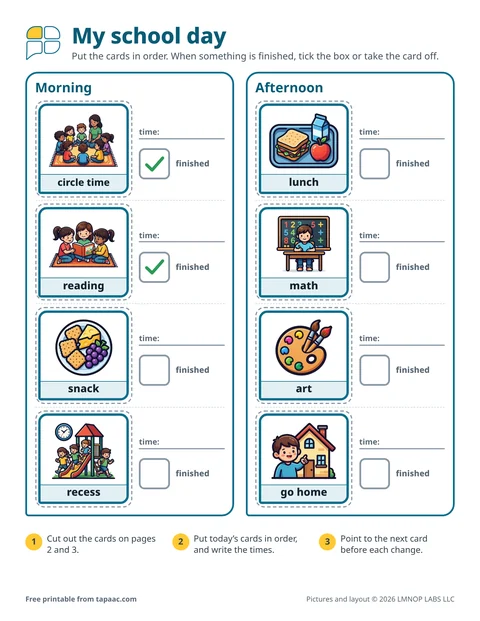 Classroom visual schedule
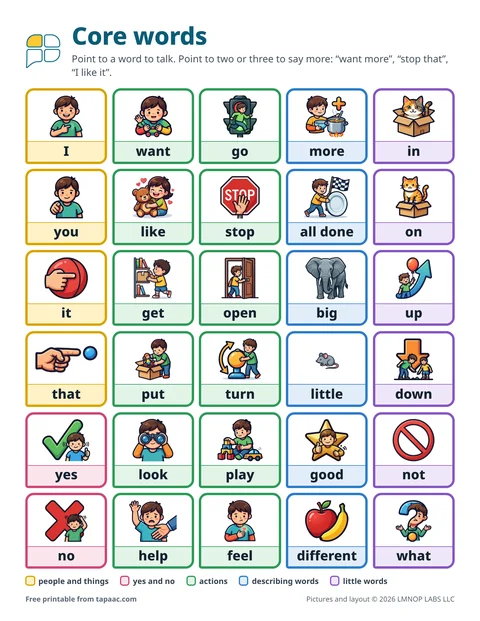 Core word board
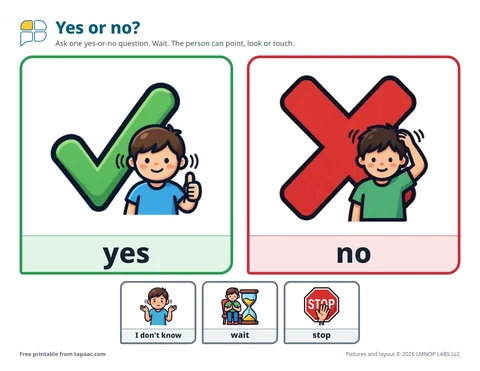 Yes and no board
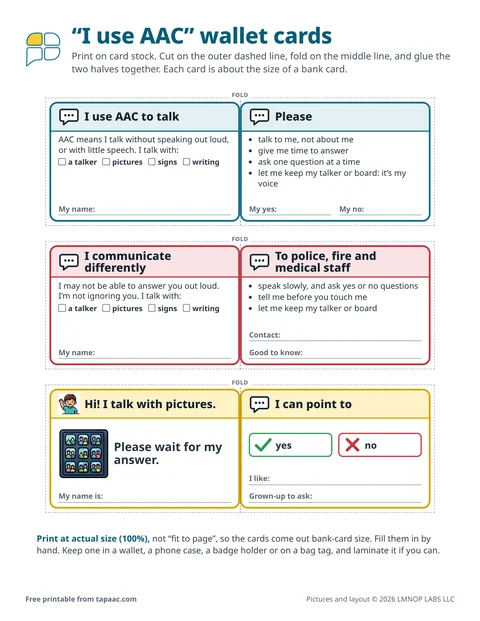 Nonverbal communication cards