 Tap AAC
Swimming communication board and pool visual schedule
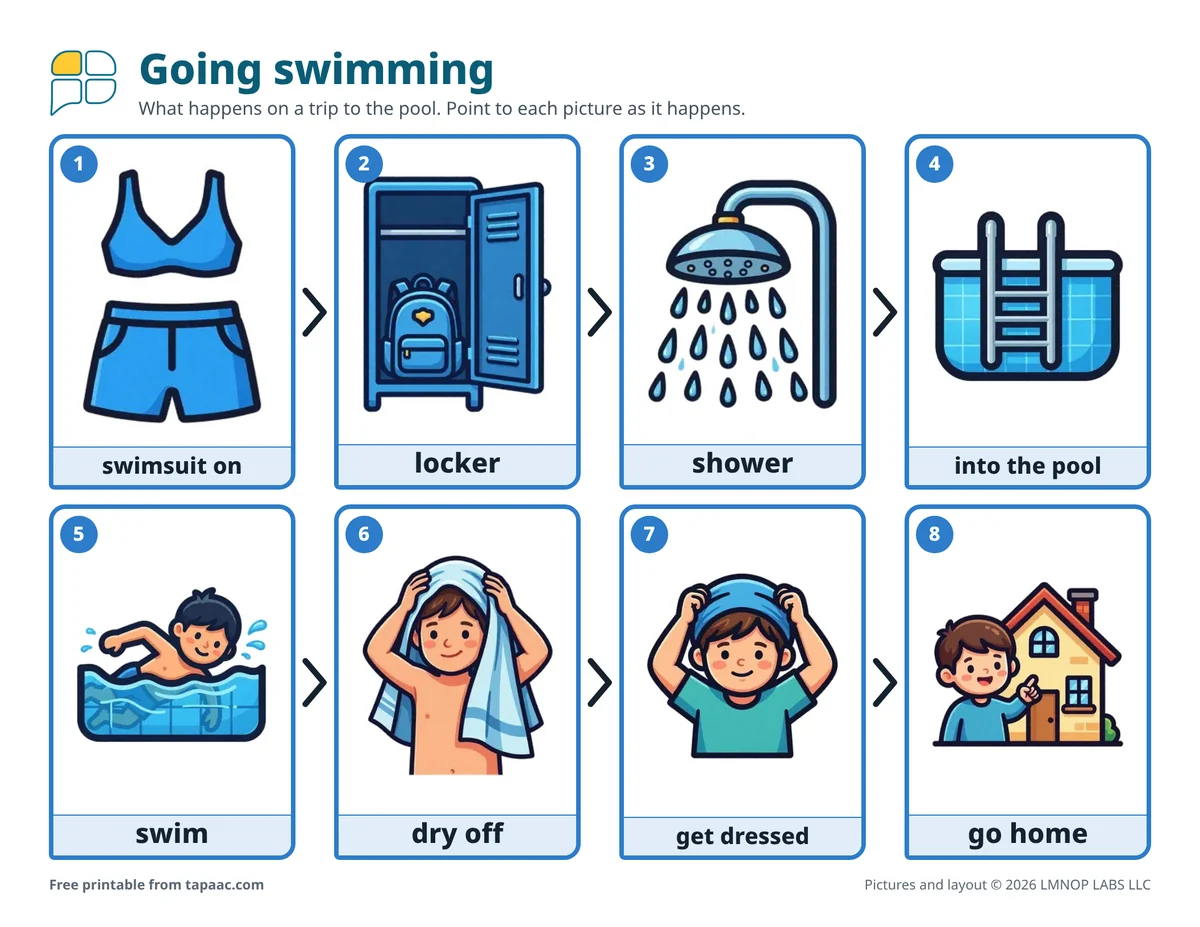
A swimming communication board gives a person who doesn’t speak, or doesn’t speak much, the words for the pool: watch me, again, too cold, float, jump in and hold me. This free PDF has the board, with 30 pictures and words for talking, the water and the pool rules, and a visual schedule for a trip to the pool, from swimsuit on to go home.
Download the free PDF US Letter, 2 pages, 1,227 KB
Printing on A4 paper? Download the A4 PDF (2 pages, 1,228 KB). Or pick one page shape for every page:
Portrait (tall page, 2 pages): US Letter PDF (1,228 KB) · A4 PDF (1,228 KB)
Landscape (wide page, 2 pages): US Letter PDF (1,228 KB) · A4 PDF (1,230 KB)
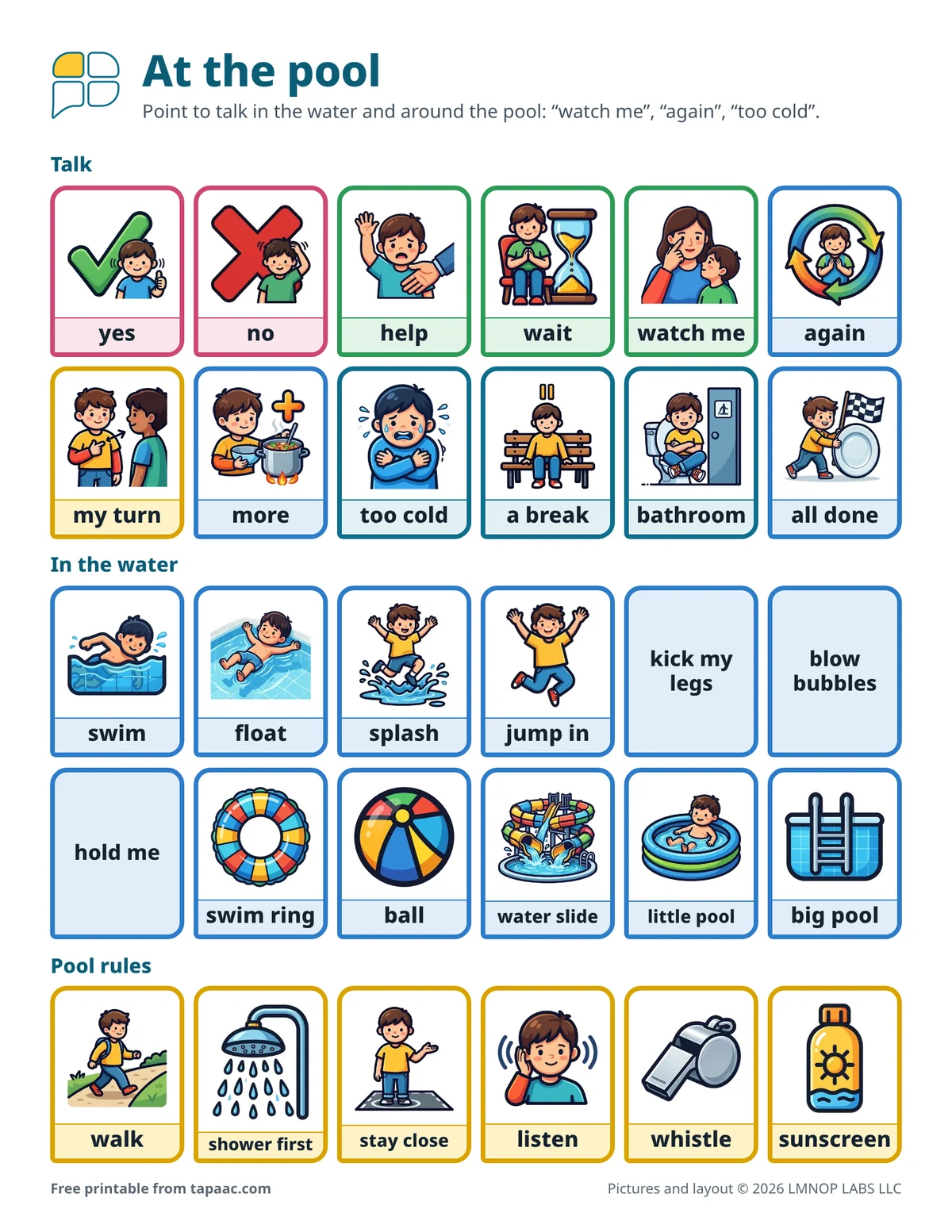
Edit this board in the free board maker: change the words and pictures, then print.
Have Tap AAC? Add to Tap AAC (.obz file, 1,144 KB) · How to add a board
- Free
- No sign-up
- Print as many as you need
Who it’s for
Children and adults who use pictures or a speech device, at swimming lessons, a public pool, a hydrotherapy session or a pool party. A speech device has to stay dry and away from the water; a laminated board can sit at the edge of the pool, in reach. It’s also for the swim teacher, who suddenly has a way to ask “again?” and get an answer.
How to use it
- Go through the schedule at home the day before: swimsuit, locker, shower, pool. The changing room can be the hardest part, and it helps to know it comes first.
- Laminate both pages, or seal them in a clear zip bag, and put the board on the side of the pool where the person can reach it.
- Model from the water. Point while you talk: “Do you want to float or splash?” “Again?” Then wait for an answer.
- Answer every point. Too cold means a towel and a break; hold me means hold them. Answering every time shows the board works, even in the water.
- Show the swim teacher how it works in one sentence: “He’ll point to answer. Again means he loved it.”
At swimming lessons
Lessons are full of instructions, splashing and noise, and the teacher has several children to watch. Give the teacher a copy of page 1 and ask them to point to the word as they say it: kick my legs, blow bubbles, float. Words like kick my legs and blow bubbles are printed as words only, because no picture shows them well; draw your own, or tape on a photo of your child doing it. The Pool rules row is for the walk to the water: walk, shower first, stay close, listen for the whistle.
Safe in and near the water
A board helps a person take part; it never replaces watching. Keep children within arm’s reach in and near the water, and follow the lifeguard and the pool’s rules. If a person can’t point while holding on, agree on a simple yes and no (a nod, a look, a hand squeeze) before getting in.
Noah is eight and doesn’t speak. At the pool, his board sits on a towel at the edge. In the changing room, his dad points to step 2, locker, then step 3, shower. In the water, Noah floats on his back while his dad holds him, then reaches over and points to again. And again. After a while he points to too cold. His dad wraps him in a towel, and they look at the schedule: dry off, get dressed, go home.
What’s on the board
Talk
- yes
- no
- help
- wait
- watch me
- again
- my turn
- more
- too cold
- a break
- bathroom
- all done
In the water
- swim
- float
- splash
- jump in
- kick my legs
- blow bubbles
- hold me
- swim ring
- ball
- water slide
- little pool
- big pool
Pool rules
- walk
- shower first
- stay close
- listen
- whistle
- sunscreen
Going swimming (page 2)
- swimsuit on
- locker
- shower
- into the pool
- swim
- dry off
- get dressed
- go home
Printing tips
- Laminate with thick pouches, or seal the pages in a clear zip bag. Pat them dry after the swim.
- Print a second copy for the swim bag, so the schedule can come into the changing room.
- Take a photo of your own pool and changing room, and glue it over steps 2 and 4.
- For changing clothes, the getting dressed visual schedule has clothes cards; for the park, use the playground communication board.
- Why point while you talk? See how to use a board: model, wait, answer.
More free boards
-
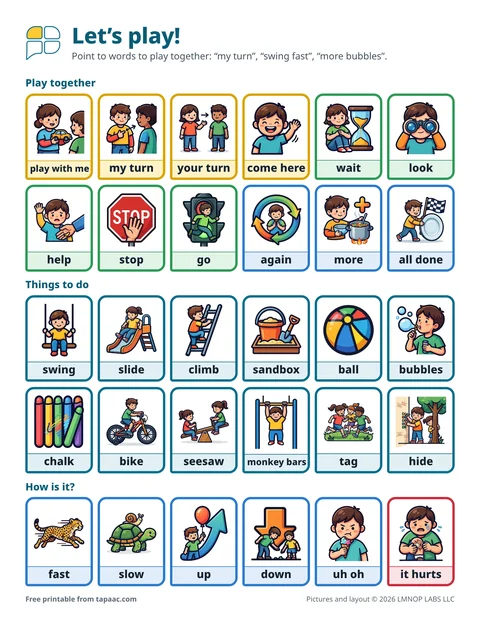 Playground communication boardMy turn, your turn, swing, slide, fast, again and more, for playing together.
-
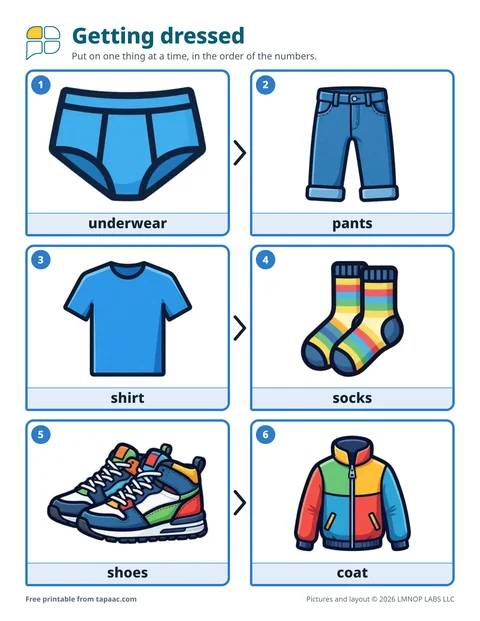 Getting dressed visual scheduleUnderwear to coat, one step at a time, plus clothes cards for any weather.
-
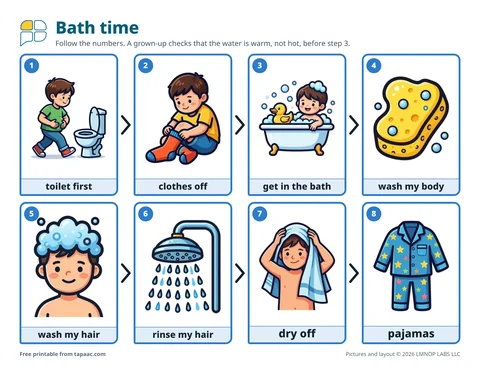 Bath time visual scheduleEight bath steps, eight shower steps, and a board for too hot, in my eyes and all done.
-
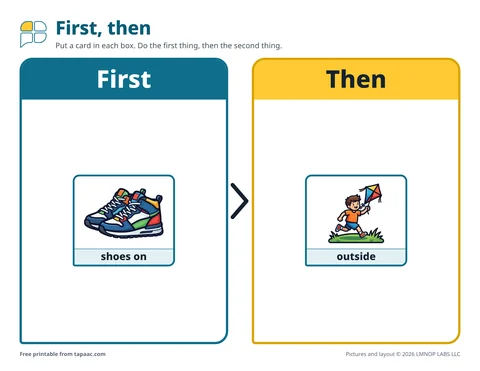 First-then boardShows what happens first and what comes next. With 12 picture cards to cut out.
Need a different board? Make your own with the free AAC board maker.
These boards and guides are general information, not therapy or medical advice, and they don’t replace a speech therapist. A speech therapist who knows the person can help choose the right words, pictures and layout. The boards are free to print and share; please don’t sell them (terms of use). Questions about the boards? Email support@lmnoplabs.fun.