 Tap AAC
Grocery store communication board and picture shopping list
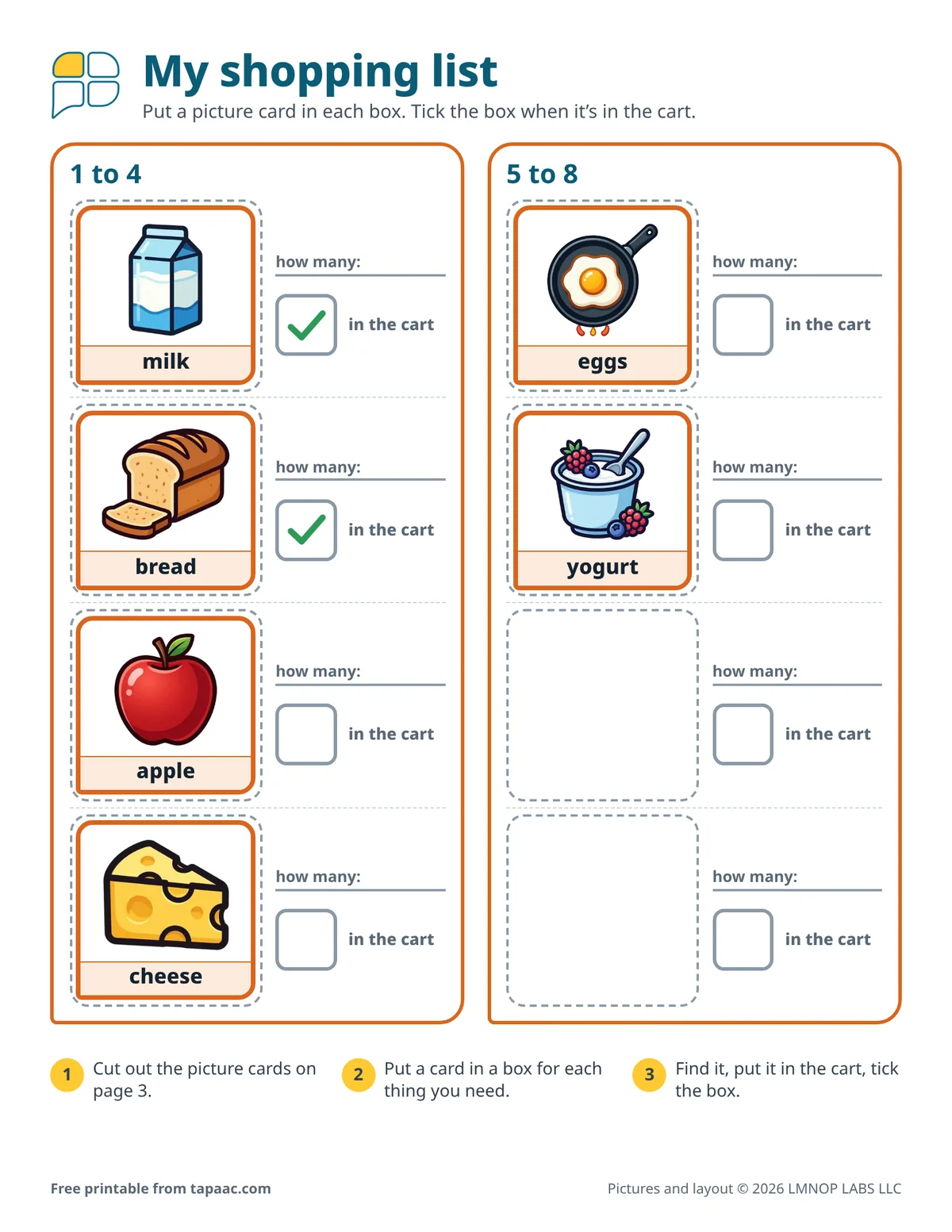
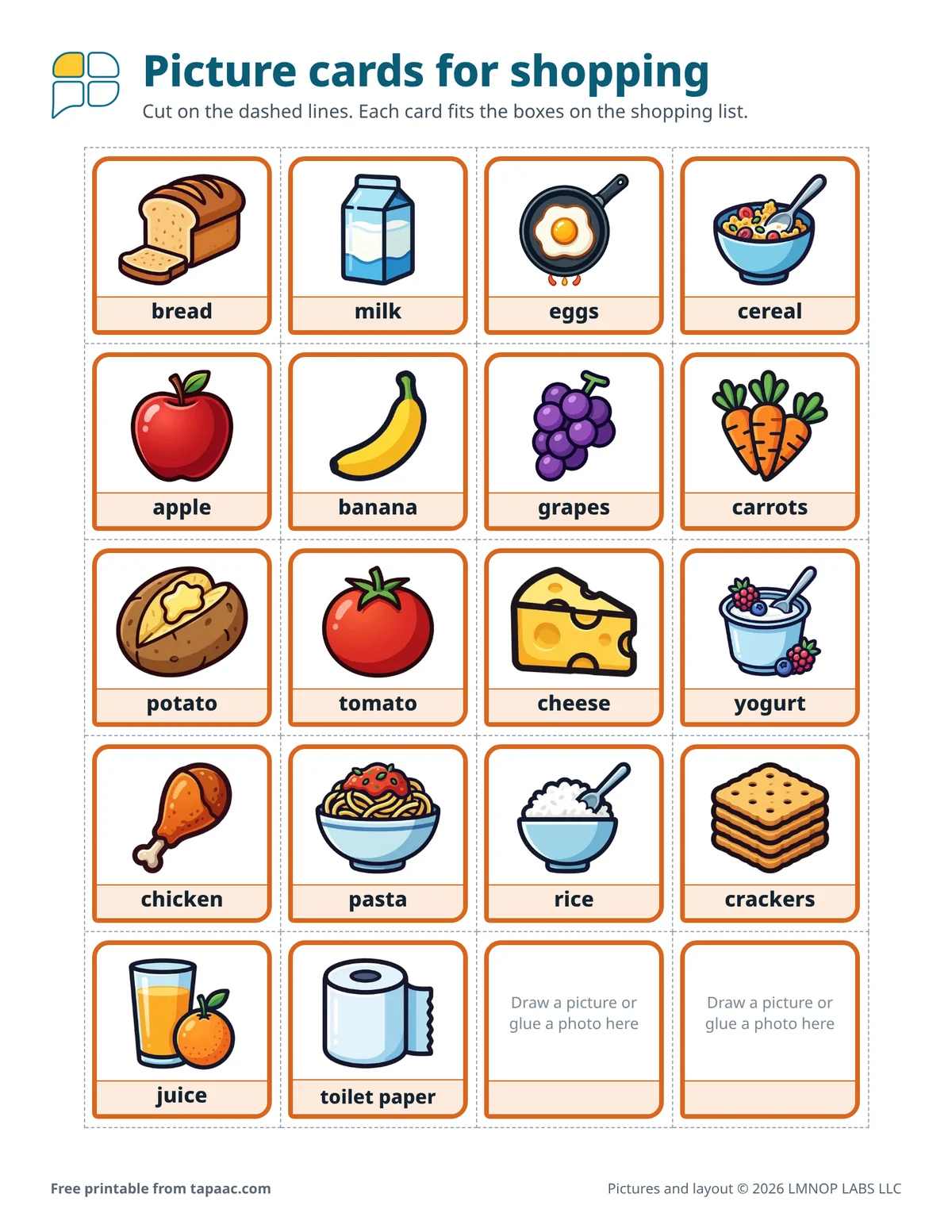
A grocery store communication board gives a person words for shopping: asking where something is, putting things in the cart, waiting in line, and saying it’s too loud or they’re all done. This free PDF has the store board, a picture shopping list with eight boxes to tick, and 18 picture cards to put on the list, so the person can help with the shopping instead of just coming along.
Download the free PDF US Letter, 3 pages, 1,318 KB
Portrait (tall page, 3 pages): US Letter PDF (1,318 KB) · A4 PDF (1,319 KB)
Landscape (wide page, 3 pages): US Letter PDF (1,318 KB) · A4 PDF (1,317 KB)
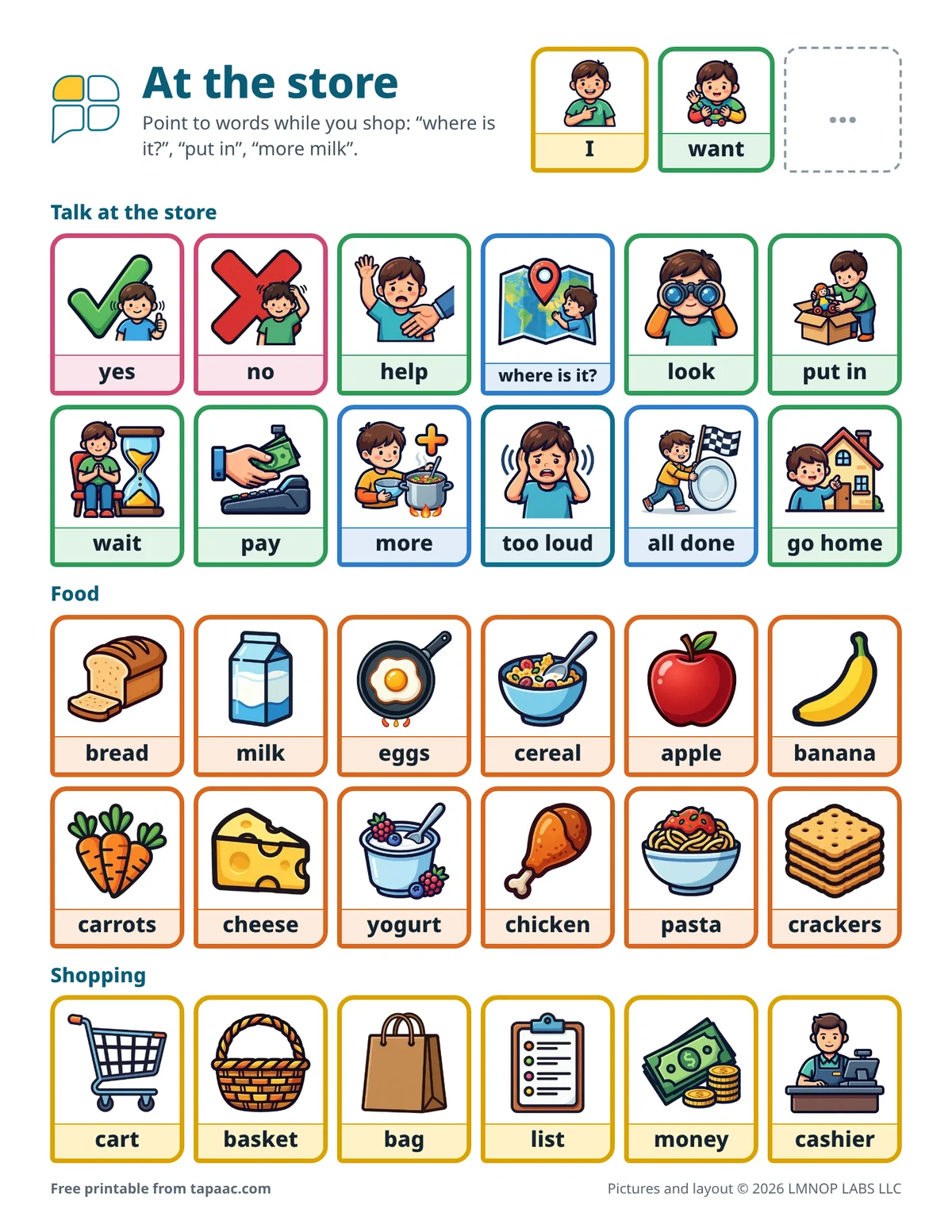
Edit this board in the free board maker: change the words and pictures, then print.
Have Tap AAC? Add to Tap AAC (.obz file, 1,162 KB) · How to add a board
- Free
- No sign-up
- Print as many as you need
Who it’s for
Children who come along to the store, teens and adults learning to shop more on their own, and life skills and community classes. It suits anyone who uses pictures to talk and wants a part in the trip, not only a seat in the cart.
How to use it
- Make the list at home, together. Pick the cards for what you need and put them on the list. Write how many.
- Give the person a job. They hold the list, find the next thing, put it in the cart and tick the box.
- Talk with the board as you shop. Point to where is it? and look as you search: “Where is it? Look, there’s the milk!”
- Let them pay, if they can. Handing over the money or the card is part of the trip.
- Listen to too loud and all done. Finish up when you can, and plan a shorter trip next time.
Start with a short trip
The first trips go best with two or three things on the list, at a quiet time of day, in a store you know. A trip that ends well is worth more than a full cart. Add more cards to the list as the trips get easier.
The list is a job
A picture list turns shopping into something the person does, not something done around them. Finding the right box, matching a card to a shelf and ticking it off all take part in it. Glue the label from a brand you always buy onto a blank card, so the card looks like the real thing on the shelf.
Saturday morning. Kai and his mom put four cards on the list: milk, bread, apple, cheese. At the store, Kai holds the list. In the dairy aisle he points to where is it? and then milk. His mom points: “Look, there.” Kai puts it in the cart and ticks the box. At the checkout it gets busy and he points to too loud. “Almost done. Pay, then go home.”
Words on the store board
Talk at the store
- yes
- no
- help
- where is it?
- look
- put in
- wait
- pay
- more
- too loud
- all done
- go home
Food
- bread
- milk
- eggs
- cereal
- apple
- banana
- carrots
- cheese
- yogurt
- chicken
- pasta
- crackers
Shopping
- cart
- basket
- bag
- list
- money
- cashier
The cards on page 3 add grapes, potato, tomato, rice, juice and toilet paper, plus two blank cards.
Printing tips
- Laminate the list, so the ticks and the numbers wipe off for next week.
- Clip the list to the cart handle with a binder clip, where both of you can see it.
- Put a hook-and-loop dot in each box and on the back of each card, and keep the spare cards in a zip bag.
- For meals out, use the restaurant board; for meals at home, the mealtime board.
More free boards
-
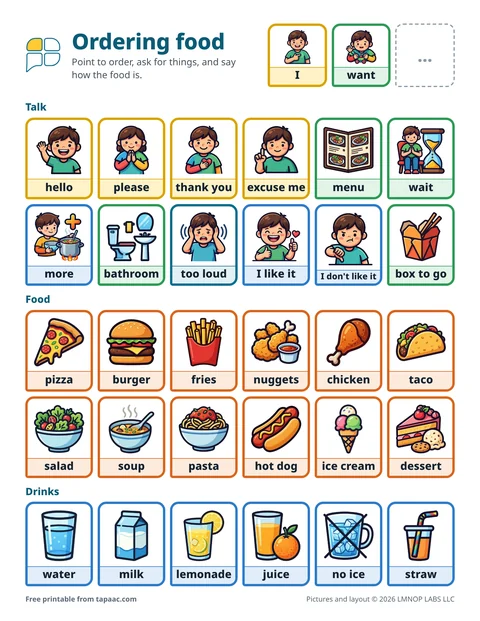 Restaurant communication boardWords for ordering, 12 foods and 6 drinks, and order cards to hand to the server.
-
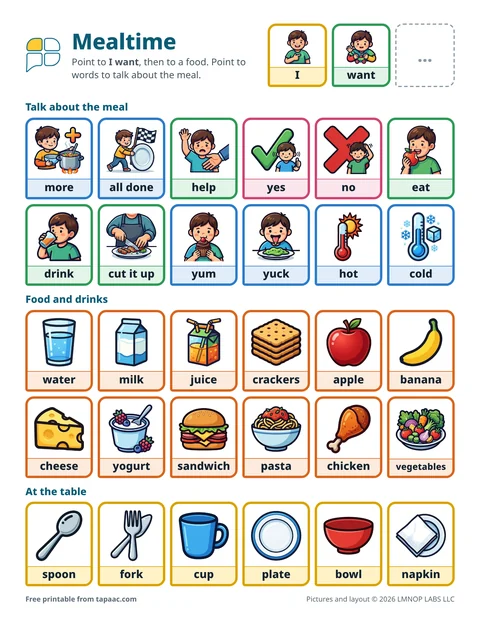 Mealtime communication boardMore, all done, yum, yuck, 12 foods and drinks, and the things on the table.
-
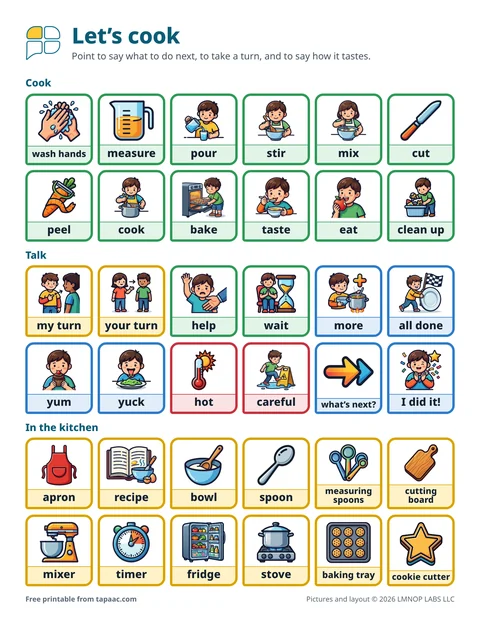 Cooking board and visual recipeCooking, talk and kitchen words, a no-cook visual recipe, and a blank visual recipe to fill in.
-
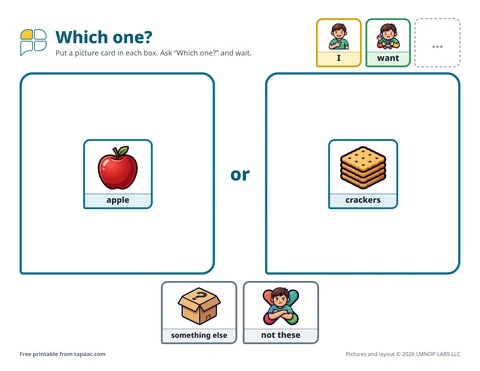 Choice boardsTwo-choice and four-choice boards, with 18 snack, drink and toy cards to cut out.
Need a different board? Make your own with the free AAC board maker.
These boards and guides are general information, not therapy or medical advice, and they don’t replace a speech therapist. A speech therapist who knows the person can help choose the right words, pictures and layout. The boards are free to print and share; please don’t sell them (terms of use). Questions about the boards? Email support@lmnoplabs.fun.