 Tap AAC
This guide is for planning ahead. In the US, contact 911; elsewhere, use your local emergency number.
Make a plan before you need it
Ready.gov, the US government’s preparedness site, has tips for people with a speech disability:1
- plan how you would evacuate with your AAC device, or how you would replace it if it were lost or destroyed
- keep the model information, and a note of where the device came from, such as Medicaid, Medicare or private insurance
- plan how you will communicate if the equipment stops working, including laminated cards with phrases or pictures
Its general advice for people with disabilities adds: carry printed cards, or keep information on your devices, to tell first responders and others how to communicate with you; build a support network and keep a contact list in your emergency kit or on your devices; and ask your local emergency management office whether it keeps a voluntary registry of people with disabilities.1
What to keep with you
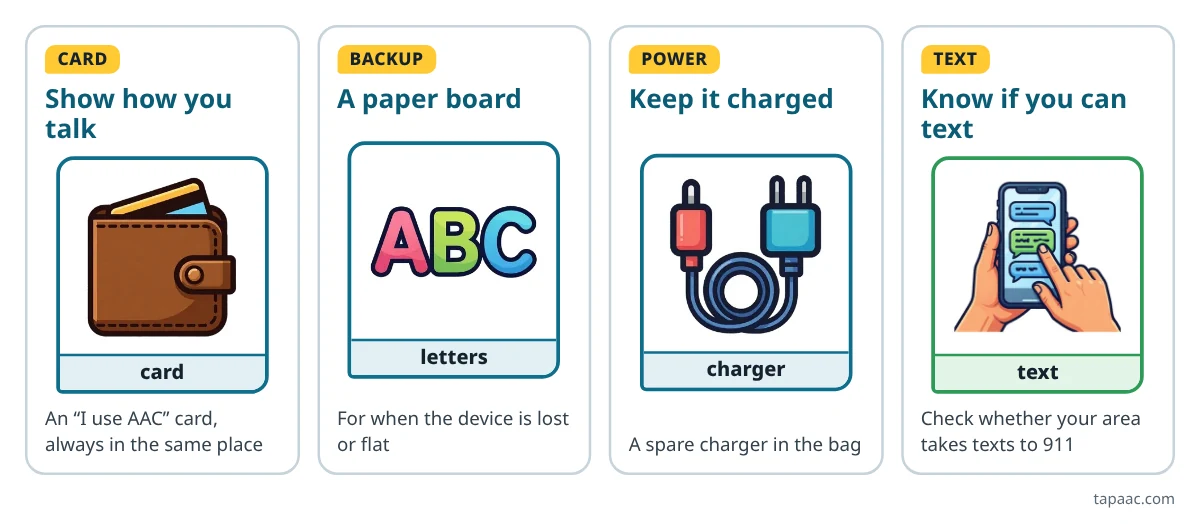
- An “I use AAC” card that says how you communicate and what helps. Our free nonverbal communication cards include a fold-out card for police, fire and medical staff.
- A spare charger, kept charged. Ready.gov suggests spare chargers for electronic devices, and an extra battery for battery-operated assistive technology.1
- A small paper board with yes, no, letters and the main needs: the alphabet board, and for a child, the I feel sick board.
- Pen and paper. Ready.gov lists them in the kit for people who are deaf or hard of hearing, for talking with someone who doesn’t know sign language;1 they help anyone who can write or point.
- A short health summary: conditions, medicines, allergies and an emergency contact, on paper and on your phone. Ready.gov suggests medical alert tags and adding key medical information to your devices.1
Contacting 911 when you can’t speak
Text-to-911 lets you send a text message to 911 from a mobile phone, but it is available only in some places, and the FCC says to make a voice call whenever you can, because calls give emergency centers more information.2 If you text 911 where the service isn’t available, you should get an automatic bounce-back message telling you to use another way, such as a voice call or a relay service. Text apps that only message other users of the same app don’t have to support it.2
The FCC keeps a list, updated monthly, of the areas where text-to-911 works.2 Check your area now, and the places you often go. Then write a short message and save it, so in an emergency you only have to add what is happening: your address, “I can’t speak, I use AAC”, and the kind of help you need.
If you are deaf, hard of hearing or speech disabled and texting isn’t available, the FCC says to use a TTY or a telecommunications relay service, if possible.2 Relay services include speech-to-speech for callers with speech disabilities.3 Emergency centers must take TTY calls directly, without relying on relay. Relay is slower in an emergency, but if you choose to call through it, the emergency center must answer and respond.4
When responders arrive
US Department of Justice guidance for police warns that people with speech or intellectual disabilities may not be able to respond to police directions, and may wrongly be seen as uncooperative.5 So:
- Show your card first, before you try to answer questions. Keep it in the same place every time, so your hand finds it without looking.
- Use your AAC, and point to yes and no.
- If someone is with you, they can help explain, but questions should still come to you.
Police departments, as programs of state or local government, are covered by the Americans with Disabilities Act.5 State and local governments must give primary consideration to the way of communicating the person asks for, unless they can show that another equally effective way is available, or that the choice would be an undue burden or a fundamental change.3 This is general information, not legal advice.
In the ambulance and at the hospital
- Take your AAC with you. People who use AAC should always have access to their communication tools,6 in a hospital bed as much as at home.
- Bring the charger and the paper board, and show staff your card.
- Hospital staff can find bedside tips in our guide to communicating with nonverbal patients, and boards like the hospital communication board and the ICU board.
For first responders: quick tips
- Ask: “Do you use a device, a board or a card to communicate?” Look for a wallet card.
- Let the person keep their device or board.
- Ask one yes-or-no question at a time, and wait for the answer.
- Don’t take a slow answer, or no spoken answer, as refusal.
- Speak to the person, not only to whoever is with them.
- Read back what you understood.
- Listen attentively, and don’t be embarrassed to ask the person to repeat what you didn’t understand, as the Department of Justice advises for people with speech disabilities.3
Practice together
Run through it when things are calm. Show the card to someone playing a police officer or a paramedic, practice the saved emergency text without sending it, and check the charger in the bag once a month. For children, school drills are a good start: the fire drill visual schedule shows each step, and our guide to AAC at home has more on going out with AAC.
Try this today
- Check whether your area accepts texts to 911, on the FCC’s list.
- Fill in an “I use AAC” card and put it where you will always find it.
- Put a spare charger and a small paper board in your bag.
- Write down your device’s model and where it came from, and keep a photo of the note on your phone.
More AAC guides
- How to communicate with nonverbal patients: a guide for nurses and care staffFor nurses and care staff: yes and no, boards, the patient’s own AAC, questions and handover.
- AAC at home: setting up the house, and helping the whole familyWhere the device and boards live, room by room, and how siblings, grandparents and sitters can help.
- AAC for autistic adults, including adults who can speakPart-time AAC when speech is unreliable, what adults use, and setting it up for daily life.
- AAC for adults: after a stroke, with ALS or MND, and in the hospitalAfter a stroke, with ALS or MND, and in the hospital: what helps, and when to plan.
- How to get an AAC device: Medicaid, Medicare, insurance and schoolThe evaluation first, then Medicaid, Medicare, insurance, the school or a state loan program (US).
Sources
We read each of these on October 13, 2026. Numbers in the text point to them.
- Ready.gov (FEMA, U.S. Department of Homeland Security). People with Disabilities. Last updated September 9, 2026.
- Federal Communications Commission (FCC). Text to 911: What You Need to Know. Last updated or reviewed January 6, 2020.
- U.S. Department of Justice, ADA.gov. ADA Requirements: Effective Communication. Accessed October 13, 2026.
- U.S. Department of Justice, ADA.gov. Access for 9-1-1 and Telephone Emergency Services. Accessed October 13, 2026.
- U.S. Department of Justice, ADA.gov. Commonly Asked Questions About the ADA and Law Enforcement. Accessed October 13, 2026.
- American Speech-Language-Hearing Association. Augmentative and Alternative Communication (Practice Portal). Professional guidance for speech-language pathologists. Accessed October 12, 2026.
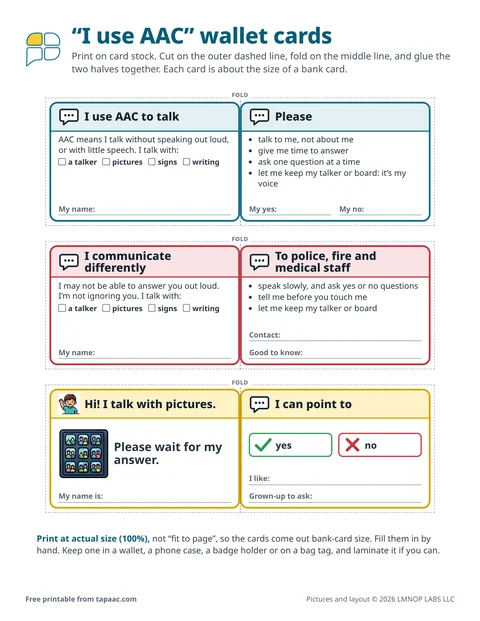 Nonverbal communication cards
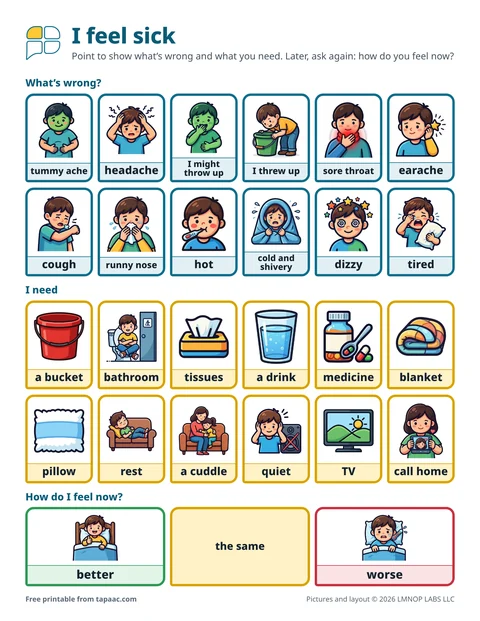 I feel sick communication board
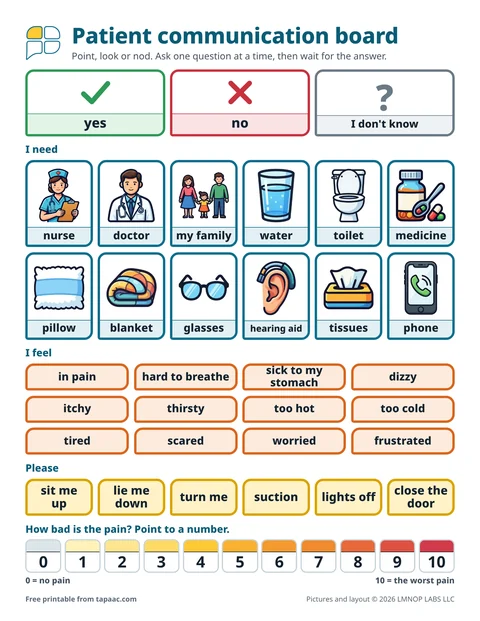 Hospital communication board
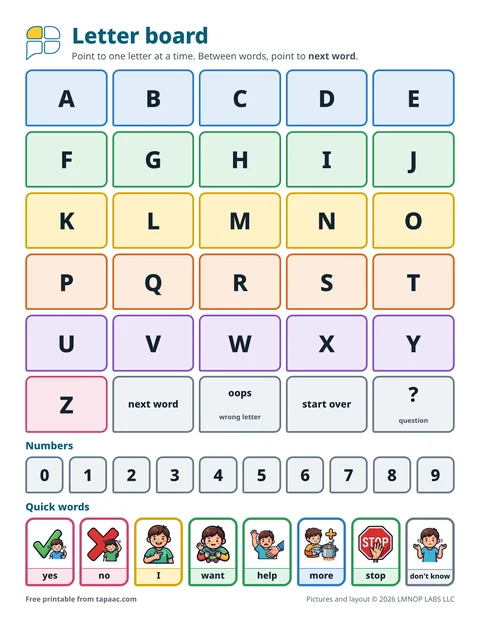 Alphabet board