 Tap AAC
Getting a shot: free visual schedule and shot plan
A getting a shot visual schedule shows a child, in pictures, what happens when they get a shot or a vaccine: wait, sit down, sleeve up, a cold wipe, 1, 2, 3, the shot, a bandage, and I did it! This free PDF has those eight steps, and a shot plan you fill in together before the visit: where to sit, where to look, what to hold, what to do, and what comes after.
Download the free PDF US Letter, 2 pages, 1,083 KB
Printing on A4 paper? Download the A4 PDF (2 pages, 1,084 KB). Or pick one page shape for every page:
Portrait (tall page, 2 pages): US Letter PDF (1,084 KB) · A4 PDF (1,084 KB)
Landscape (wide page, 2 pages): US Letter PDF (1,083 KB) · A4 PDF (1,083 KB)
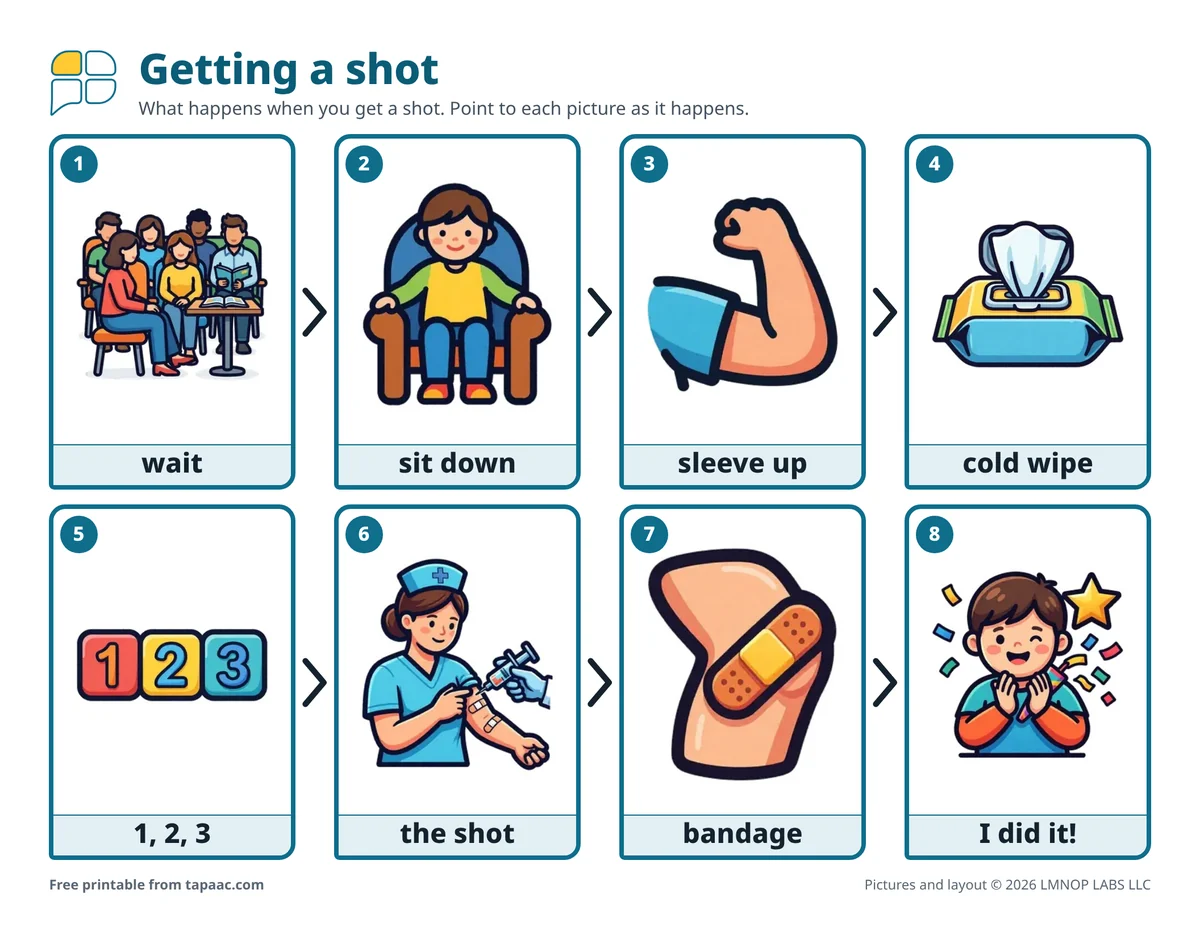
Edit this board in the free board maker: change the words and pictures, then print.
Have Tap AAC? Add to Tap AAC (.obz file, 985 KB) · How to add a board
- Free
- No sign-up
- Print as many as you need
Who it’s for
Children who are going to get a shot (a vaccine, a flu shot, an allergy shot), especially children who worry about it for days, children who find surprises hard, and children who don’t speak or don’t speak much. Older children and teens can use the plan on their own.
Be honest about the shot
The schedule calls it what it is: the shot. Don’t promise it won’t hurt: a child who was told “it won’t hurt” and then feels the poke stops trusting the pictures. Say instead what will happen and how long it lasts: “A quick poke, then a bandage, then we’re done.” Step 8, I did it!, matters as much as the others: it tells the child there is an end, and it comes fast.
How to use it
- Look at the steps a day or two before, not weeks before. Go through them calmly, once or twice, and practice steps 2 to 4 with a teddy.
- Fill in the shot plan together. Let the child tick one picture in each row: where to sit, where to look, what to hold, what to do and what comes after. A child who chooses has something to do besides worry.
- Bring both pages, and show the plan to the nurse before the shot, so everyone follows the same plan.
- Point to each step as it happens, and to the next one: “Next, 1, 2, 3.” Keep the count the same as at home.
- Celebrate step 8, whatever happened in between. Crying doesn’t undo I did it!
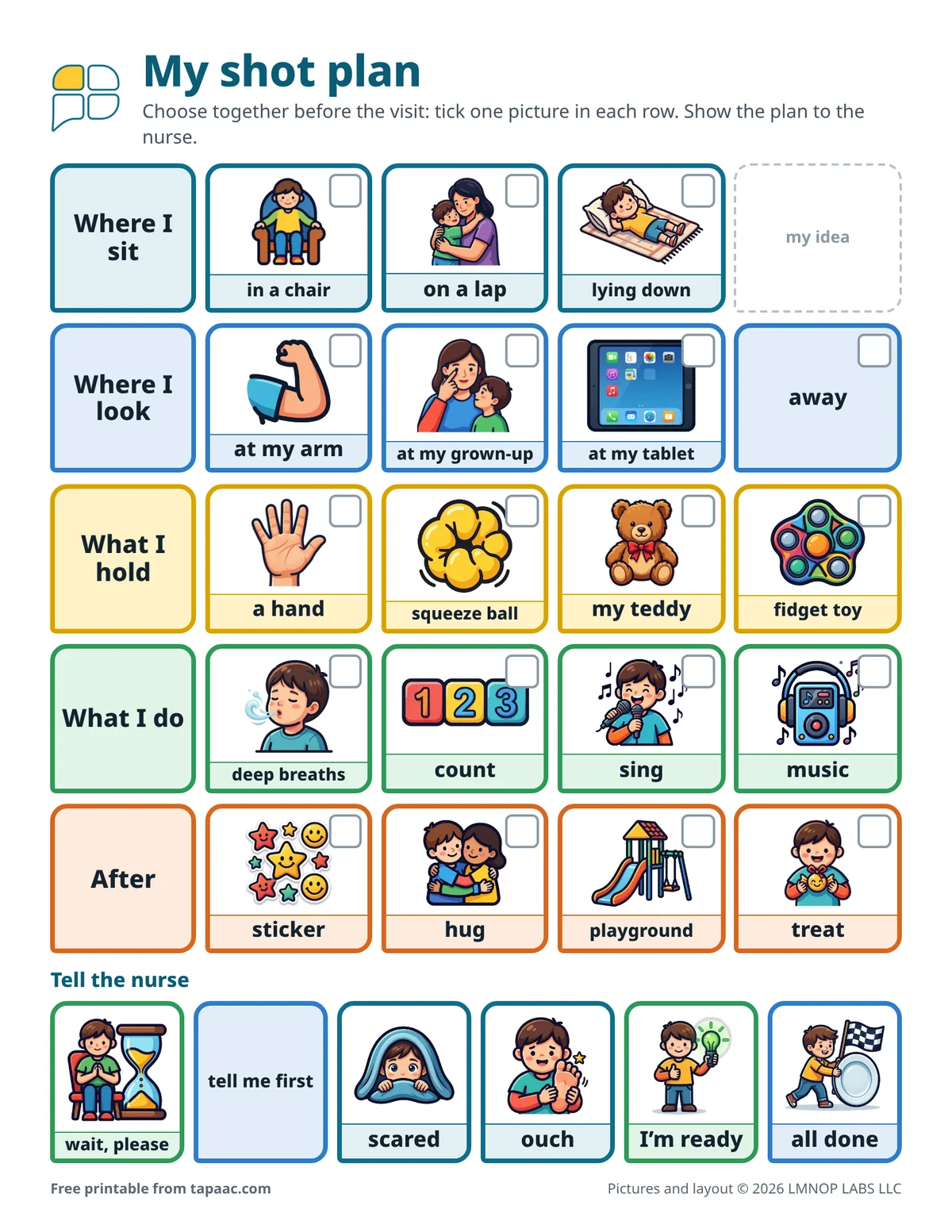
The shot plan
Every row has a choice, and every choice is the child’s. Some children like to sit on a grown-up’s lap; others want their own chair. Some want to watch the arm; others look at their tablet or at their grown-up’s face. The my idea box is for something we didn’t think of. The bottom row gives the child words for the nurse: wait, please, tell me first, I’m ready. A plan made at home, in a calm moment, is easier to think through than choices offered in the exam room.
Questions about the shot itself
This page helps a child know what will happen and take part. It isn’t medical advice. Ask the doctor or nurse about the shot itself: what it’s for, what to expect afterwards, and anything that worries you. In an emergency, call 911 or your local emergency number.
Zoe is seven and has been dreading her flu shot. The night before, she and her mom fill in the plan: on a lap, at my tablet, squeeze ball, count, and a sticker after. At the clinic her mom shows the plan to the nurse, who says, “Great plan.” Zoe sits on her mom’s lap with her ball and her tablet. Her mom points to 1, 2, 3 and they count together. Zoe says “ouch” with her board, and then points to I did it! before the bandage is even on.
What’s on the PDF
Getting a shot
- wait
- sit down
- sleeve up
- cold wipe
- 1, 2, 3
- the shot
- bandage
- I did it!
My shot plan
- in a chair
- on a lap
- lying down
- at my arm
- at my grown-up
- at my tablet
- away
- a hand
- squeeze ball
- my teddy
- fidget toy
- deep breaths
- count
- sing
- music
- sticker
- hug
- playground
- treat
Tell the nurse
- wait, please
- tell me first
- scared
- ouch
- I’m ready
- all done
Printing tips
- Print a fresh shot plan for each visit, and keep the old ones: next time, start from what worked.
- Change the steps to match your visit: if the child lies down, or there’s no wipe, cross the step out and draw what will happen.
- The shot is often part of a checkup: the doctor visit visual schedule has the rest of the visit, and the where does it hurt board helps afterwards.
- For the waiting room, the calm down choices board has breathing and squeezing ideas, and cards that fit in a pocket.
More free boards
-
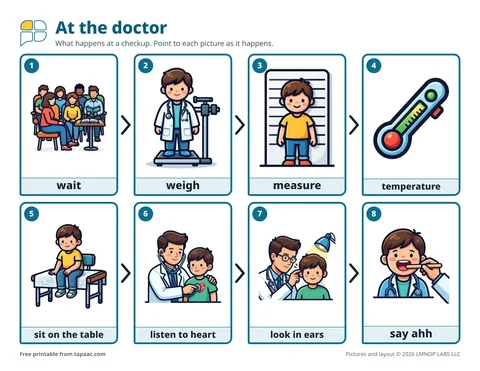 Doctor visit visual scheduleWhat happens at a checkup, words to talk to the doctor, and 20 cards for any visit.
-
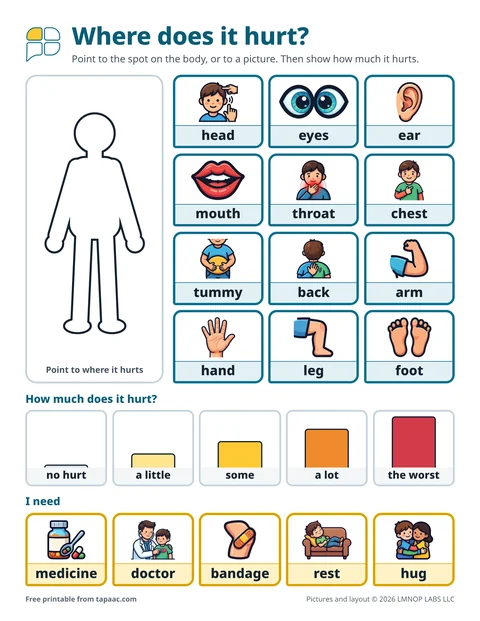 Where does it hurt boardA body outline, 12 body parts and a simple scale for how much it hurts.
-
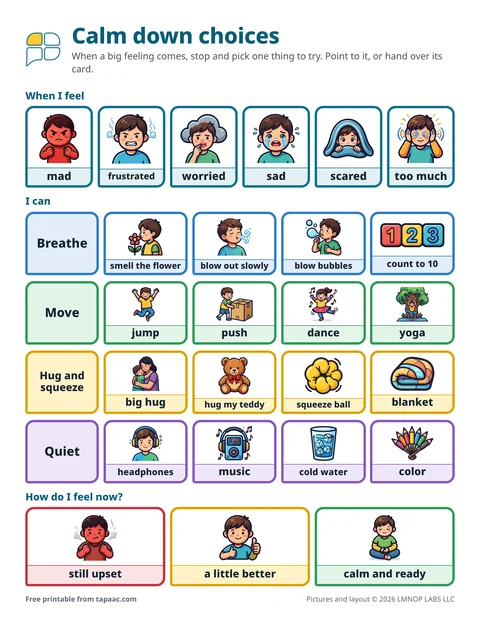 Calm down choices board16 calm down choices in four groups, a breathing square to trace, and calm down cards to cut out.
-
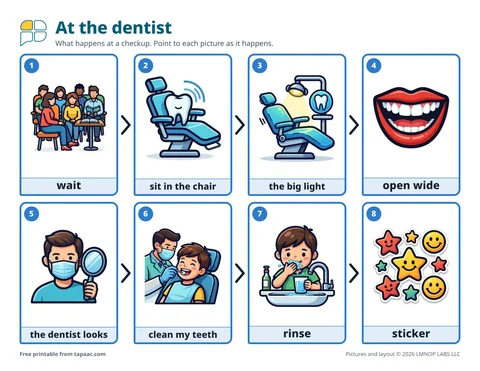 Dentist visit visual scheduleWhat happens at a dental checkup, a stop signal, and words for talking to the dentist.
Need a different board? Make your own with the free AAC board maker.
Making a schedule? Use the free visual schedule maker: routines ready to open and change.
These boards and guides are general information, not therapy or medical advice, and they don’t replace a speech therapist. A speech therapist who knows the person can help choose the right words, pictures and layout. The boards are free to print and share; please don’t sell them (terms of use). Questions about the boards? Email support@lmnoplabs.fun.