 Tap AAC
Doctor visit visual schedule: free printable for kids
A doctor visit visual schedule shows a child what will happen at the doctor, step by step, before it happens: wait, get weighed and measured, have a temperature taken, sit on the table, then the doctor listens to the heart, looks in the ears and asks for an “ahh”. This free PDF has the eight checkup steps, a board for telling the doctor yes, no, stop and where it hurts, and 20 cards to build the steps of your own visit.
Download the free PDF US Letter, 3 pages, 1,544 KB
Printing on A4 paper? Download the A4 PDF (3 pages, 1,545 KB). Or pick one page shape for every page:
Portrait (tall page, 3 pages): US Letter PDF (1,545 KB) · A4 PDF (1,545 KB)
Landscape (wide page, 3 pages): US Letter PDF (1,547 KB) · A4 PDF (1,547 KB)
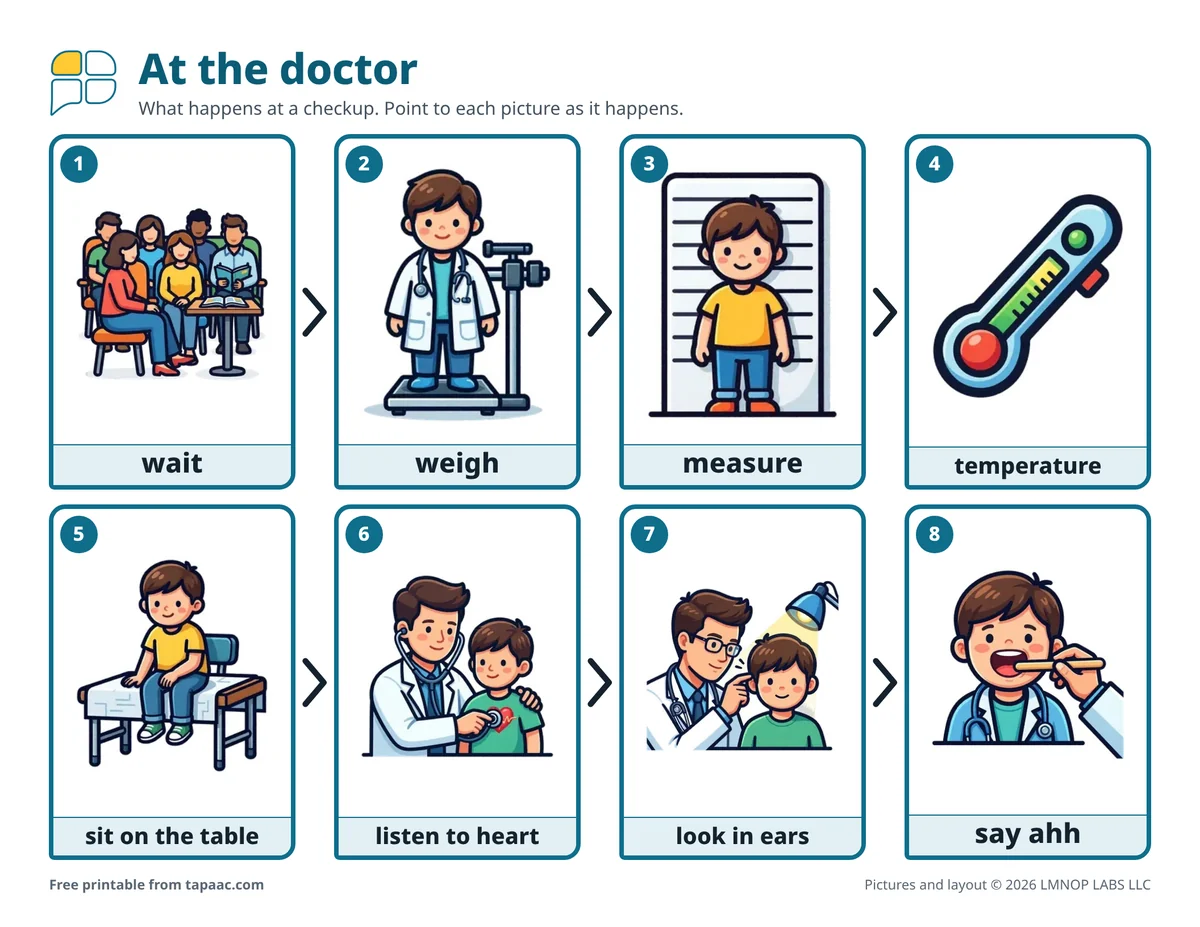
Edit this board in the free board maker: change the words and pictures, then print.
Have Tap AAC? Add to Tap AAC (.obz file, 1,425 KB) · How to add a board
- Free
- No sign-up
- Print as many as you need
Who it’s for
Children going to a checkup or a sick visit, especially children who find new places, waiting or being touched hard, and children who don’t speak or don’t speak much. The talk board on page 2 gives them a way to say stop, scared or it hurts during the visit.
How to use it
- Look at it together a day or two before. Go through the steps calmly, and act some of them out with a toy.
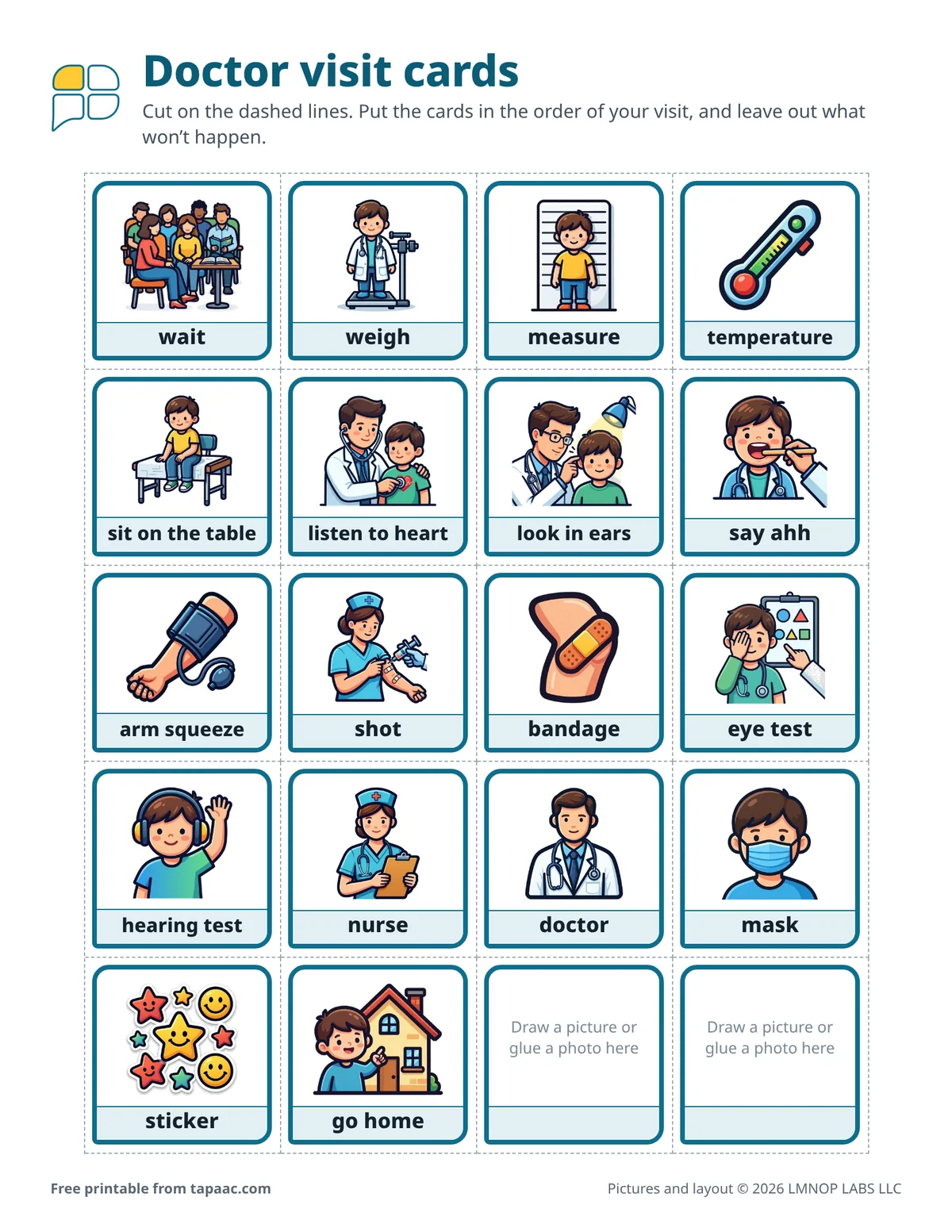
- Build your visit with the cards. Put page 3’s cards in the order you expect, and leave out what won’t happen.
- Bring it along. In the waiting room, point to the first step: “We’re here. Wait.”
- Point to each step as it happens, and to the next one before it starts: “Next, the doctor looks in your ears.”
- Show the doctor or nurse the talk board, so they know the child may answer by pointing, and give them time to answer.
Be honest about the hard parts
If there will be a shot, put the shot card in the schedule. A schedule that leaves out the hard part stops being trusted the first time it’s wrong. Put something good straight after it, like sticker or go home. If you’re not sure what will happen, say so, and use what’s next? to ask the nurse together.
Talking to the doctor
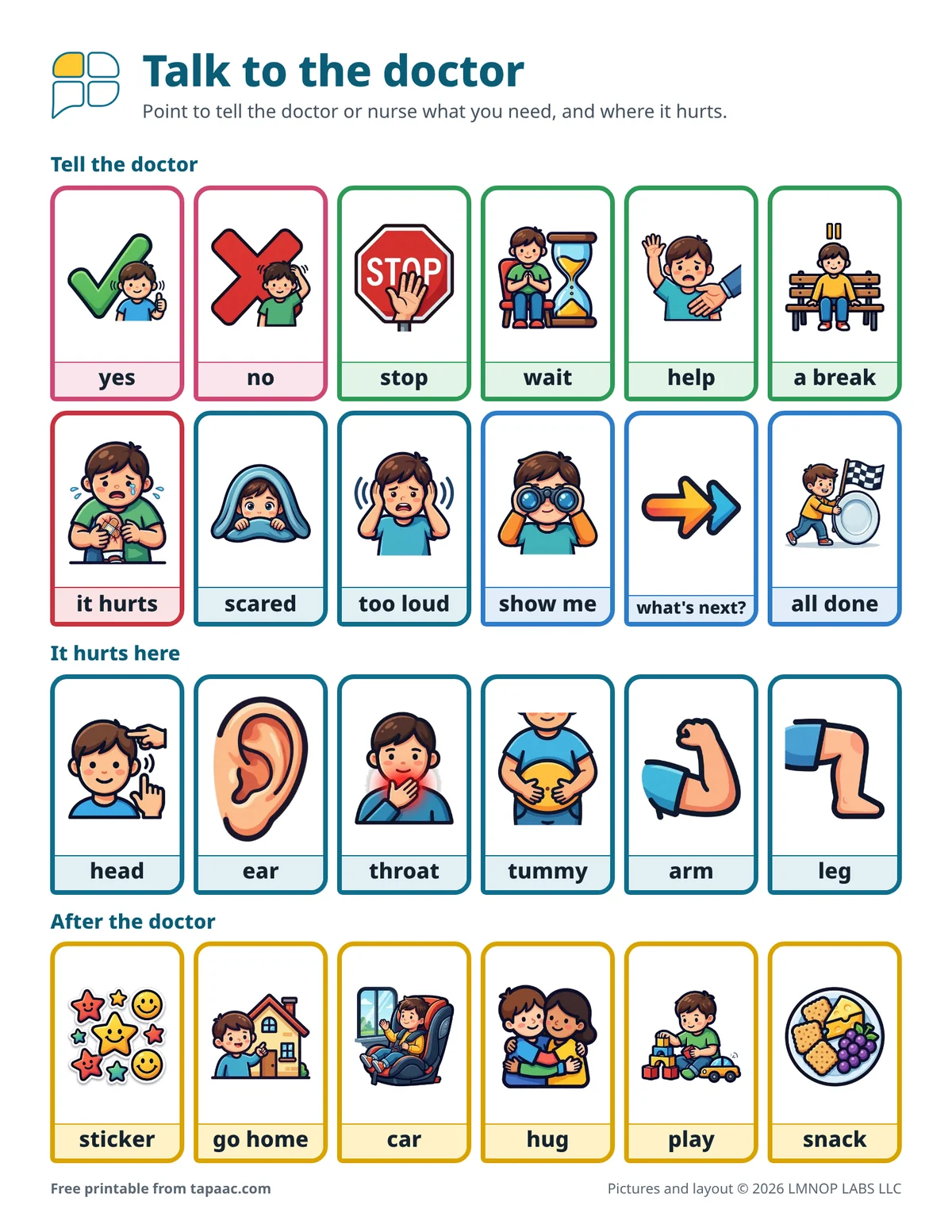
The talk board on page 2 lets a child answer questions (yes, no), set limits (stop, wait, a break), say how they feel (scared, too loud) and show where it hurts. Ask the doctor to talk to the child, not only to you, and to wait for the point.
In the waiting room, Aria and her dad look at the schedule again. Weigh, measure, temperature: Aria points to each one as it happens. When the doctor reaches for the ear light, Aria points to scared. The doctor stops: “I’ll show you first.” She shines the light on her own hand, then looks in Aria’s ears. Say ahh, then sticker, and Aria points to go home.
What’s on the PDF
Checkup steps
- wait
- weigh
- measure
- temperature
- sit on the table
- listen to heart
- look in ears
- say ahh
Tell the doctor
- yes
- no
- stop
- wait
- help
- a break
- it hurts
- scared
- too loud
- show me
- what’s next?
- all done
Page 2 also has head, ear, throat, tummy, arm and leg, and things for after the visit: sticker, go home, car, hug, play and snack. The cards on page 3 add arm squeeze (blood pressure), shot, bandage, eye test, hearing test, nurse, doctor, mask, sticker and go home.
Printing tips
- Laminate the pages, and keep the cards in a zip bag clipped to them.
- Glue a photo of the real doctor’s office or the real doctor onto a blank card, if you can get one.
- This board helps a child take part in a visit. It isn’t a medical tool. If a child may be badly hurt or very sick, call 911 or your local emergency number.
- For a hospital stay, see the hospital communication board. To show where it hurts in more detail, use the where does it hurt board.
More free boards
-
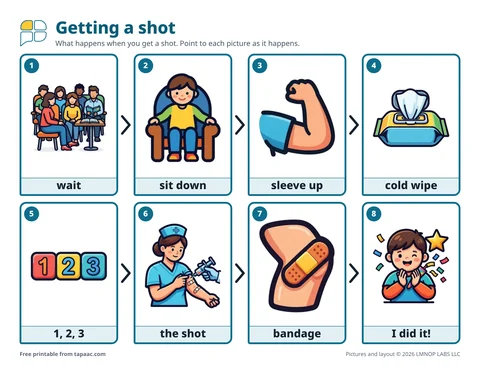 Getting a shot visual scheduleThe eight steps of getting a shot, and a shot plan to fill in together: where to sit, look and hold.
-
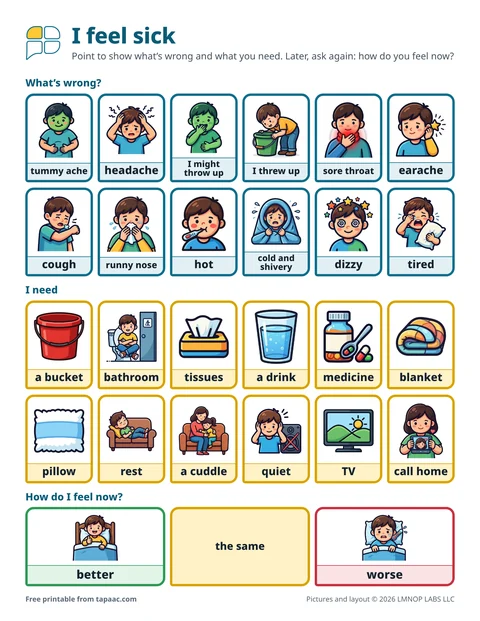 I feel sick communication boardWhat’s wrong, what I need, how I feel now, and sick cards for school to hand to a teacher or the nurse.
-
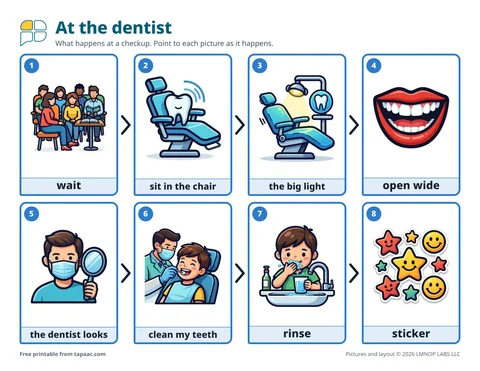 Dentist visit visual scheduleWhat happens at a dental checkup, a stop signal, and words for talking to the dentist.
-
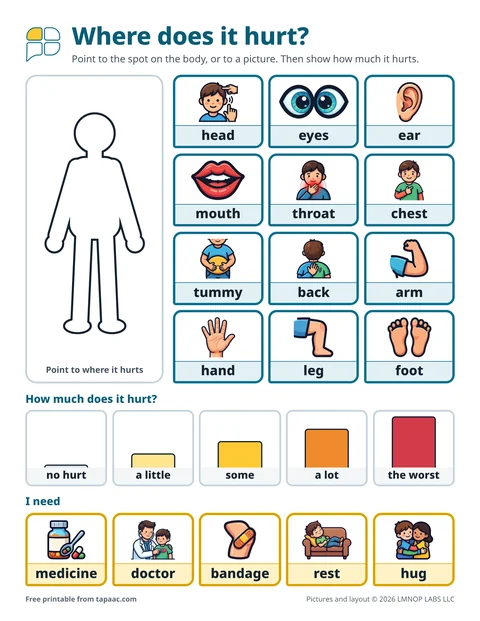 Where does it hurt boardA body outline, 12 body parts and a simple scale for how much it hurts.
Need a different board? Make your own with the free AAC board maker.
Making a schedule? Use the free visual schedule maker: routines ready to open and change.
These boards and guides are general information, not therapy or medical advice, and they don’t replace a speech therapist. A speech therapist who knows the person can help choose the right words, pictures and layout. The boards are free to print and share; please don’t sell them (terms of use). Questions about the boards? Email support@lmnoplabs.fun.