 Tap AAC
Haircut visual schedule: free printable
A haircut visual schedule shows, in pictures, what will happen at the hairdresser before it happens: wait my turn, sit in the chair, spray water, comb, cut my hair, hair dryer, look in the mirror, all done. This free PDF has the eight steps, a board for telling the hairdresser too loud, itchy or a break, and a note you fill in together and hand over when you arrive.
Download the free PDF US Letter, 3 pages, 1,103 KB
Printing on A4 paper? Download the A4 PDF (3 pages, 1,105 KB). Or pick one page shape for every page:
Portrait (tall page, 3 pages): US Letter PDF (1,104 KB) · A4 PDF (1,104 KB)
Landscape (wide page, 3 pages): US Letter PDF (1,105 KB) · A4 PDF (1,105 KB)
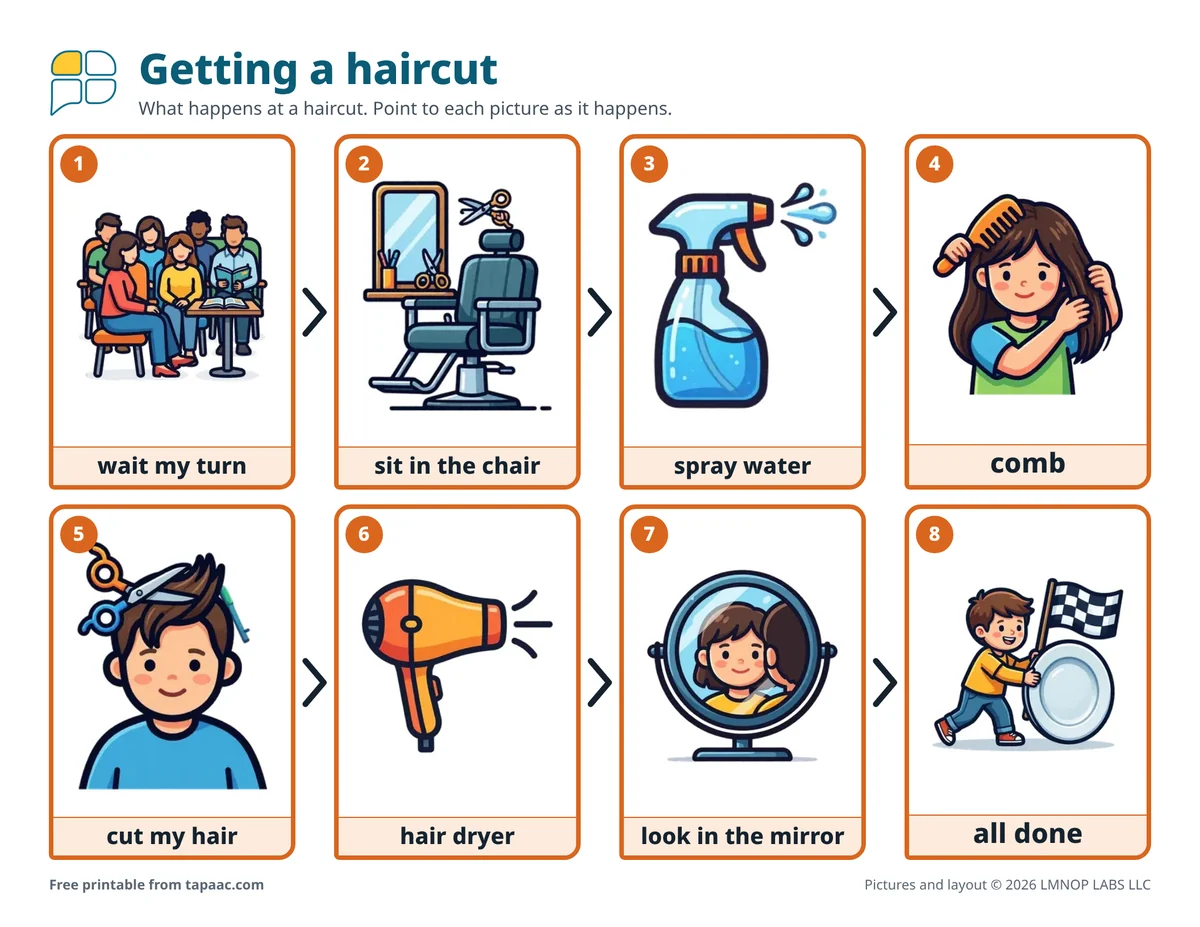
Edit this board in the free board maker: change the words and pictures, then print.
Have Tap AAC? Add to Tap AAC (.obz file, 959 KB) · How to add a board
- Free
- No sign-up
- Print as many as you need
Who it’s for
Children, teens and adults who find haircuts hard: the buzz of clippers, the cold spray, the itchy bits of hair on the neck, a stranger’s hands near the face, and not knowing how long it will last. That includes some autistic children, and anyone who doesn’t speak or doesn’t speak much. A schedule shows what comes next and when it ends; the board gives them a way to say what’s wrong while it’s happening.
How to use it
- Look at it together a few days before. Go through the eight steps calmly. Play hairdresser at home with a comb and a spray bottle, and let the person spray you back.
- Agree on a stop signal, like a raised hand, and practice it: hand up, and the comb stops.
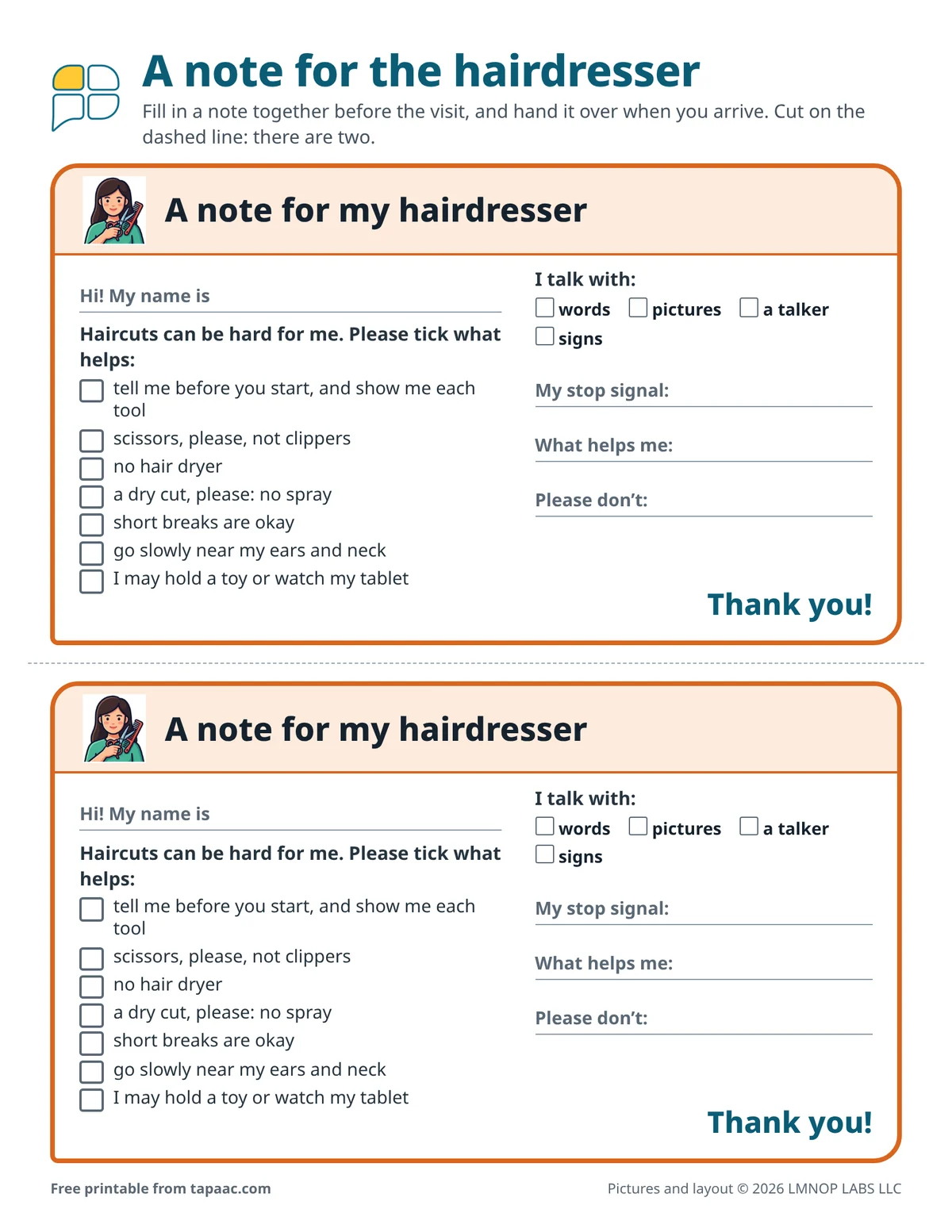
- Fill in the note on page 3 together, and hand it to the hairdresser when you arrive, before the cape goes on.
- Hold the schedule where the person can see it in the mirror or on their lap. Point to each step as it happens, and to the next one before it starts: “Next, the hair dryer.”
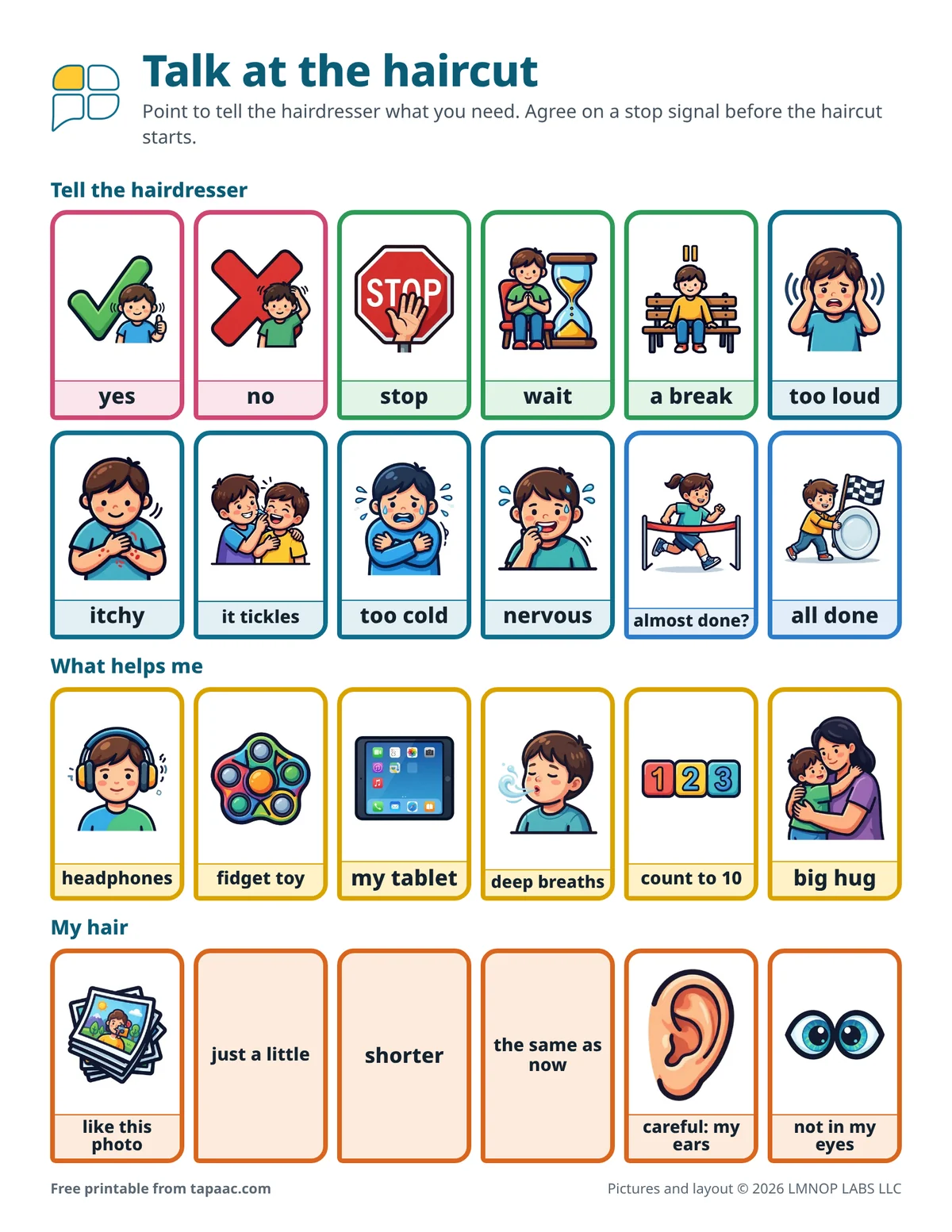
- Model the words on page 2. Point to too loud when the dryer starts, or to almost done? and answer it: “Yes, two more steps.”
Change the steps to match the salon
Every salon and barbershop works a little differently, and a schedule that turns out wrong stops being trusted. If the hairdresser washes hair first, draw a sink on a sticky note and put it before step 3. If the person is fine without the dryer, cross out step 6 and ask for a towel dry. Clippers instead of scissors? Write “clippers” on step 5. Call or visit the salon before the first haircut and ask what they do, so the pictures are true.
The note for the hairdresser
A hairdresser who has never met the person can’t know what helps. The note on page 3 says it for you: tell me before you start, show me each tool, scissors rather than clippers, no hair dryer, short breaks. It also says how the person talks (with words, pictures, a talker or signs), their stop signal, what helps and what not to do. Fill in a fresh note for each new salon, and keep the second copy for next time.
Leo, who is six, hates the hair dryer. Before his haircut, he and his mom play hairdresser with a spray bottle, and he practices his stop signal. At the salon, his mom hands over the note with no hair dryer ticked. Leo holds the schedule. At step 3 he points to too cold, and the hairdresser warms the water in her hand. At step 5 he raises his hand; she stops and waits. He points to almost done? “Two more steps,” she says. Step 6 is crossed out, so it’s straight to the mirror.
What’s on the PDF
Haircut steps
- wait my turn
- sit in the chair
- spray water
- comb
- cut my hair
- hair dryer
- look in the mirror
- all done
Tell the hairdresser
- yes
- no
- stop
- wait
- a break
- too loud
- itchy
- it tickles
- too cold
- nervous
- almost done?
- all done
What helps me
- headphones
- fidget toy
- my tablet
- deep breaths
- count to 10
- big hug
My hair
- like this photo
- just a little
- shorter
- the same as now
- careful: my ears
- not in my eyes
Printing tips
- Laminate page 1, or slide it into a sheet protector: bits of hair brush right off.
- Take a photo of the salon, the chair and the hairdresser on a first visit, and glue them over steps 1 and 2.
- Bring a photo of a haircut the person likes, and point to like this photo.
- For the dentist and the doctor, there are matching schedules: the dentist visit visual schedule and the doctor visit visual schedule. For waiting your turn, use the wait card.
- New to picture boards? Read how to get started with printed boards, or AAC and autism: answers to common parent questions.
More free boards
-
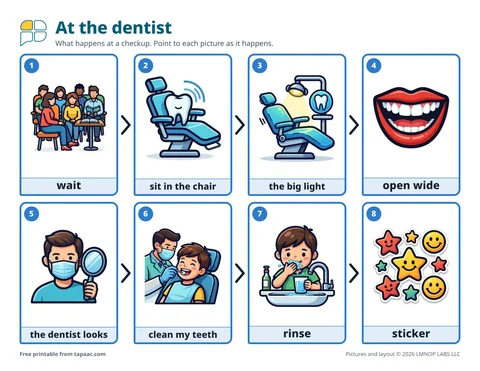 Dentist visit visual scheduleWhat happens at a dental checkup, a stop signal, and words for talking to the dentist.
-
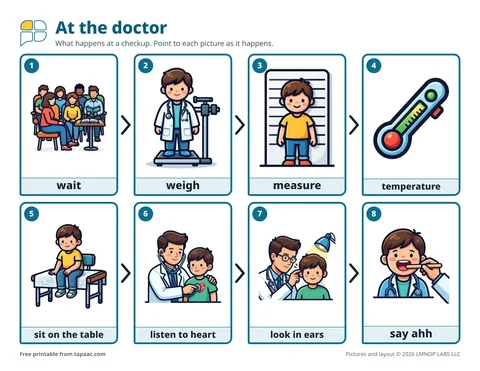 Doctor visit visual scheduleWhat happens at a checkup, words to talk to the doctor, and 20 cards for any visit.
-
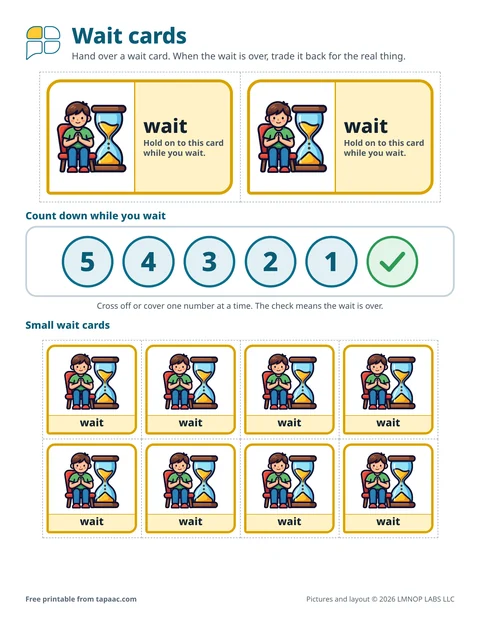 Wait cardsWait cards, a 5-to-1 countdown, and my turn and your turn cards with a Now and Next board.
-
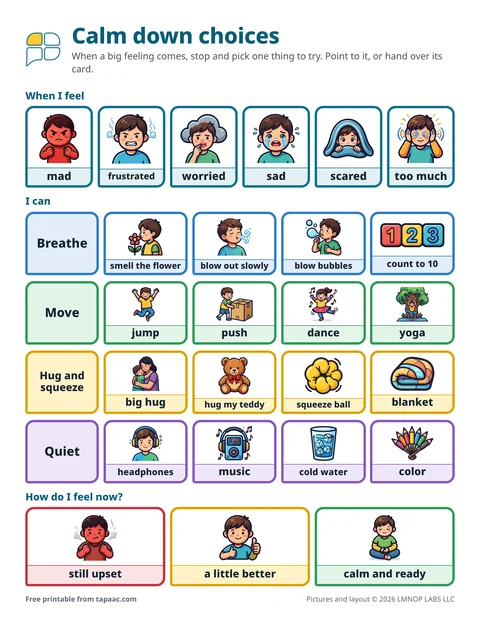 Calm down choices board16 calm down choices in four groups, a breathing square to trace, and calm down cards to cut out.
Need a different board? Make your own with the free AAC board maker.
Making a schedule? Use the free visual schedule maker: routines ready to open and change.
These boards and guides are general information, not therapy or medical advice, and they don’t replace a speech therapist. A speech therapist who knows the person can help choose the right words, pictures and layout. The boards are free to print and share; please don’t sell them (terms of use). Questions about the boards? Email support@lmnoplabs.fun.