 Tap AAC
Why autistic adults use AAC
A substantial proportion of autistic adults don’t develop fluent spoken language by adulthood, and autistic adults often meet communication barriers that affect relationships, work and health.1
Being able to speak doesn’t settle the question. Autistic adults who use speech may find it intermittent, unreliable or not enough, and difficulties can depend on the setting and on what is being said.2 The professional guidance for speech-language pathologists says autistic adults may have functional speech and still need AAC to fully meet their communication needs, and it lists part-time use of AAC, when spoken language is lost for a time, among the things a clinician may see.3
Most research on autism and AAC has been with nonspeaking children, and AAC use by autistic adults, and by autistic people who speak, has had little academic attention. Much of what is known comes from autistic adults who have shared their own strategies and experiences.2
What autistic adults use
Autistic adults report three main kinds of AAC:2
- Everyday tools not made for AAC: text messaging apps, online chat and handwriting.
- Mobile apps made for communication, on a phone or tablet.
- Signed languages, such as American Sign Language, and gestures.
Different tools can suit different places. The professional guidance says low-tech supports can give quick access or help unfamiliar communication partners, while high-tech tools and speech-generating devices let a person put across more detailed ideas, out loud.3
Setting it up
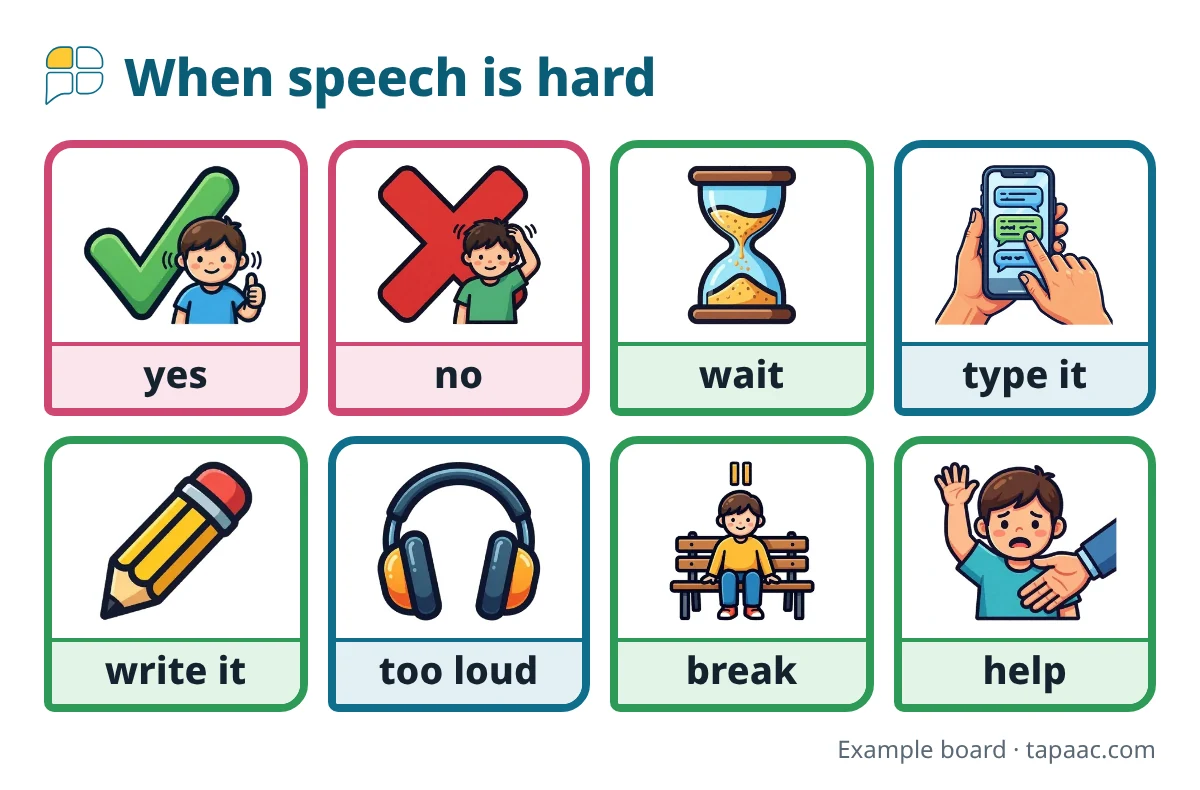
- Start from the situations, not the tool. Where does speech get hard? Phone calls, a busy shop, appointments, the end of a long day, a difficult conversation. A 2019 overview of AAC for speaking autistic adults recommends working out communication goals first, then matching them to the features of a system.2
- Save the phrases you need most, so they are one tap away: “I can’t talk right now, but I can type.” “Please give me a minute.” “Can you write that down?” “Not now.”
- Have a fast option and a full one: a card or a few big buttons for the moment itself, and a keyboard for everything else.
- Choose a voice and a volume that work in a noisy room, or turn the screen round so the other person can read it.
- Keep it where your hand can find it, in the same pocket or the same spot on the home screen.
- Practice switching from speech to AAC with someone you trust, so it feels ordinary in the middle of a conversation.
If you can spell, a letter board is quick to point to and needs no battery. You can design a small board of your own in the free board maker.
Common barriers, and what helps
The same overview, drawing on what autistic adults have shared, describes four barriers: not knowing what options exist, attitudes about who AAC is for, the belief that someone who can speak should use AAC less, and the cost of dedicated AAC apps and devices. Its recommendations:2
- support autistic people in defining their own communication needs, whether or not they speak
- work out communication goals, and match them to the features of a system
- value all communication, not only speech
- explore a variety of options, including low-cost and free ones
The wider AAC guidance agrees: people who use AAC should always have access to their communication tools, and there are no prerequisites for AAC.4 If people around you worry that AAC will make speech worse, our AAC myths and facts guide answers that worry with the research.
New people, health care and emergencies
- New people. A short, ready-made message saves explaining every time: “I’m autistic. Sometimes I type instead of talking. Please give me time.” The free “I use AAC” wallet cards have room for it.
- Health care (US). Under the Americans with Disabilities Act, businesses that serve the public, doctors’ offices among them, must communicate effectively with people with speech disabilities, and for someone who uses a board or device, the Department of Justice says that can mean simply allowing more time.5 You can ask for a longer appointment, or for questions and answers in writing.
- Emergencies. Plan before you need it: texting emergency services, a card for responders and a charged device. See AAC in an emergency.
Getting an evaluation as an adult
A speech-language pathologist who knows AAC can help match tools to needs and set them up. Services can be harder to find for adults: the professional guidance notes a lack of services and supports for autistic adults, and that state-funded autism programs typically require documentation of a developmental disability from before age 22.3 See what happens in an AAC evaluation and how to get an AAC device.
For family, friends and support staff
- Treat typed and app messages as the person’s own words, and answer them the same way you would answer speech.
- Don’t ask them to “just say it” when they have chosen AAC.
- Wait for the whole message, and only finish sentences if they have said they like that.
- Don’t put the AAC away because they talked earlier in the day.
- Learn where things are on their system, so you can follow along.
For autistic children, see AAC and autism.
Try this today
- Write down three situations where speech gets hard, and what you would want to say in each.
- Save three phrases on your phone or AAC app so they are one tap away.
- Print an “I use AAC” wallet card and fill it in.
- Tell one person you trust how you would like them to respond when you switch to AAC.
More AAC guides
- AAC and autism: answers to common parent questionsWill AAC stop my child from talking? Is my child ready? How do I start?
- What is an AAC evaluation? What to expect, and how to prepareWho does it, what they look at, trying devices, how to prepare and what to ask.
- AAC in an emergency: a plan, a card, and tips for first respondersTexting 911, an “I use AAC” card, a charged device and a paper backup, and tips for responders.
- How to choose an AAC app: questions to ask before you buyStart with the person, try before you buy, and the questions to ask about any app.
- AAC myths and facts: 10 common myths, and what the research saysTen things people believe about AAC, and what research and professional guidance say instead.
Sources
We read each of these on October 13, 2026. Numbers in the text point to them.
- de Marchena A, Cuneo N, Gurbuz E, Brown M, Trujillo J, Bergstrom J (2025). Communication in Autistic Adults: An Action-Focused Review. Current Psychiatry Reports, 27(8), 471–481. Abstract on PubMed.
- Zisk AH, Dalton E (2019). Augmentative and Alternative Communication for Speaking Autistic Adults: Overview and Recommendations. Autism in Adulthood, 1(2), 93–100. Abstract and lay summary on PubMed.
- American Speech-Language-Hearing Association. Autism (Practice Portal). Professional guidance for speech-language pathologists. Accessed October 13, 2026.
- American Speech-Language-Hearing Association. Augmentative and Alternative Communication (Practice Portal). Professional guidance for speech-language pathologists. Accessed October 12, 2026.
- U.S. Department of Justice, ADA.gov. ADA Requirements: Effective Communication. Accessed October 13, 2026.
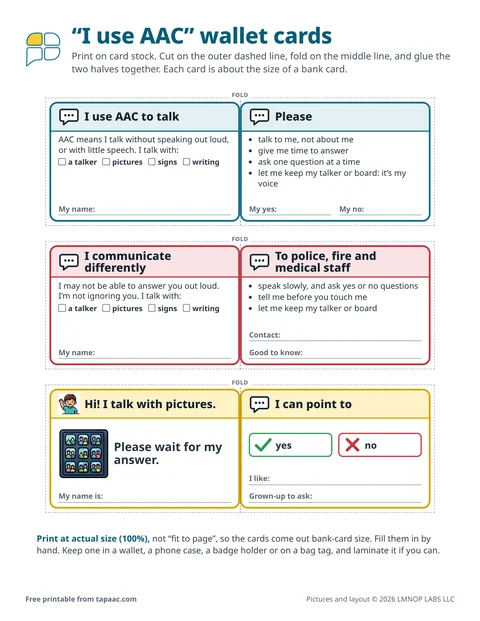 Nonverbal communication cards
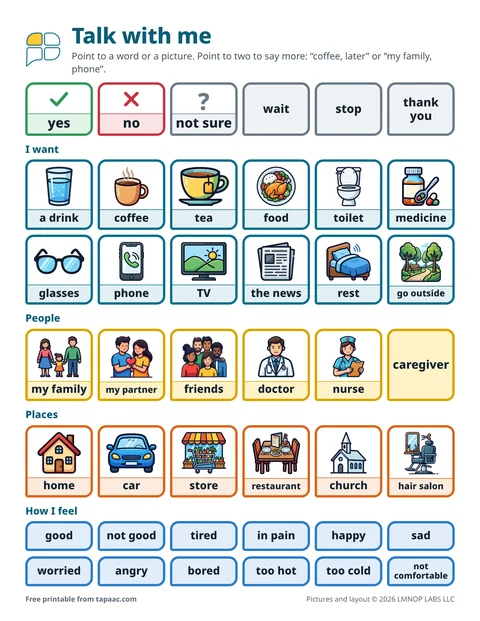 Communication board for adults
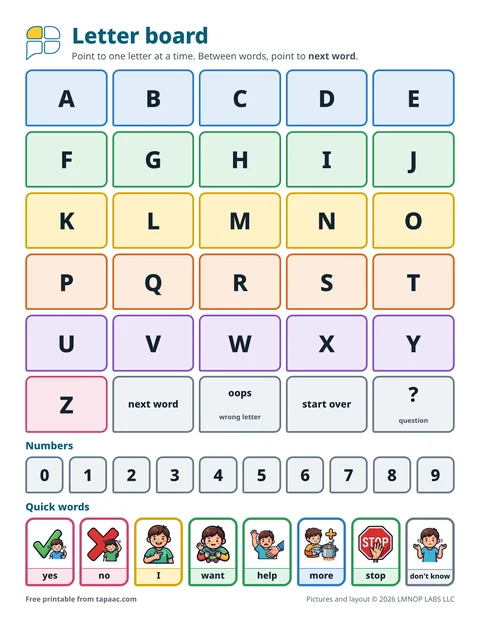 Alphabet board
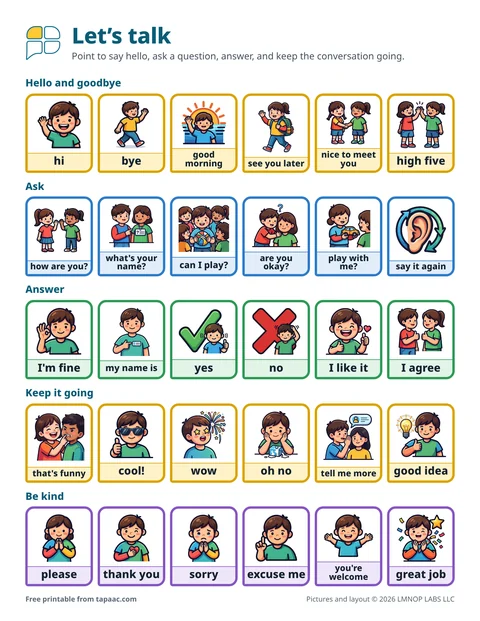 Greetings and conversation board