 Tap AAC
Communication board for adults: free printable PDF
A communication board for adults lets a grown-up who can’t speak, or can’t be understood, point to what they want to say: a drink, toilet, my family, in pain. This free two-page PDF uses adult-looking pictures and plain words, with no cartoon children: yes and no, 12 everyday wants, people, places and 12 feelings on page 1, and a keyboard page for spelling anything else.
Download the free PDF US Letter, 2 pages, 836 KB
Portrait (tall page, 2 pages): US Letter PDF (836 KB) · A4 PDF (836 KB)
Landscape (wide page, 2 pages): US Letter PDF (837 KB) · A4 PDF (837 KB)
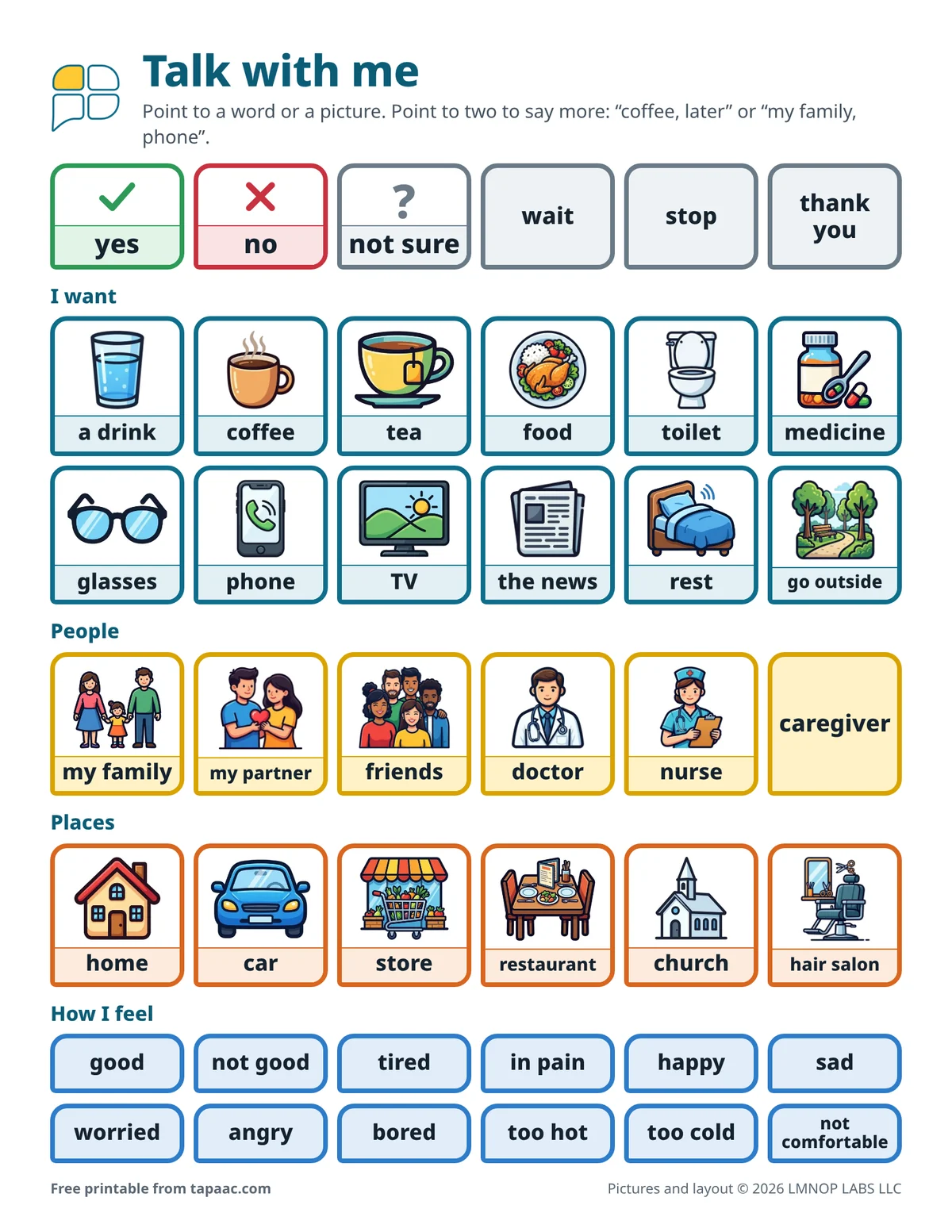
Edit this board in the free board maker: change the words and pictures, then print.
Have Tap AAC? Add to Tap AAC (.obz file, 733 KB) · How to add a board
- Free
- No sign-up
- Print as many as you need
Who it’s for
Adults whose speech is hard to understand, or gone for now: after a stroke or a brain injury, with ALS (also called MND), Parkinson’s or multiple sclerosis, after surgery on the mouth or throat, or with a voice too weak to be heard. It also suits adults with a learning disability or autism who use pictures to talk. And it’s for the people around them: a partner, grown-up children, caregivers and home care staff.
Why a board made for adults
Many printable boards are made for young children, with cartoon kids, toys and snacks. Handing one of those to a 70-year-old can feel like being talked down to. This board uses pictures of grown-up things (coffee, the newspaper, a hair salon, a partner) and puts feelings in plain words instead of pictures of children’s faces. Page 2 is a keyboard laid out like the one on a computer, because many adults spelled for years before they lost their speech.
How to use it
- Keep it where the person is. On the table by their chair, on a tray, on the bedside table. Not in a drawer.
- Talk to the person, not about them. Sit at their eye level, and speak in your normal voice and normal words.
- Ask one thing at a time, then wait. “Do you want something to drink?” Give them time to find the picture.
- Say back what they pointed to. “Coffee. And later?” Let them say yes, no or not sure.
- Spell what isn’t there. Turn to the keyboard. Say each letter out loud as they point, and guess the word as soon as you can.
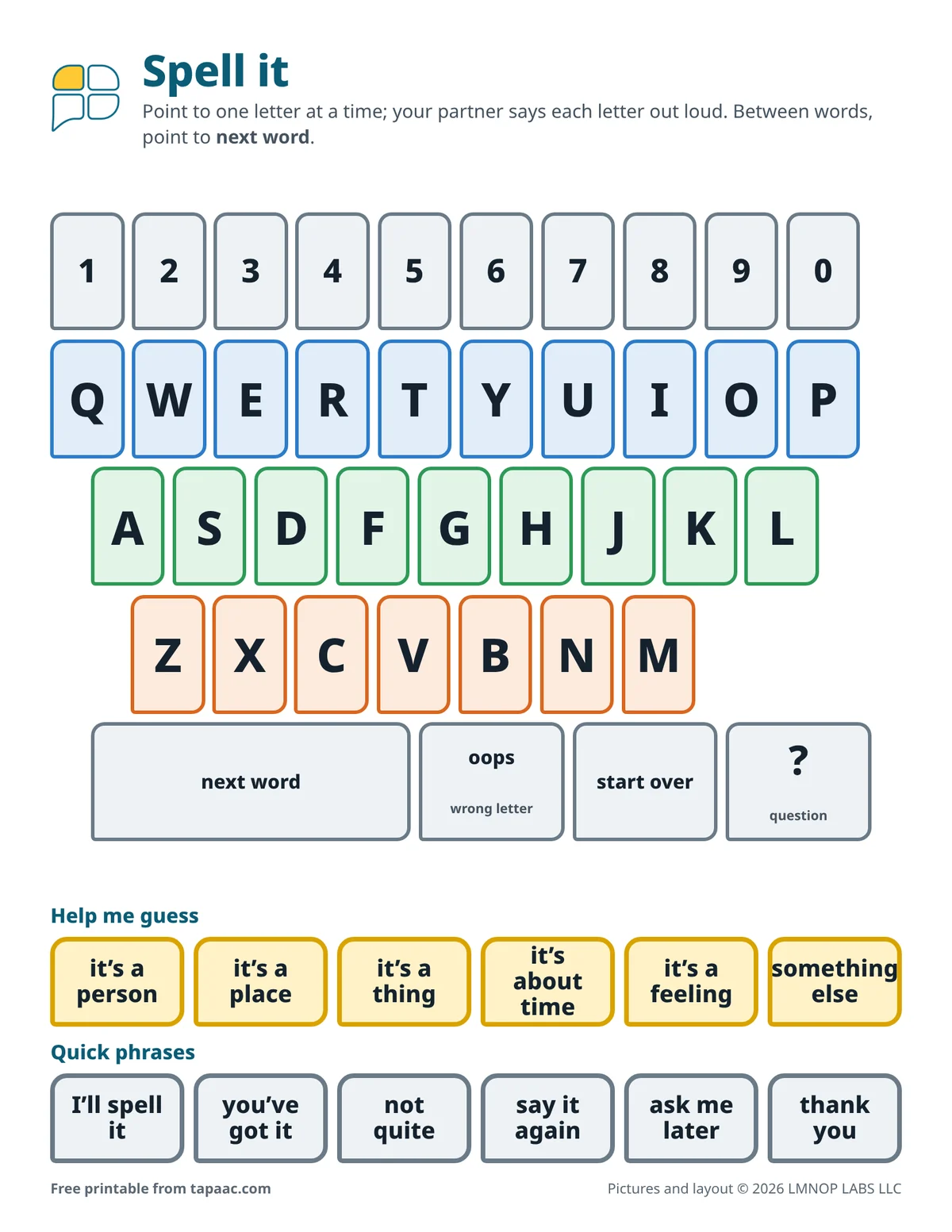
Helping each other guess
Spelling a whole word is slow and tiring. The Help me guess row on page 2 lets the person narrow it down first: it’s a person, it’s a place, it’s about time. Then one or two letters are often enough. The quick phrases do the same job in a conversation: you’ve got it, not quite, say it again, ask me later.
Since his stroke, Walter’s speech is hard to follow, and he hates repeating himself. His daughter sets the board on the table with his breakfast. He points to coffee, then the news. She brings both. Later he turns to page 2, points to it’s a person, then spells B, O. “Bob? Uncle Bob?” You’ve got it. “Do you want me to call him?” Yes.
What’s on the board
I want
- a drink
- coffee
- tea
- food
- toilet
- medicine
- glasses
- phone
- TV
- the news
- rest
- go outside
People and places
- my family
- my partner
- friends
- doctor
- nurse
- caregiver
- home
- car
- store
- restaurant
- church
- hair salon
How I feel
- good
- not good
- tired
- in pain
- happy
- sad
- worried
- angry
- bored
- too hot
- too cold
- not comfortable
Across the top: yes, no, not sure, wait, stop and thank you.
Printing tips
- Print both pages and put them back to back in a sheet protector, or laminate them, so they can be wiped clean.
- Cross out what the person never needs and write in what they do: a pet’s name, a TV channel, a grandchild.
- If small print is hard to see, print the page at a copy shop on larger paper, like tabloid (11 by 17 inches) or A3.
- A speech-language pathologist can help find the best way for the person to communicate, and whether a board, a letter board or a speech device suits them best.
New to paper boards? Read low-tech AAC: how to get started with printed boards. After a stroke, see also how to talk with someone who has aphasia. For the bigger picture, read AAC for adults: after a stroke, with ALS or MND, and in the hospital.
More free boards
-
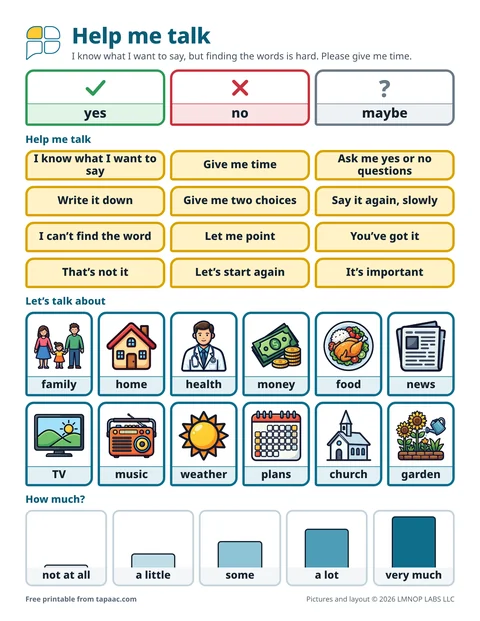 Aphasia communication boardHelp-me-talk phrases, topics and a how-much scale, plus a page for the conversation partner.
-
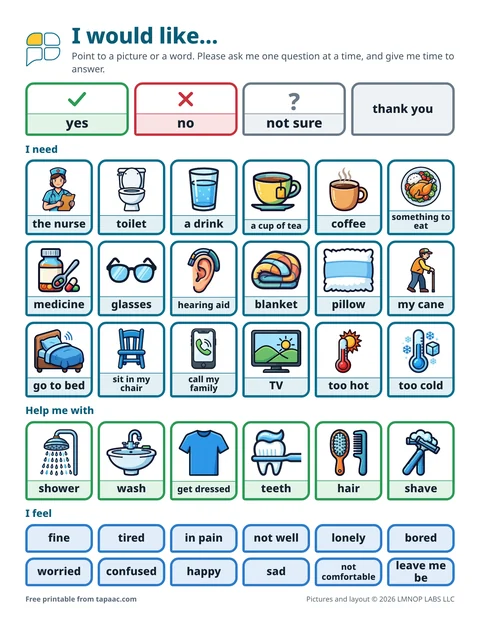 Care home communication boardNeeds and comfort for residents, things they enjoy, and an About me page for staff.
-
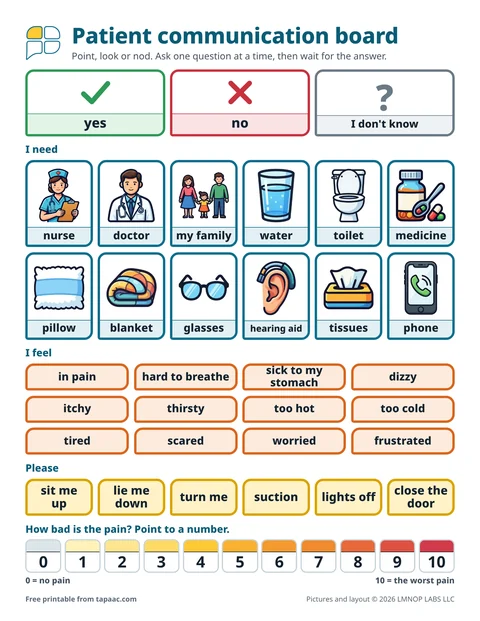 Hospital communication boardFor adult patients: needs, feelings, a 0 to 10 pain scale, letters and questions.
-
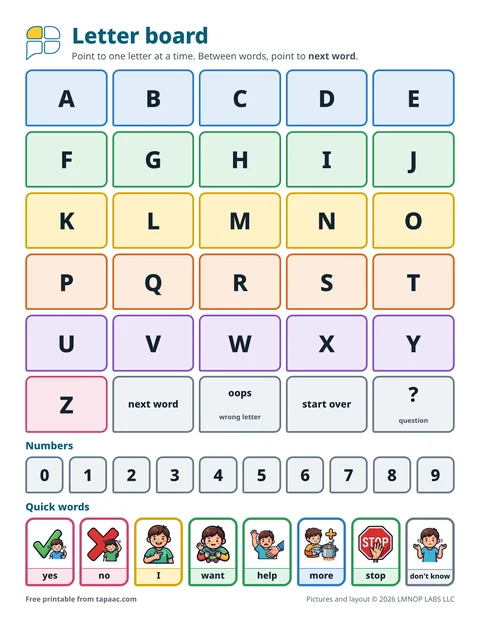 Alphabet boardA to Z for spelling, in alphabet order and keyboard order, with quick words.
Need a different board? Make your own with the free AAC board maker.
These boards and guides are general information, not therapy or medical advice, and they don’t replace a speech therapist. A speech therapist who knows the person can help choose the right words, pictures and layout. The boards are free to print and share; please don’t sell them (terms of use). Questions about the boards? Email support@lmnoplabs.fun.