 Tap AAC
Aphasia communication board: free printable
Aphasia makes it hard to find words, say them or understand them, often after a stroke. An aphasia communication board helps both people in a conversation: the person with aphasia can point to yes, no, a topic or a phrase like Give me time, and the partner gets ways to help. This free PDF has the board and a conversation partner page for writing key words, offering choices and checking times and numbers.
Download the free PDF US Letter, 2 pages, 761 KB
Portrait (tall page, 2 pages): US Letter PDF (761 KB) · A4 PDF (761 KB)
Landscape (wide page, 2 pages): US Letter PDF (760 KB) · A4 PDF (761 KB)
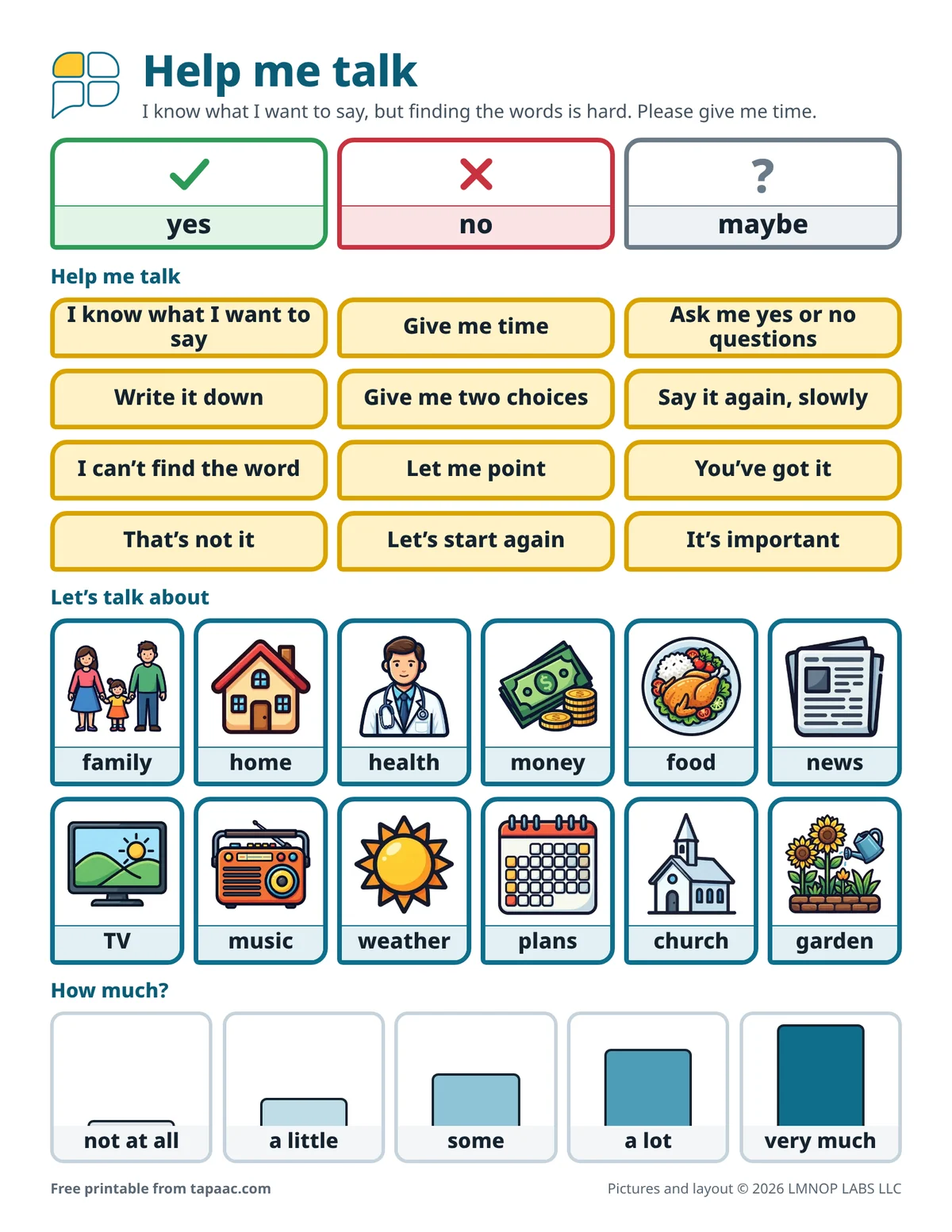
Edit this board in the free board maker: change the words and pictures, then print.
Have Tap AAC? Add to Tap AAC (.obz file, 672 KB) · How to add a board
- Free
- No sign-up
- Print as many as you need
Who it’s for
Adults with aphasia after a stroke or a head injury, and the people who talk with them: a husband or wife, grown-up children, friends, caregivers and nurses. The board starts from a simple idea, printed at the top: the person knows what they want to say; the words are what’s hard. The help-me-talk phrases tell the partner how to help, without the person having to explain it each time.
How to talk with the board
- Find a quiet spot. Turn the TV off. One conversation at a time.
- Say the topic first. Point to it on the board: “Let’s talk about plans. This weekend.”
- Use short sentences, one idea each. Speak at a normal volume. Aphasia isn’t a hearing problem.
- Write key words as you say them. On the partner page, in big letters: “Sunday”, “lunch”, “Anna”.
- Ask yes-or-no questions, or offer two choices. Write the choices in the Which one? boxes and let the person point.
- Check what you understood. “So you want Anna to come on Sunday?” Wait for yes or That’s not it.
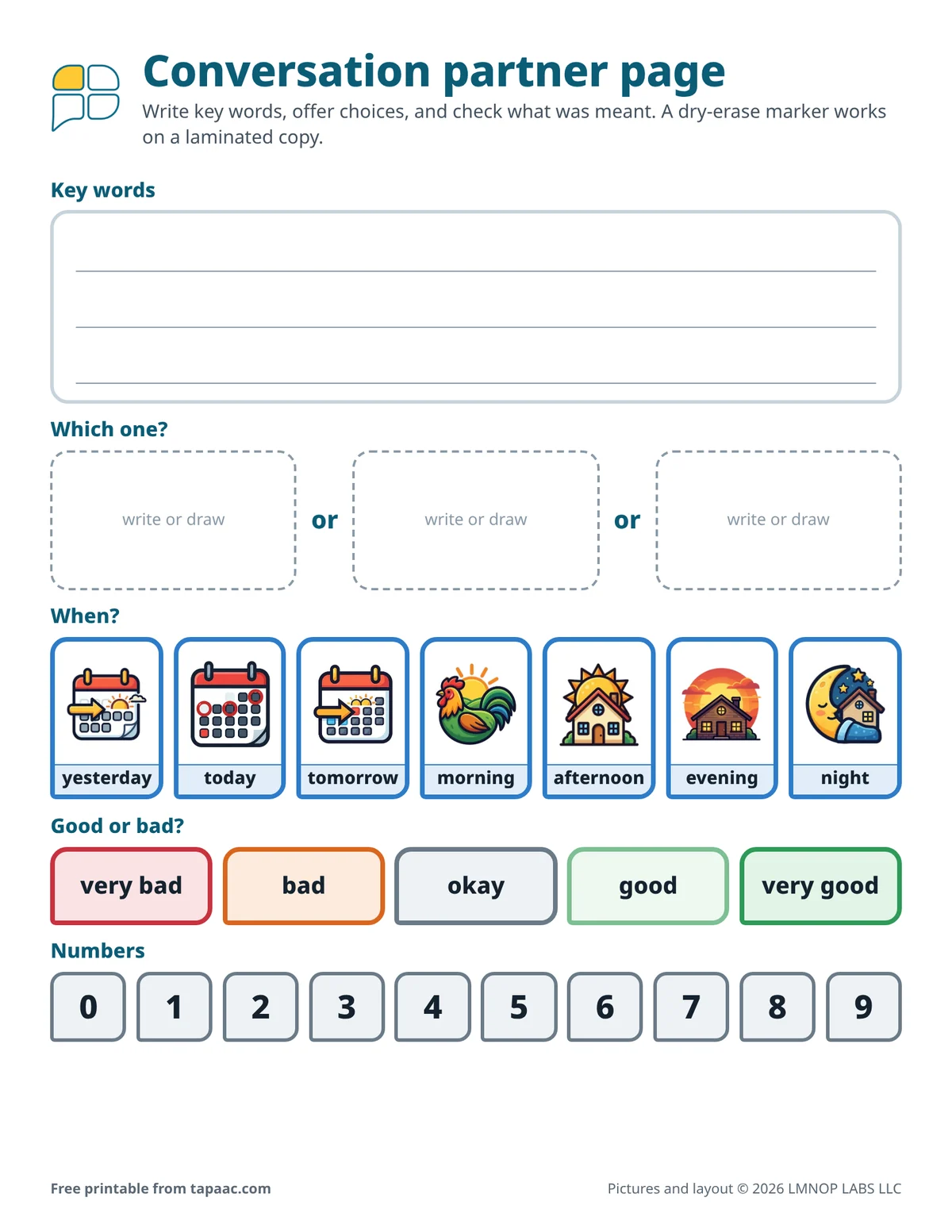
The help-me-talk phrases
Each phrase is a short instruction for the partner. Give me time means stop talking and wait. Give me two choices means write two options. Write it down means the person understands written words more easily than spoken ones today. It’s important means don’t give up on this one; come back to it later if you need to. Showing a phrase is easier than saying it, and it keeps the conversation going instead of stopping it.
The partner page
Page 2 is for the person without aphasia. Write key words on the lines, put choices in the boxes, and use the rows to check details that often go wrong: which day, which part of the day, good or bad, and numbers. A laminated copy and a dry-erase marker mean the page can be used again and again.
Maria wants to tell her husband something about the weekend. She points to family, then plans. He writes “family” and “weekend” on the partner page. “Saturday or Sunday?” He writes both in the Which one? boxes. She points to Sunday. “Is someone coming?” Yes. She points to I can’t find the word, then tries the name: “An… An…” He writes “Anna?”. You’ve got it.
What’s on the board
Help me talk
- I know what I want to say
- Give me time
- Ask me yes or no questions
- Write it down
- Give me two choices
- Say it again, slowly
- I can’t find the word
- Let me point
- You’ve got it
- That’s not it
- Let’s start again
- It’s important
Let’s talk about
- family
- home
- health
- money
- food
- news
- TV
- music
- weather
- plans
- church
- garden
Page 1 also has yes, no and maybe, and a how-much scale: not at all, a little, some, a lot, very much.
Making it work
- Laminate both pages and keep a dry-erase marker clipped to them.
- Change the topics to the person’s own: write over church or garden with a grandchild’s name, a sports team or a job they did.
- Don’t finish the person’s sentences unless they ask you to. Guessing aloud, and checking, is different from taking over.
- A speech-language pathologist can show you ways of talking that suit this person, and may suggest changes to the board.
More tips for family and friends: how to talk with someone who has aphasia, and AAC for adults, from paper boards to speech apps.
More free boards
-
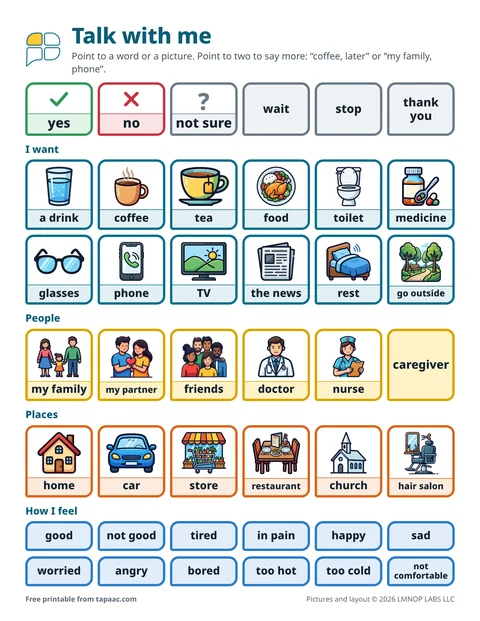 Communication board for adultsGrown-up pictures and plain words: wants, people, places, feelings, and a keyboard page for spelling.
-
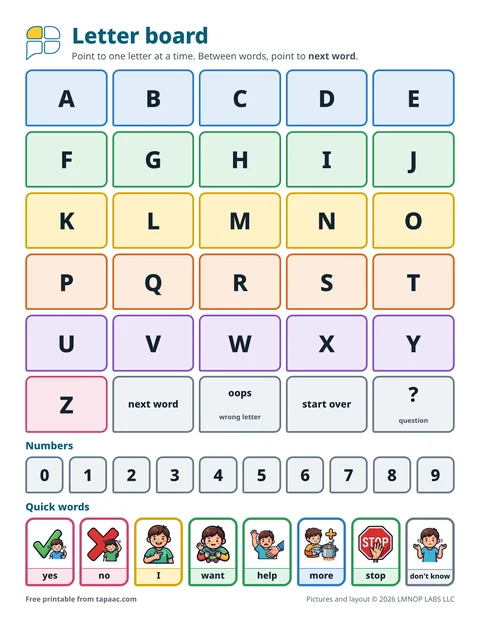 Alphabet boardA to Z for spelling, in alphabet order and keyboard order, with quick words.
-
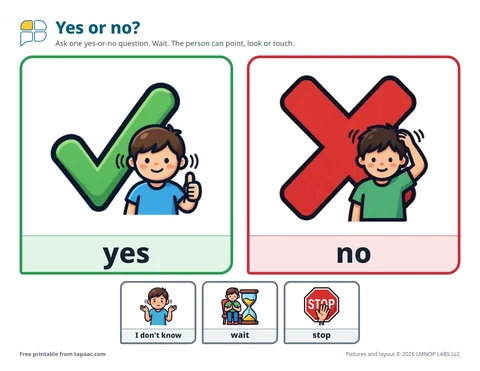 Yes and no boardA big yes and no to point to or look at, plus 20 cards to cut out.
-
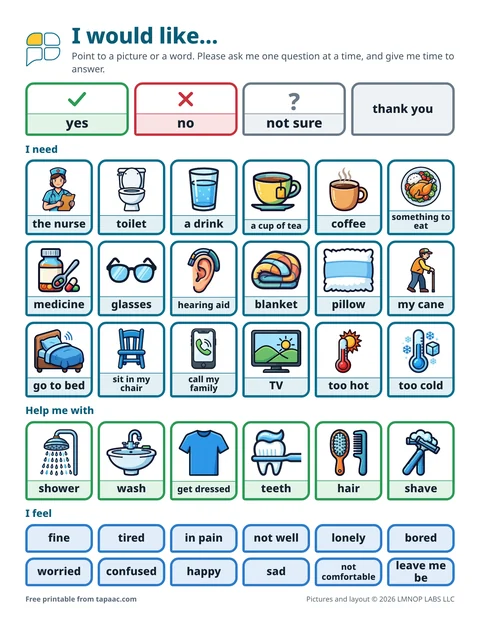 Care home communication boardNeeds and comfort for residents, things they enjoy, and an About me page for staff.
Need a different board? Make your own with the free AAC board maker.
These boards and guides are general information, not therapy or medical advice, and they don’t replace a speech therapist. A speech therapist who knows the person can help choose the right words, pictures and layout. The boards are free to print and share; please don’t sell them (terms of use). Questions about the boards? Email support@lmnoplabs.fun.