 Tap AAC
Follow your unit’s policies and the patient’s care plan. A board or an app is a way to talk, not a way to monitor: if a patient points to pain or trouble breathing, or seems distressed, respond and get help the way your unit does.
Who these patients are
A patient can be awake and alert and still unable to speak: with a breathing tube, after a stroke or a brain injury, with a progressive condition such as ALS, or after surgery such as removal of the voice box. Others arrive already using AAC because of a lifelong condition, such as cerebral palsy, autism or an intellectual disability.1 We use the word “nonverbal” because most people search for it, but many of these patients understand language and can use words by pointing, writing or spelling.
The need is common in intensive care. The professional guidance cites a review of hospital records in which 33% of intensive care patients met the criterion for AAC, against 3% of other patients, and an Australian study in which intensive care patients couldn’t communicate verbally 17% of the time and staff reported difficulty communicating 35% of the time, yet patients used other ways of communicating during only 11% of their time.1
Why it matters
A 2008 study reviewed 2,355 adult charts from 20 hospitals in Quebec. Patients who had a preventable adverse event had three times the odds of having a communication problem, and patients with communication problems were more likely to have more than one preventable event (46% against 20%). The authors concluded that patients with communication problems appeared to be at the highest risk.2
A 2014 review of hospital research on patients with severe communication disabilities found that poor patient-provider communication keeps being cited as a possible cause of preventable adverse events. It drew out six strategies:3
- services, systems and policies that support communication
- enough time for communication
- access to communication tools, including the nurse call system and communication aids
- access to written health information the patient carries with them
- working well with carers, spouses and parents
- building the communication skills of hospital staff
The review also found no reports that trialed these strategies in hospitals at the time, so they are what the research suggests, not tested methods.3
Start with yes and no
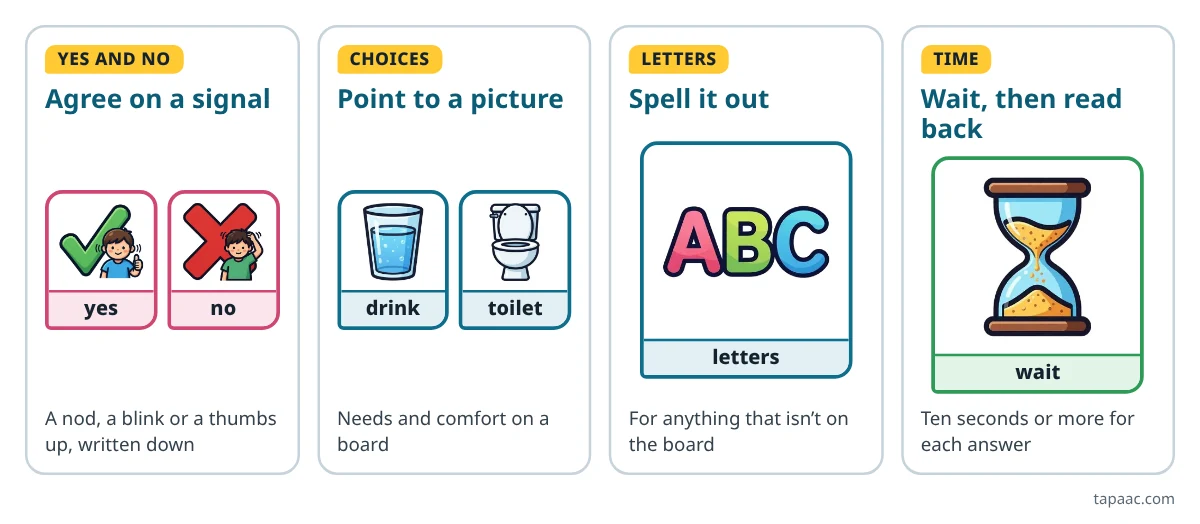
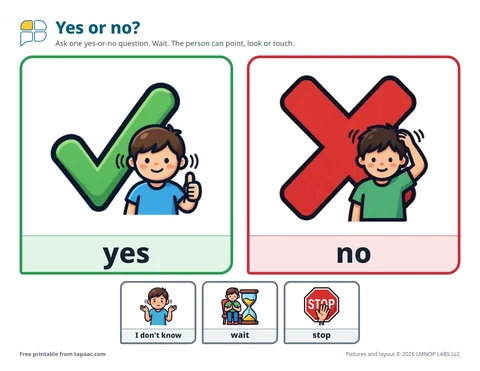
- Find a reliable signal. Ask the patient, or the family, how the patient shows yes and no: a nod, a blink, a thumbs up, a squeeze of the hand. Check it with two questions you know the answers to.
- Write it where everyone sees it: on the whiteboard, on a bedside sign, in the care plan. Each new shift shouldn’t have to work it out again.
- Check it again when things change. In acute care, a patient’s physical, thinking and language abilities can change with medication side effects, pain, alertness and how ill they are.1
Step-by-step bedside tips, and how to ask about pain with a scale, are on our hospital communication board page.
If the patient has their own AAC
Some patients arrive with a communication board, a speech app or a speech device, and people who use AAC should always have access to it.1 In practice:
- Keep it within reach and usable from the bed. Positioning and access from a hospital bed are one of the known difficulties in acute care.1
- Ask the family to bring the charger, and plug it in at night.
- Don’t put it away to clear the table, and don’t send it home with visitors.
- Ask the patient or family for a two-minute demonstration, and for any written information the patient carries about how they communicate; access to personally held health information is one of the six strategies above.3
- Wait for the whole message. Typing or pointing takes longer than speech.
If the patient has nothing to use
A 2016 systematic review of 29 studies with awake, mechanically ventilated adults in intensive care noted that communication tools exist but are used infrequently. In the three studies of communication boards, boards improved communication and patient satisfaction but could be slow and limit what patients could say; in nine studies, computer-based AAC devices helped, with touch or eye and blink controls for patients who can’t move much. The authors advise combining methods, and the evidence was limited.4
- For very ill or drowsy patients, use a board with a few big choices, like the ICU communication board.
- For patients who can manage more, the hospital communication board adds feelings, questions and a letter page; the where does it hurt board has a body outline.
- For quick answers, a yes and no board; for spelling, the alphabet board; for patients who can only move their eyes, the eye gaze board.
- Ask whether your hospital has an AAC tool kit. Many acute care facilities have one, and the professional guidance encourages clinicians to consider creating one.1
Questions a patient can answer
| Instead of | Try |
|---|---|
| “How are you feeling?” | “Are you in pain?” Then: “Is it your chest? Your stomach? Somewhere else?” |
| “What do you need?” | “Do you need the toilet? A drink? To move? Something else?”, pointing to each on the board |
| “Do you want the blanket or the pillow?” | One thing per question: “Do you want the blanket?” |
| Asking the family “Is he in pain?” | Asking the patient first, then checking with the family |
| Guessing the end of a spelled word and moving on | Saying your guess and waiting for yes: “C-O-L… cold? You’re cold?” |
Offer “something else” whenever you give choices, so the patient isn’t trapped by your guesses, and read back every answer before acting on it.
After a stroke
Aphasia affects language: understanding and expressing it, and reading and writing.5 The professional guidance stresses that language and thinking are separate, though overlapping, skills, and that the presence of aphasia doesn’t imply problems with thinking.6 Because reading can be affected too, a letter board may not work; try written key words, short spoken choices and pictures. Our guide to talking with someone who has aphasia has twelve tips, and AAC for adults explains aphasia, apraxia of speech and dysarthria.
Training, and the speech-language pathologist
In the SPEACS trial, in two intensive care units with 89 intubated patients and 30 nurses, nurses had basic communication skills training, then training in AAC tools plus consultation from a speech-language pathologist. Successful exchanges about pain were more frequent in both training groups than with usual care, and patients in the AAC and speech-language pathologist group used more AAC methods and less often rated communication as very difficult.7 A larger follow-up in six intensive care units trained 323 nurses: their knowledge, satisfaction and comfort in communicating rose, but care-quality measures such as restraint use, sedation and length of stay didn’t change.8
So ask for a speech-language pathologist early. Training doctors, nurses and other staff in AAC is one of the roles the professional guidance gives them.1
Handover, transfers and discharge
- Hand over how the patient communicates as you would any other care need: the yes and no signal, the tools, what works.
- Send the board or device with the patient to scans, procedures and other units.
- At discharge, check that the patient’s own AAC and charger go home with them, and that a follow-up with a speech-language pathologist is in the plan if they need one.
The law, briefly (US)
The Americans with Disabilities Act requires state and local government services, and businesses and nonprofits that serve the public, to communicate effectively with people who have speech, hearing or vision disabilities. That includes companions, such as a family member hospital staff need to talk with. For people with speech disabilities, the US Department of Justice gives examples: a qualified speech-to-speech transliterator, paper and pencil, or simply allowing more time to communicate with someone who uses a communication board or device.9 This is general information, not legal advice.
Try this today
- Check that every patient who can’t speak has a yes and no signal written where staff can see it.
- Find out whether your unit has communication boards or an AAC kit, and where it is kept.
- Print the ICU and hospital boards, and keep copies in sheet protectors.
- Add “how the patient communicates” to your handover.
More AAC guides
- AAC for adults: after a stroke, with ALS or MND, and in the hospitalAfter a stroke, with ALS or MND, and in the hospital: what helps, and when to plan.
- How to talk with someone who has aphasia: 12 tips for family and friendsTwelve tips for family and friends, easier questions, and what to do when you’re stuck.
- Using a communication board in the hospitalOn the hospital board’s page: yes and no, asking about pain, and spelling with a patient who can’t speak.
- Using an eye gaze boardOn the eye gaze board’s page: spelling with the eyes, and partner-assisted scanning, step by step.
- AAC in an emergency: a plan, a card, and tips for first respondersTexting 911, an “I use AAC” card, a charged device and a paper backup, and tips for responders.
Sources
We read each of these on October 13, 2026. Numbers in the text point to them.
- American Speech-Language-Hearing Association. Augmentative and Alternative Communication (Practice Portal). Professional guidance for speech-language pathologists. Accessed October 12, 2026.
- Bartlett G, Blais R, Tamblyn R, Clermont RJ, MacGibbon B (2008). Impact of patient communication problems on the risk of preventable adverse events in acute care settings. CMAJ, 178(12), 1555–1562. Abstract on PubMed.
- Hemsley B, Balandin S (2014). A metasynthesis of patient-provider communication in hospital for patients with severe communication disabilities: informing new translational research. Augmentative and Alternative Communication, 30(4), 329–343. Abstract on PubMed.
- Ten Hoorn S, Elbers PW, Girbes AR, Tuinman PR (2016). Communicating with conscious and mechanically ventilated critically ill patients: a systematic review. Critical Care, 20(1), 333. Abstract on PubMed.
- National Institute on Deafness and Other Communication Disorders (NIH). Aphasia. Last updated April 16, 2025.
- American Speech-Language-Hearing Association. Aphasia (Practice Portal). Professional guidance for speech-language pathologists. Accessed October 12, 2026.
- Happ MB, Garrett KL, Tate JA, DiVirgilio D, Houze MP, Demirci JR, George E, Sereika SM (2014). Effect of a multi-level intervention on nurse-patient communication in the intensive care unit: results of the SPEACS trial. Heart & Lung, 43(2), 89–98. Abstract on PubMed.
- Happ MB, Sereika SM, Houze MP, Seaman JB, Tate JA, Nilsen ML, et al. (2015). Quality of care and resource use among mechanically ventilated patients before and after an intervention to assist nurse-nonvocal patient communication. Heart & Lung, 44(5), 408–415. Abstract on PubMed.
- U.S. Department of Justice, ADA.gov. ADA Requirements: Effective Communication. Accessed October 13, 2026.
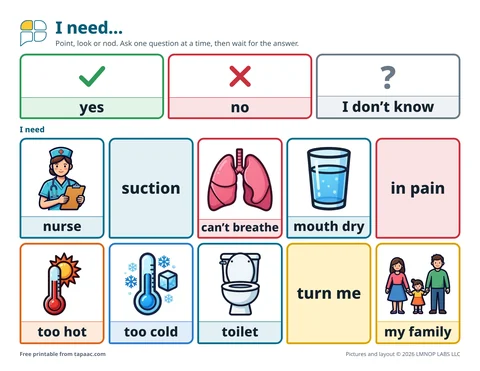 ICU communication board
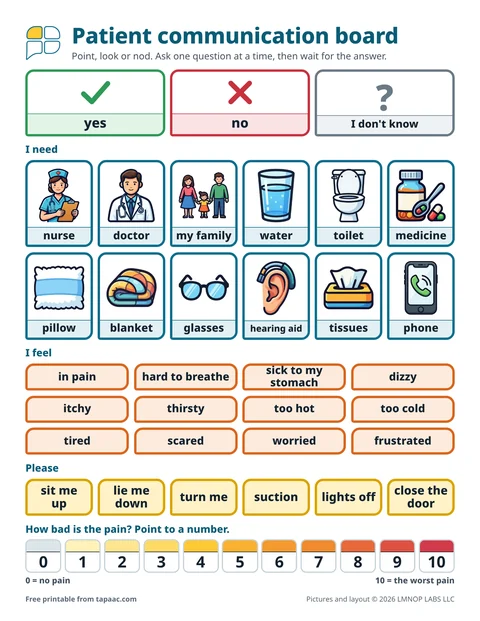 Hospital communication board
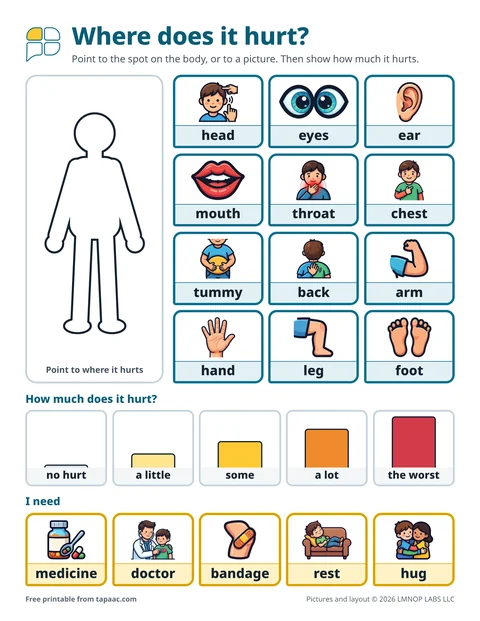 Where does it hurt board
 Yes and no board