 Tap AAC
Fire drill visual schedule: free printable for school
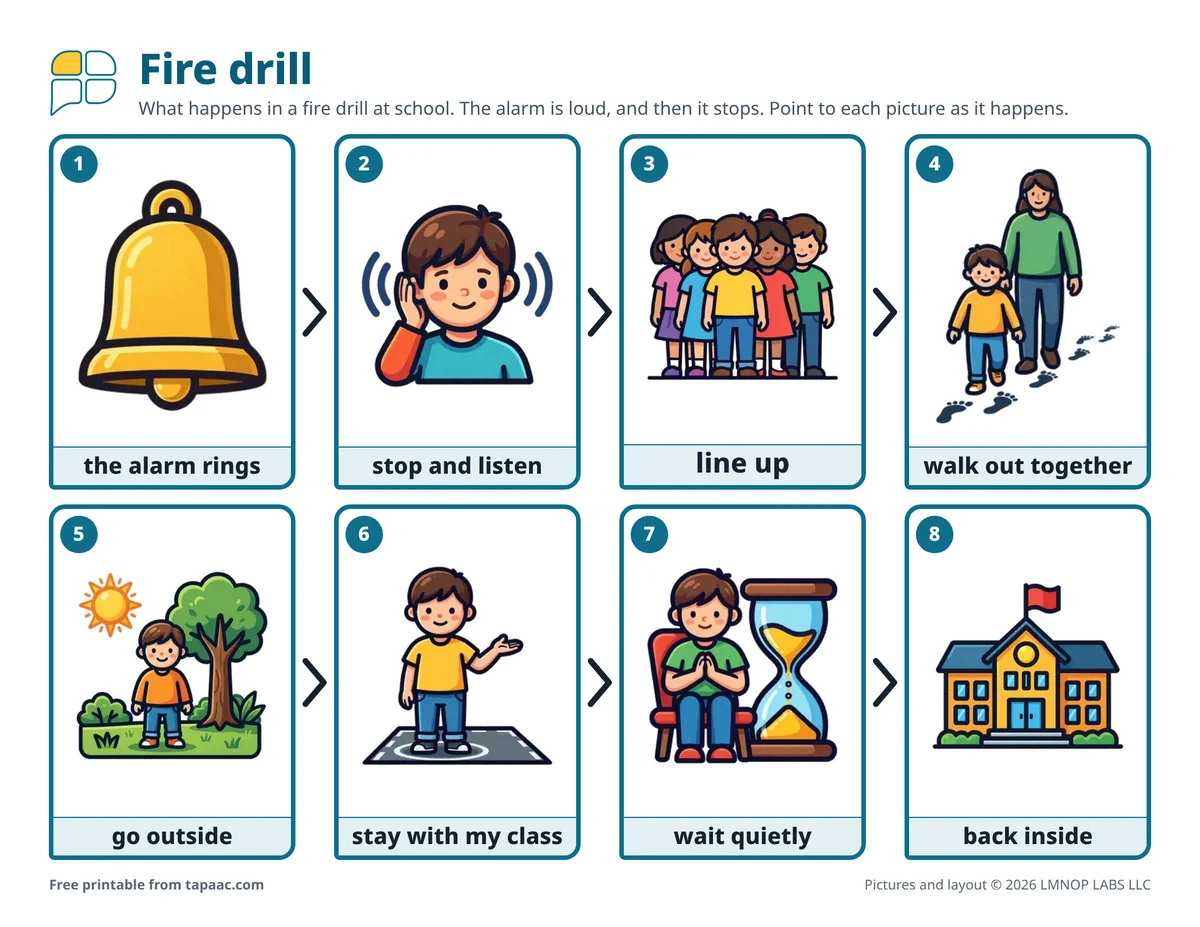
A fire drill visual schedule shows a student, in pictures, what happens in a school fire drill before the alarm ever rings: the alarm rings, stop and listen, line up, walk out together, go outside, stay with my class, wait quietly, back inside. This free PDF has those eight steps, a board with words and what helps during the drill, and a drill plan to fill in with the teacher. There are no pictures of fire or smoke.
Download the free PDF US Letter, 3 pages, 1,278 KB
Printing on A4 paper? Download the A4 PDF (3 pages, 1,279 KB). Or pick one page shape for every page:
Portrait (tall page, 3 pages): US Letter PDF (1,278 KB) · A4 PDF (1,279 KB)
Landscape (wide page, 3 pages): US Letter PDF (1,279 KB) · A4 PDF (1,280 KB)
Edit this board in the free board maker: change the words and pictures, then print.
Have Tap AAC? Add to Tap AAC (.obz file, 933 KB) · How to add a board
- Free
- No sign-up
- Print as many as you need
Who it’s for
Students who find fire drills hard: the sudden, very loud alarm, leaving in the middle of something, a crowded hallway, and waiting outside without knowing when it ends. That includes some autistic students, students who are very sensitive to noise, and students who don’t speak or don’t speak much and can’t ask what’s happening. Teachers, aides and parents can all use it.
Calm, plain pictures
A drill is practice, and the schedule treats it that way. It has no pictures of fire, smoke or fire trucks: a bell for the alarm, a line of classmates, the schoolyard, and the school to go back into. It says what happens, in order, and it shows that the drill ends. A student who is scared of fire can learn the steps without looking at the thing that scares them.
How to use it
- Teach the steps on a calm day, far from any drill. Walk the real route together and point to each picture as you go: “Line up. Walk out together. Go outside.”
- Get to know the sound, a little at a time. Some students do better after hearing a recording of the alarm quietly first, with headphones within reach and a way to say stop.
- Fill in the plan on page 3 with the teacher, and keep a copy in the folder for substitute teachers.
- Ask the school whether the student can be told before a planned drill, and where to keep the headphones so they can be grabbed on the way out.
- On the day, point to each step as it happens. Afterwards, look at How did it go? together, and celebrate I did it! whatever happened in between.
The drill plan
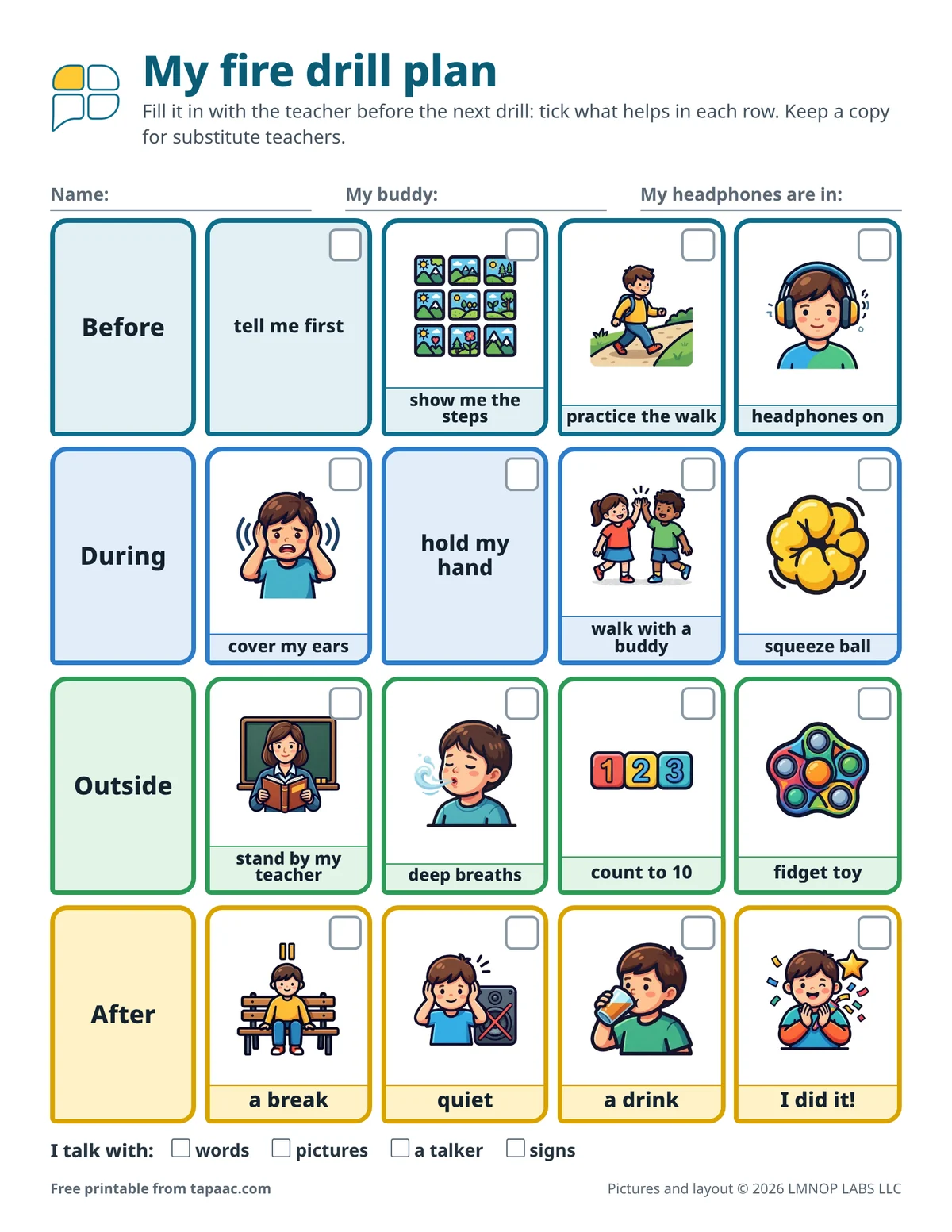
Every student’s plan is different. One needs headphones on before the alarm; another needs a buddy to walk with, or to be told first. The plan has four rows: before, during, outside and after. Tick what helps in each one, and write the buddy’s name and where the headphones are kept. The last line says how the student talks: with words, pictures, a talker or signs. Give a copy to every adult who might be with the student in a drill: the teacher, the aide, the specials teachers and substitutes.
Other drills
Schools practice other drills too. The same way of working fits any of them: the steps in pictures, practiced on a calm day, with a plan for what helps. Ask the school what its drills look like, then open this board with the “Edit this board” link above and change the pictures and words to match.
Eli is seven, and he used to run when the alarm rang. His class walked the route with the schedule on a quiet Monday, and his plan says headphones on, walk with a buddy and stand by my teacher. His headphones hang on a hook by the door. When the next drill comes, his teacher points to line up, and his buddy Sam walks out with him. Outside, Eli points to is it over? His teacher points to wait quietly: “Soon. Then back inside.” Back in class, Eli points to I did it!
What’s on the PDF
Fire drill steps
- the alarm rings
- stop and listen
- line up
- walk out together
- go outside
- stay with my class
- wait quietly
- back inside
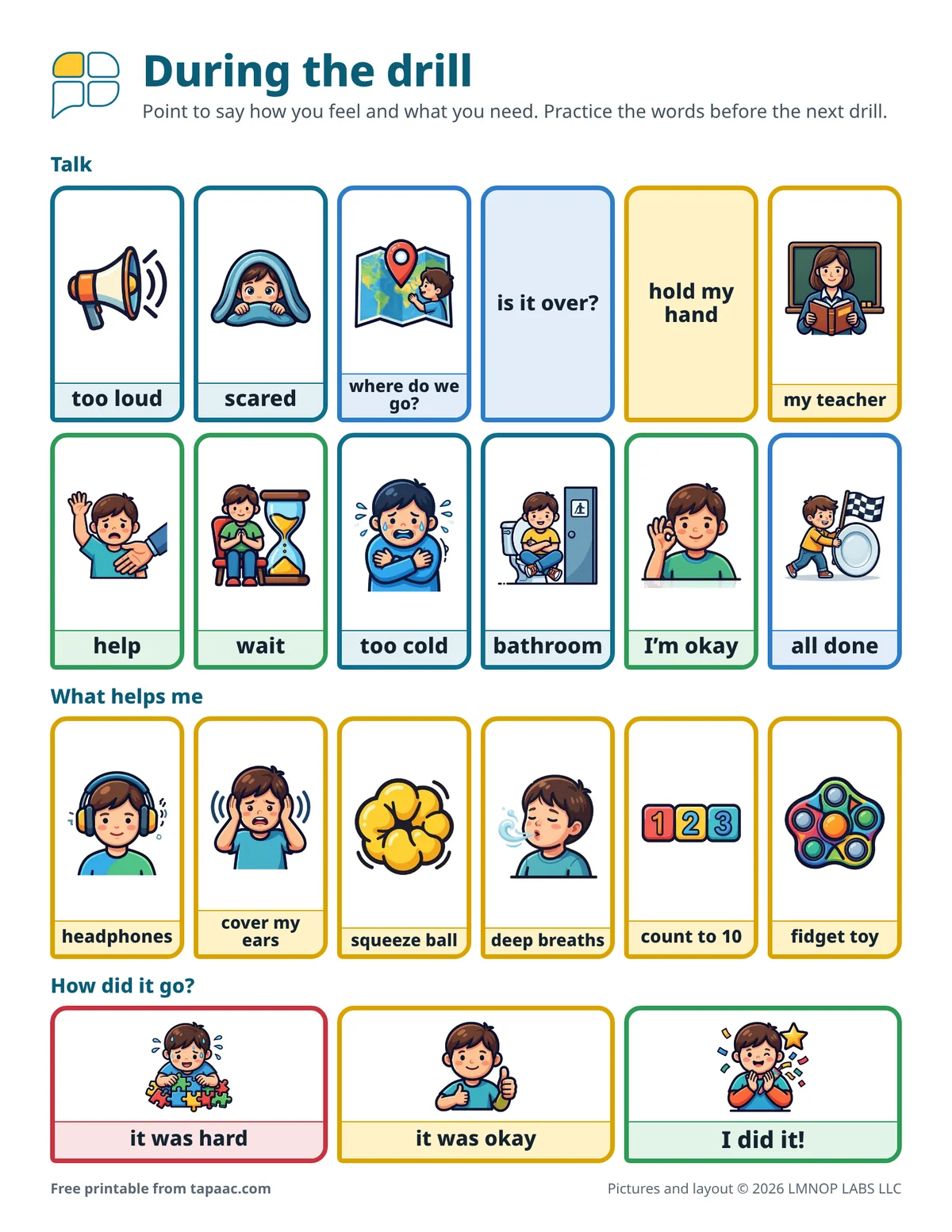
Talk
- too loud
- scared
- where do we go?
- is it over?
- hold my hand
- my teacher
- help
- wait
- too cold
- bathroom
- I’m okay
- all done
What helps me
- headphones
- cover my ears
- squeeze ball
- deep breaths
- count to 10
- fidget toy
How did it go?
- it was hard
- it was okay
- I did it!
My fire drill plan
- tell me first
- show me the steps
- practice the walk
- headphones on
- cover my ears
- hold my hand
- walk with a buddy
- squeeze ball
- stand by my teacher
- deep breaths
- count to 10
- fidget toy
- a break
- quiet
- a drink
- I did it!
Printing tips
- Post page 1 by the classroom door at the student’s eye level, next to the school’s own map of the way out.
- Keep a small copy of page 2 with the headphones, or on a key ring, for the walk out.
- For after the drill, the calm down choices board and the break card; for the rest of the day, the classroom visual schedule.
- Planning with the school? AAC in the classroom: it’s a team job, AAC and autism: answers to common parent questions, and getting ready for changes with visual supports.
More free boards
-
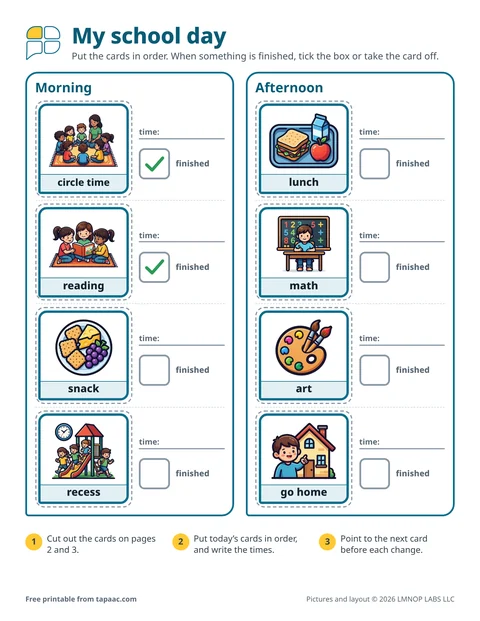 Classroom visual scheduleA school day schedule with times and tick boxes, and 38 picture cards from circle time to go home.
-
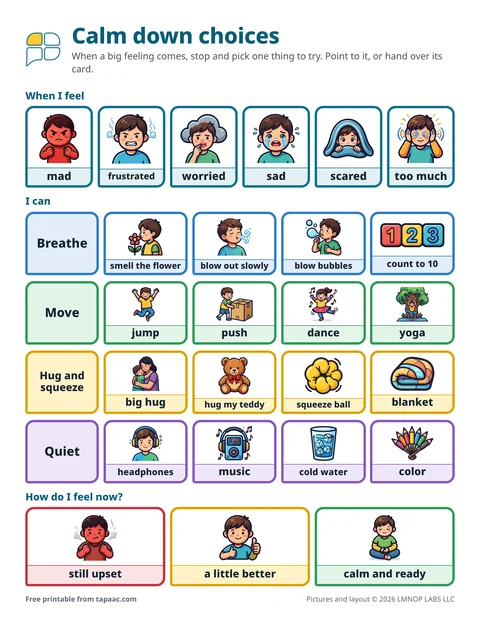 Calm down choices board16 calm down choices in four groups, a breathing square to trace, and calm down cards to cut out.
-
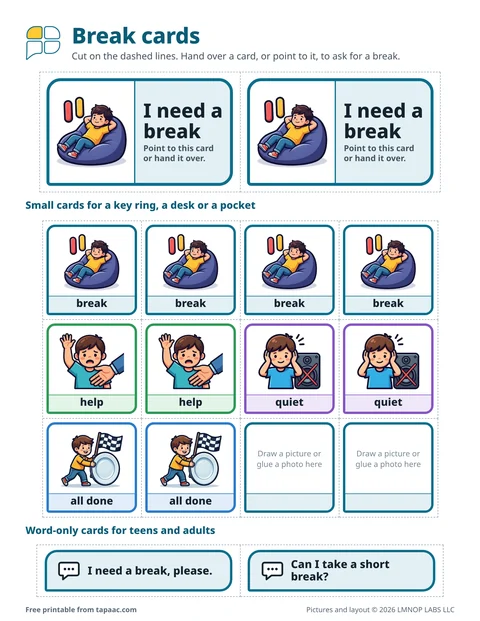 Break cards“I need a break” cards in three sizes, and a board of things to do on a break.
-
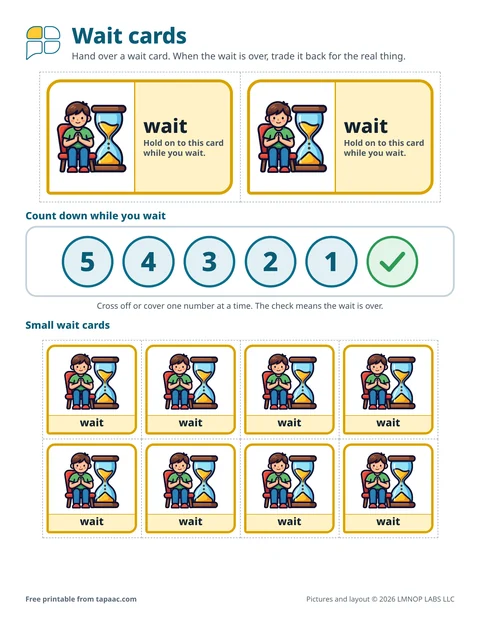 Wait cardsWait cards, a 5-to-1 countdown, and my turn and your turn cards with a Now and Next board.
Need a different board? Make your own with the free AAC board maker.
Making a schedule? Use the free visual schedule maker: routines ready to open and change.
These boards and guides are general information, not therapy or medical advice, and they don’t replace a speech therapist. A speech therapist who knows the person can help choose the right words, pictures and layout. The boards are free to print and share; please don’t sell them (terms of use). Questions about the boards? Email support@lmnoplabs.fun.