 Tap AAC
I feel sick communication board: free printable
An I feel sick communication board lets a child who doesn’t speak, or doesn’t speak much, show what’s wrong when they’re unwell: tummy ache, headache, I might throw up, sore throat, hot, dizzy, and what they need: a bucket, bathroom, a drink, a cuddle. This free PDF has the board, with a row for how I feel now (better, the same, worse), and a page of sick cards for school to hand to a teacher or the nurse.
Download the free PDF US Letter, 2 pages, 1,069 KB
Portrait (tall page, 2 pages): US Letter PDF (1,069 KB) · A4 PDF (1,070 KB)
Landscape (wide page, 2 pages): US Letter PDF (1,069 KB) · A4 PDF (1,069 KB)
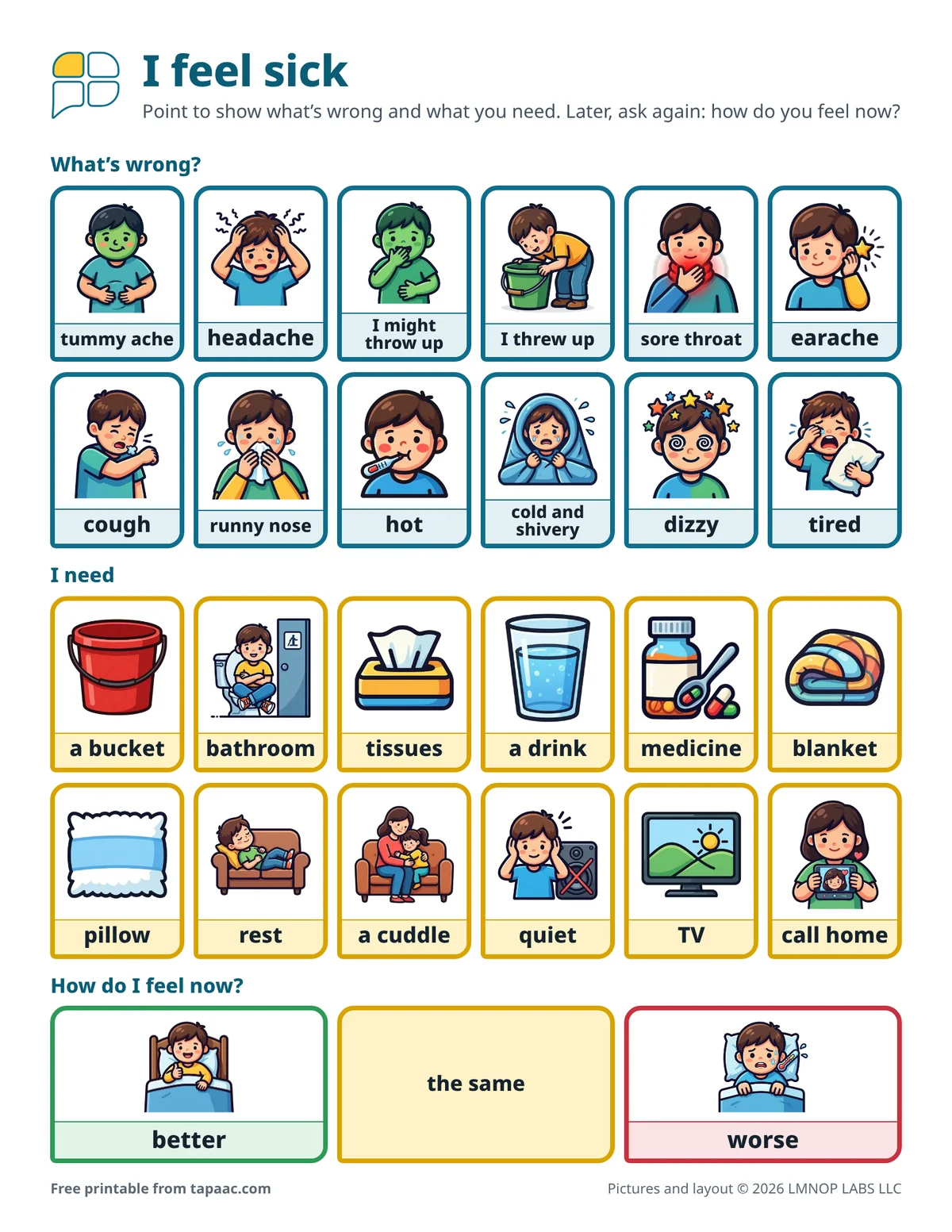
Edit this board in the free board maker: change the words and pictures, then print.
Have Tap AAC? Add to Tap AAC (.obz file, 967 KB) · How to add a board
- Free
- No sign-up
- Print as many as you need
Who it’s for
Children who can’t easily say they feel unwell: children who don’t speak or don’t speak much, children whose talker has no words for being sick on its first page, and children who find it hard to notice or name what they feel inside. Parents can use it at home; teachers, aides and school nurses at school.
How to use it
- Teach it on a well day. Go through the pictures together, and use them about yourself: “When I have a headache, my head hurts here.”
- Keep it where being sick happens: by the bed, in the car, in the school bag.
- When your child seems unwell, bring the board and ask one question at a time: “Does your tummy hurt?” Point to tummy ache, and wait.
- Then ask what would help, from the I need rows.
- Ask again later with How do I feel now?: better, the same or worse. It shows you whether things are changing.
How it’s different from the where does it hurt board
The where does it hurt board is for pain: a body outline to point at, and a scale for how much it hurts. This board is for being sick: throwing up, a sore throat, feeling hot or shivery, dizzy or tired, and what helps when you’re unwell. Use them together when a child is sick and hurting.
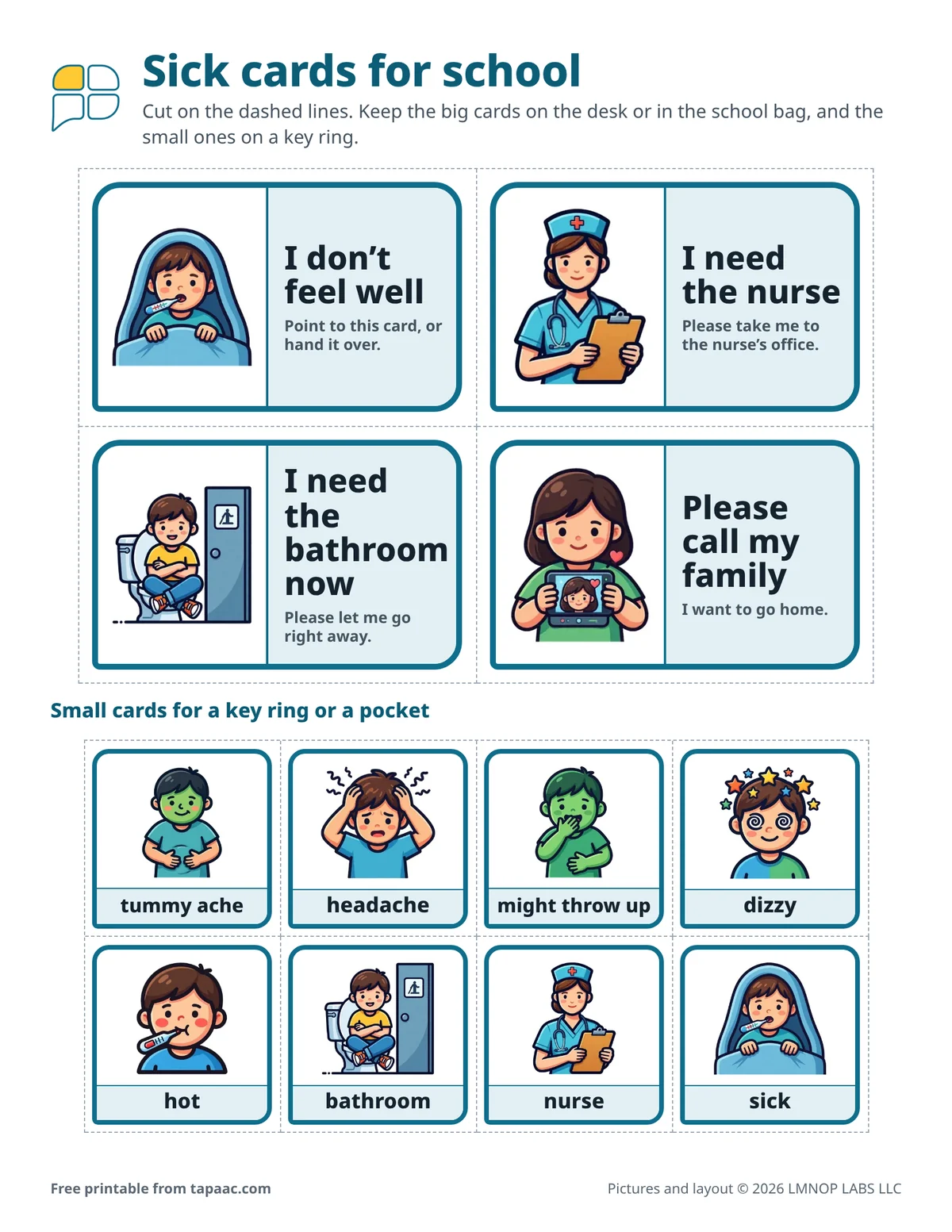
Sick cards for school
At school, a child who feels unwell needs a quick way to tell whoever is nearby. Page 2 has four big cards, I don’t feel well, I need the nurse, I need the bathroom now and Please call my family, and eight small ones for a key ring. Show the cards to the teacher, the aide and the school nurse, and agree on what happens when a card is handed over.
Not medical advice
This board helps a child tell you how they feel. It isn’t medical advice, and it doesn’t replace a doctor or nurse. Only a grown-up gives medicine, as the label or the doctor says. If you’re worried, call the doctor or nurse. In an emergency, call 911 or your local emergency number.
Lily is seven and has a talker, but its first page has no words for feeling sick. At school one morning she goes quiet and puts her head on the desk. Her aide brings the sick cards, and Lily hands over I don’t feel well. On the small cards she points to tummy ache, then might throw up, and the aide takes her to the nurse’s office. The nurse shows her the big board, and Lily points to a bucket, then rest. An hour later the nurse asks, “How do you feel now?” Lily points to better.
What’s on the PDF
What’s wrong?
- tummy ache
- headache
- I might throw up
- I threw up
- sore throat
- earache
- cough
- runny nose
- hot
- cold and shivery
- dizzy
- tired
I need
- a bucket
- bathroom
- tissues
- a drink
- medicine
- blanket
- pillow
- rest
- a cuddle
- quiet
- TV
- call home
How do I feel now?
- better
- the same
- worse
Sick cards for school
- I don’t feel well
- I need the nurse
- I need the bathroom now
- Please call my family
Small cards
- tummy ache
- headache
- might throw up
- dizzy
- hot
- bathroom
- nurse
- sick
Printing tips
- Laminate it: it will need wiping.
- Make a copy for the school nurse’s office, and one for the grandparents or the babysitter.
- For pain, the where does it hurt board; for a visit, the doctor visit visual schedule; for everyday needs, the needs board.
- Sick cards only help if they’re close by when it happens: keep it with the student, all day. Need words that aren’t here? How to make a communication board walks you through adding your own.
More free boards
-
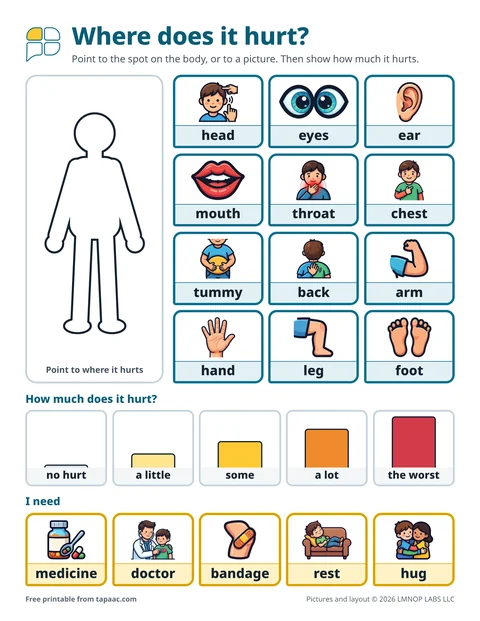 Where does it hurt boardA body outline, 12 body parts and a simple scale for how much it hurts.
-
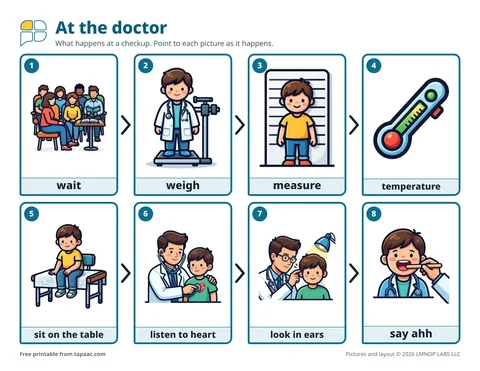 Doctor visit visual scheduleWhat happens at a checkup, words to talk to the doctor, and 20 cards for any visit.
-
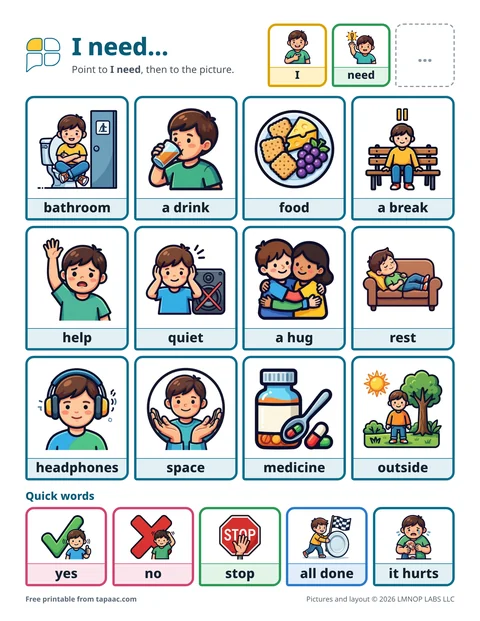 Needs boardBathroom, a drink, food, a break, help, quiet and more, with yes, no and stop.
-
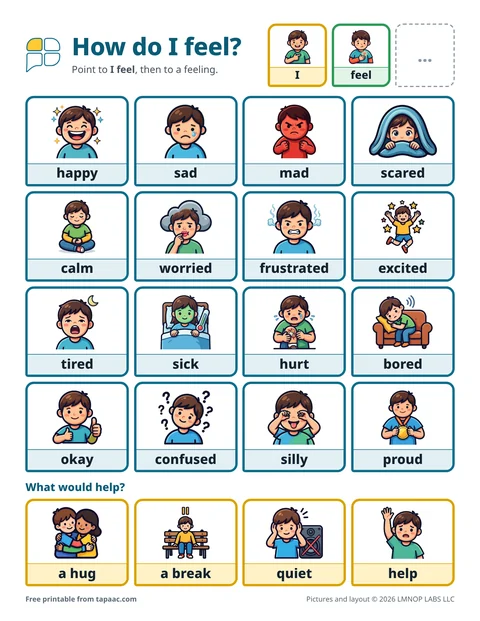 Feelings board16 feelings, from happy and calm to mad and worried, plus what would help.
Need a different board? Make your own with the free AAC board maker.
These boards and guides are general information, not therapy or medical advice, and they don’t replace a speech therapist. A speech therapist who knows the person can help choose the right words, pictures and layout. The boards are free to print and share; please don’t sell them (terms of use). Questions about the boards? Email support@lmnoplabs.fun.