 Tap AAC
ICU communication board: free large-print printable
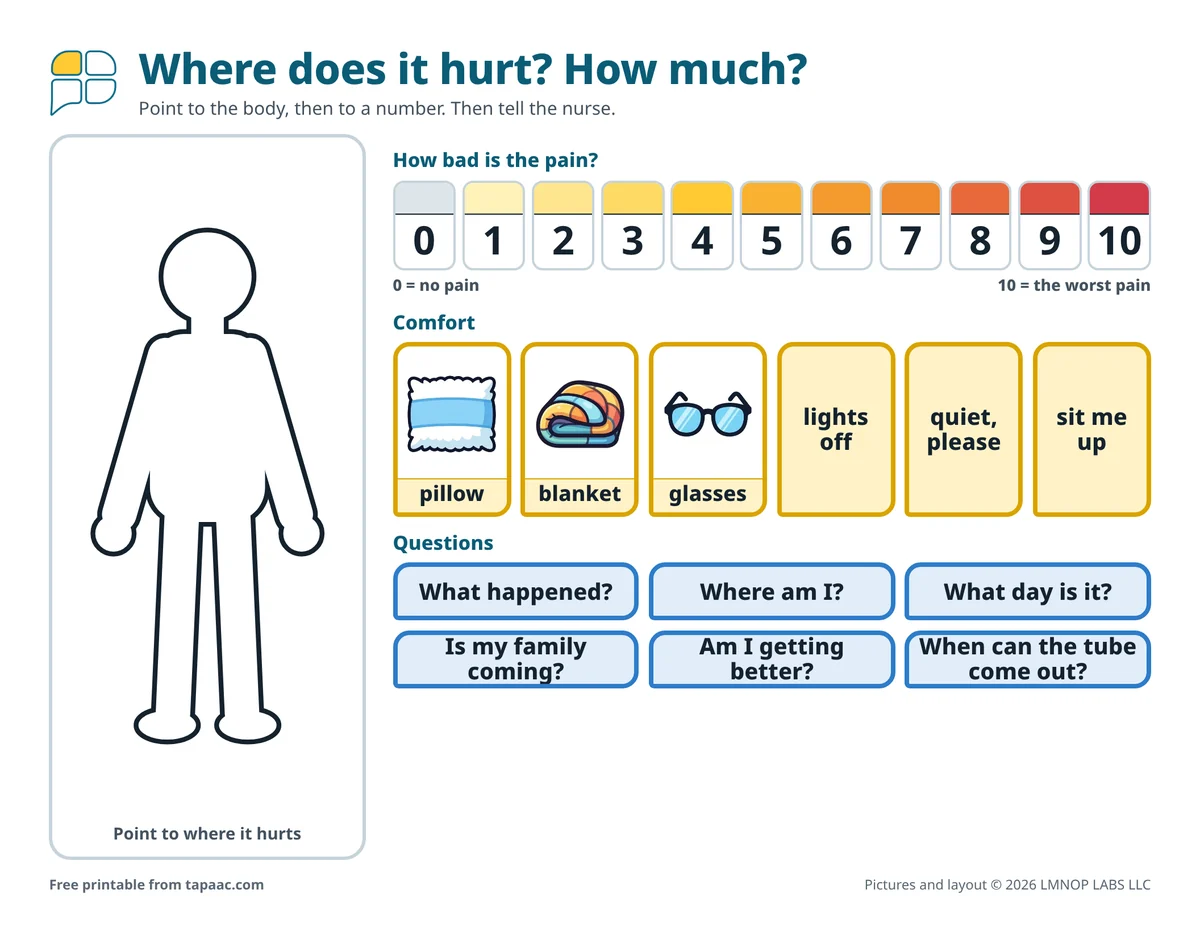
In intensive care, a patient may be awake but unable to speak: because of a breathing tube, weakness or exhaustion. This free ICU communication board is made for that moment, with very few, very large choices that a tired patient can point to or look at: yes, no, I don’t know, and ten needs like nurse, suction, can’t breathe, in pain and turn me. Page 2 has a body outline, a 0 to 10 pain scale, comfort requests and six questions.
Download the free PDF US Letter, 2 pages, 348 KB
Portrait (tall page, 2 pages): US Letter PDF (350 KB) · A4 PDF (349 KB)
Landscape (wide page, 2 pages): US Letter PDF (348 KB) · A4 PDF (348 KB)
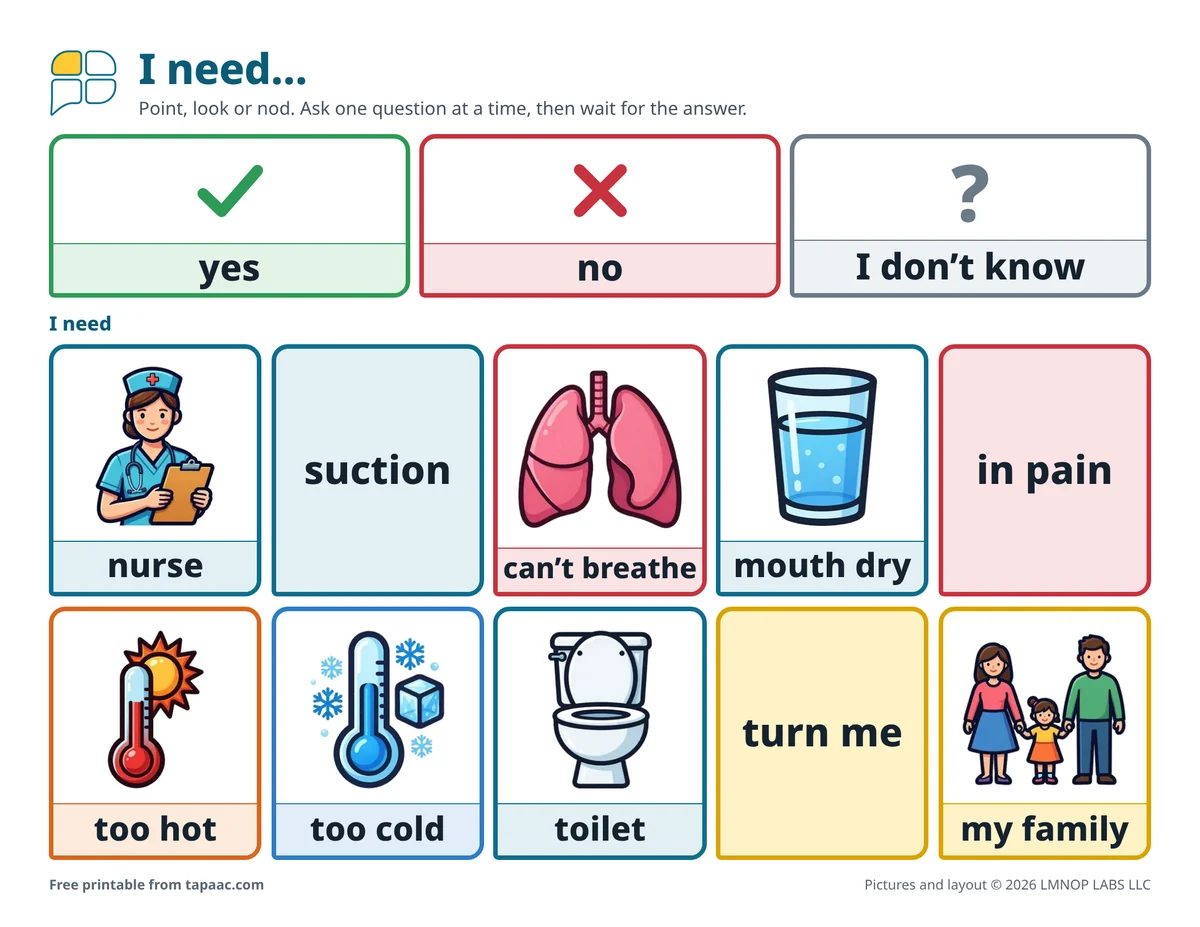
Edit this board in the free board maker: change the words and pictures, then print.
Have Tap AAC? Add to Tap AAC (.obz file, 282 KB) · How to add a board
- Free
- No sign-up
- Print as many as you need
If the patient points to can’t breathe, or seems to be in distress, call the nurse straight away. Outside the hospital, call 911 or your local emergency number.
Who it’s for
Patients in an intensive care or high-dependency unit who are awake but can’t speak, for example with a breathing tube or a tracheostomy, and the family members and staff at the bedside. It’s different from our hospital communication board: that one has more words and a letter page, for patients who can manage a busier board. This one has far fewer, far bigger choices, for patients who are very weak, drowsy or can only point roughly.
How to use it at the bedside
- Ask the nurse first. Check it’s a good moment, and whether the patient can see without glasses.
- Hold the board close and still, where the patient can see it and reach it, or look at it.
- Start with yes and no. “Can you show me yes?” Then ask one question at a time and wait.
- Read back what they chose. “You pointed to mouth dry. I’ll tell the nurse.” Don’t give food or drink without asking the nurse.
- Keep it short. A few questions, then let the patient rest. Come back later.
Where it hurts, and how much
Ask first: “Are you in pain?” If yes, the patient points to the body outline on page 2, or you point and they say yes. Then move your finger slowly along the 0 to 10 scale and let them stop you. Tell the nurse in the patient’s words: “He pointed to his chest, and to 6.” The nurse decides what happens next.
For family at the bedside
Being with someone who can’t talk is hard for the visitor too. The board gives you something to do: ask whether they are comfortable, too hot or too cold, and whether they want the lights off. The questions on page 2 are ones that are hard to ask without a voice, like What happened? and Is my family coming? If you don’t know the answer, say so, and ask the nurse together.
Daniel is awake after his operation, with a breathing tube in. He’s restless. His sister holds up the board. He moves his hand to too hot. She tells the nurse, who takes off a blanket. Later he points to the questions on page 2: When can the tube come out? His sister asks the nurse, and she comes over to explain it to Daniel herself.
What’s on the board
Page 1
- yes
- no
- I don’t know
- nurse
- suction
- can’t breathe
- mouth dry
- in pain
- too hot
- too cold
- toilet
- turn me
- my family
Page 2
- body outline
- pain 0 to 10
- pillow
- blanket
- glasses
- lights off
- quiet, please
- sit me up
- What happened?
- Where am I?
- What day is it?
- Is my family coming?
- Am I getting better?
- When can the tube come out?
Printing and cleaning
- Print each page on its own sheet, sideways, and put it in a sheet protector or laminate it, so it can be wiped. Follow the unit’s cleaning rules.
- Ask the nurse before bringing anything into the unit; some units have their own boards or rules.
- When the patient is ready for more words, move on to the hospital communication board, which has a letter page for spelling.
- Ask whether a speech-language pathologist can see the patient. They can help find the best way to communicate.
For the time after intensive care, read AAC for adults: after a stroke, with ALS or MND, and in the hospital. Nurses and care staff: how to communicate with nonverbal patients covers yes and no signals, questions a patient can answer, and handover between shifts.
More free boards
-
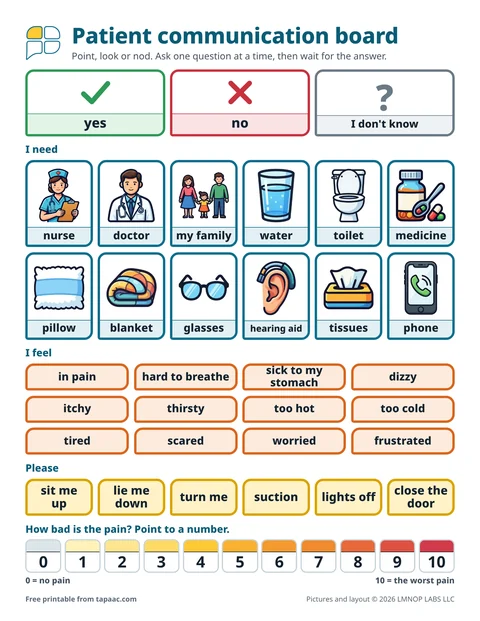 Hospital communication boardFor adult patients: needs, feelings, a 0 to 10 pain scale, letters and questions.
-
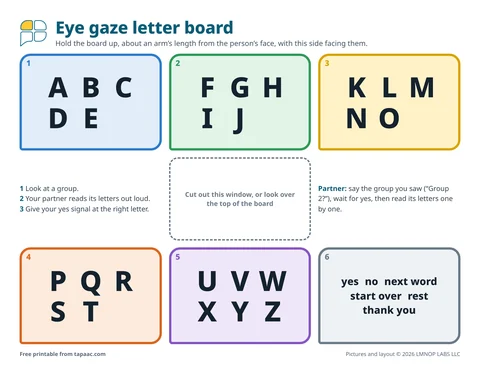 Eye gaze boardSpell with the eyes: a six-group letter board, and a partner scanning board for when looking is hard.
-
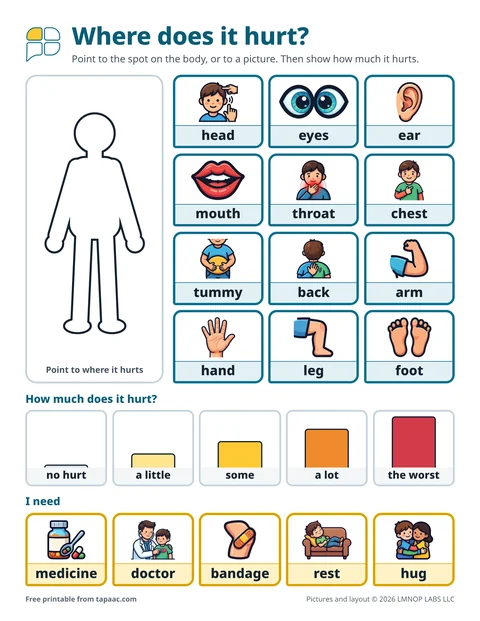 Where does it hurt boardA body outline, 12 body parts and a simple scale for how much it hurts.
-
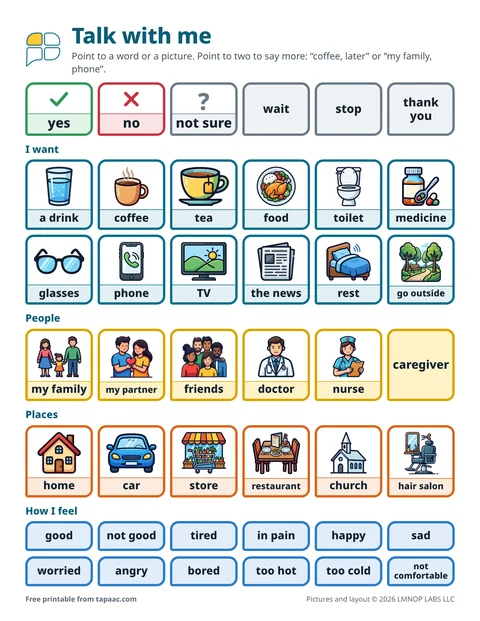 Communication board for adultsGrown-up pictures and plain words: wants, people, places, feelings, and a keyboard page for spelling.
Need a different board? Make your own with the free AAC board maker.
These boards and guides are general information, not therapy or medical advice, and they don’t replace a speech therapist. A speech therapist who knows the person can help choose the right words, pictures and layout. The boards are free to print and share; please don’t sell them (terms of use). Questions about the boards? Email support@lmnoplabs.fun.