 Tap AAC
Care home communication board for residents: free printable
A care home communication board helps a resident who finds talking hard tell staff what they need (a cup of tea, toilet, my glasses, too cold) and say yes or no about their own care. This free PDF has a board of needs, comfort, personal care and feelings with grown-up pictures, and an About me page the resident and their family fill in, so every carer on every shift knows who the person is.
Download the free PDF US Letter, 2 pages, 1,196 KB
Portrait (tall page, 2 pages): US Letter PDF (1,196 KB) · A4 PDF (1,196 KB)
Landscape (wide page, 2 pages): US Letter PDF (1,197 KB) · A4 PDF (1,197 KB)
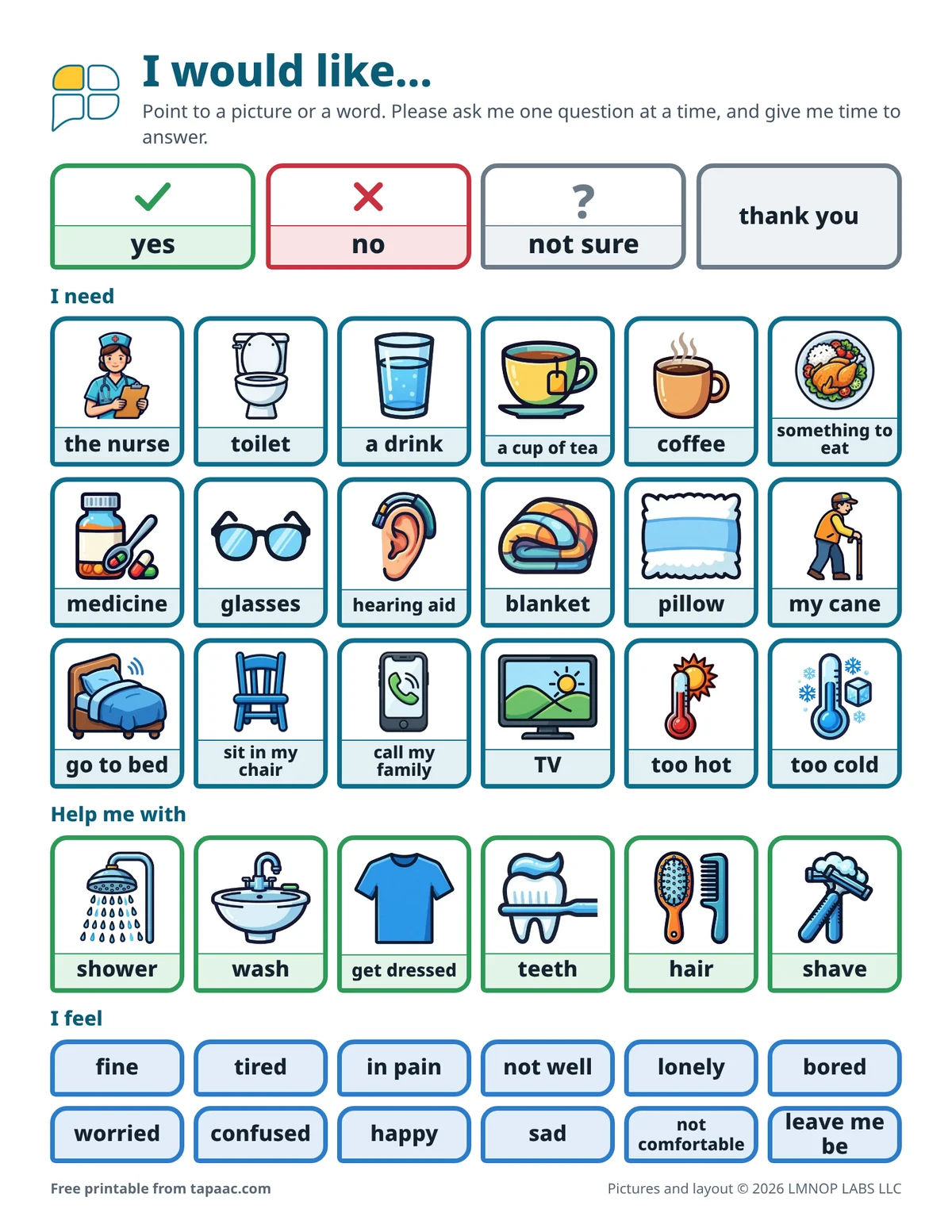
Edit this board in the free board maker: change the words and pictures, then print.
Have Tap AAC? Add to Tap AAC (.obz file, 1,115 KB) · How to add a board
- Free
- No sign-up
- Print as many as you need
If a resident may be hurt or unwell, follow the home’s procedures and tell the nurse in charge right away. In an emergency, call 911 or your local emergency number.
Who it’s for
Residents of nursing homes, care homes and assisted living who find speaking or understanding speech hard, for any reason: after a stroke, with dementia, with hearing loss, with Parkinson’s, or with a voice that’s too weak. It’s also for the care staff, activity staff and families who talk with them every day. It works at home too, with home care workers.
How to use it
- Fill in About me together, with the resident and their family, when they move in or when the board is first used.
- Keep the board within reach: by the bed, on the chair table, on the walker bag. Bring it to meals and activities.
- Ask before you help. Point to Help me with and ask: “Shower now, or later?” Wait for the answer.
- Ask one question at a time, face the person, and give them time to point.
- Respect the answer. Leave me be and no are answers too. Come back later and ask again.
- Pass it on. Show new staff, agency staff and visitors how the resident uses the board.
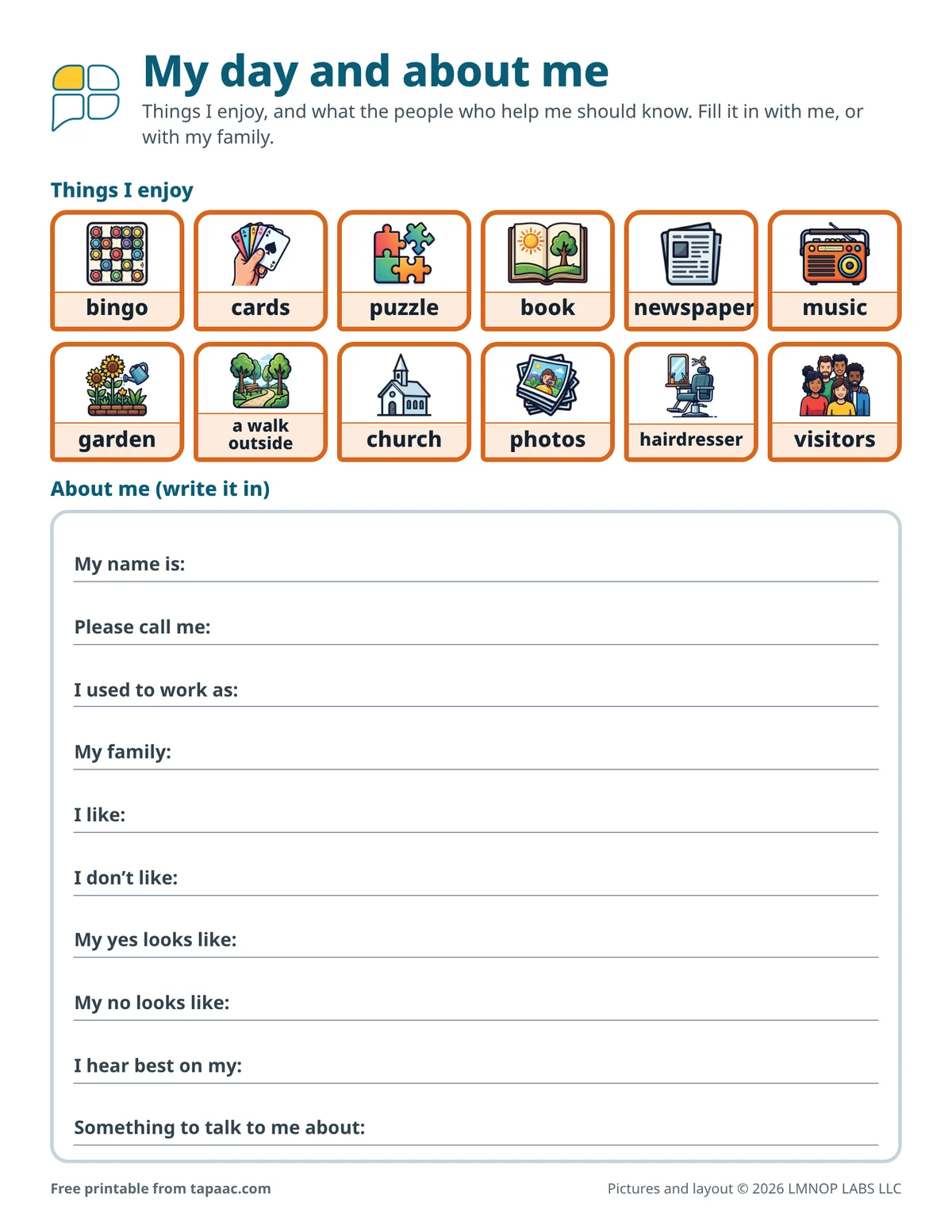
Why the About me page matters
Staff change between shifts, and agency staff may meet a resident for the first time. A page that says “Please call me Bill”, “I was a mail carrier for 30 years”, “I hear best on my left side” and “My yes is a thumbs up” gives every carer what they need to start a real conversation, not only a care task. Something to talk to me about is often the most useful line on it.
Things I enjoy
Page 2 also has 12 things to enjoy: bingo, cards, a puzzle, a book, the newspaper, music, the garden, a walk outside, church, photos, the hairdresser and visitors. Activity staff can use them to offer a choice. Families can use them to plan a visit.
Mrs. Okafor has been quiet all morning. A new carer starts her shift, reads the About me page, and says, “Good morning, Grace. I hear you used to teach.” Grace smiles. Later she points to too cold, then blanket. After lunch, she points to call my family. The carer helps her make the call.
What’s on the board
I need
- the nurse
- toilet
- a drink
- a cup of tea
- coffee
- something to eat
- medicine
- glasses
- hearing aid
- blanket
- pillow
- my cane
- go to bed
- sit in my chair
- call my family
- TV
- too hot
- too cold
Help me with
- shower
- wash
- get dressed
- teeth
- hair
- shave
I feel
- fine
- tired
- in pain
- not well
- lonely
- bored
- worried
- confused
- happy
- sad
- not comfortable
- leave me be
Printing tips
- Laminate both pages or use a sheet protector, and clean them the way the home cleans other shared items.
- Fill in About me with a permanent marker, and the changing details with a dry-erase marker.
- Swap my cane for a walker or a wheelchair by writing over it, and cross out what the person never needs.
- Ask whether a speech-language pathologist can see the resident. They can suggest the best way to communicate and changes to the board.
For more ways to communicate in later life, read AAC for adults: after a stroke, with ALS or MND, and in the hospital.
More free boards
-
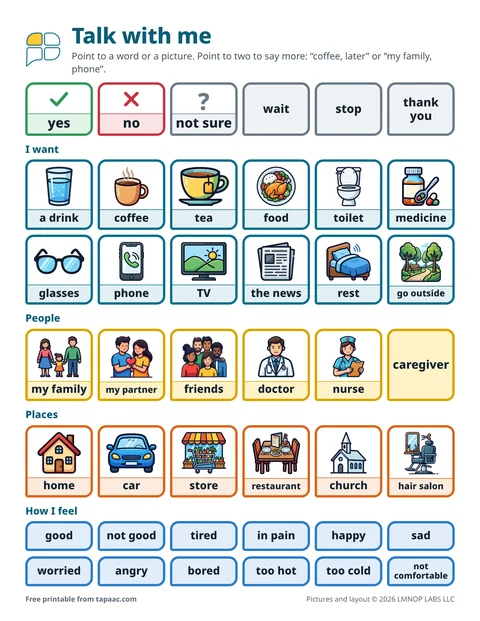 Communication board for adultsGrown-up pictures and plain words: wants, people, places, feelings, and a keyboard page for spelling.
-
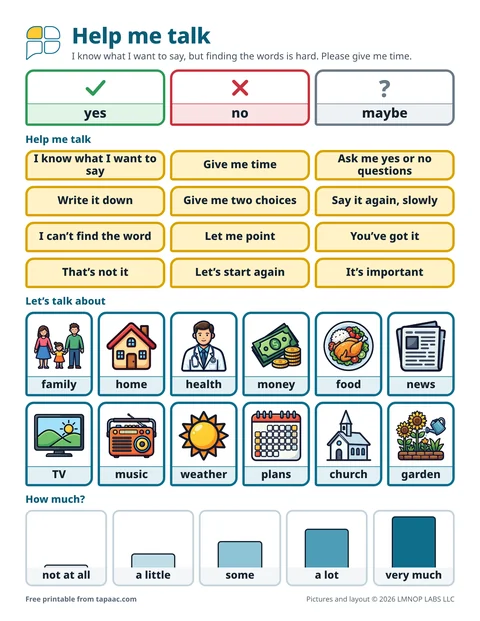 Aphasia communication boardHelp-me-talk phrases, topics and a how-much scale, plus a page for the conversation partner.
-
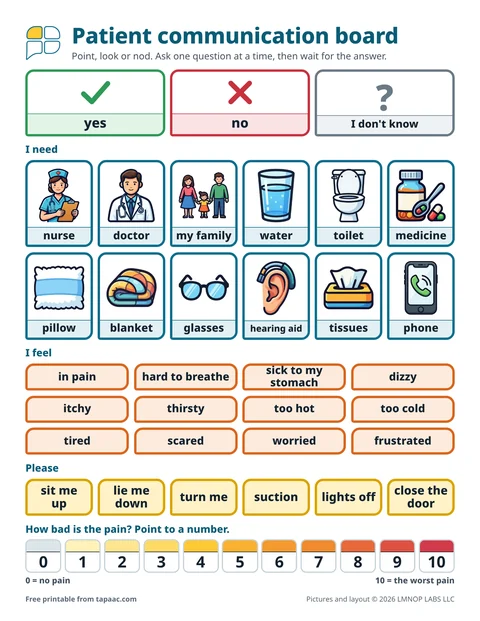 Hospital communication boardFor adult patients: needs, feelings, a 0 to 10 pain scale, letters and questions.
-
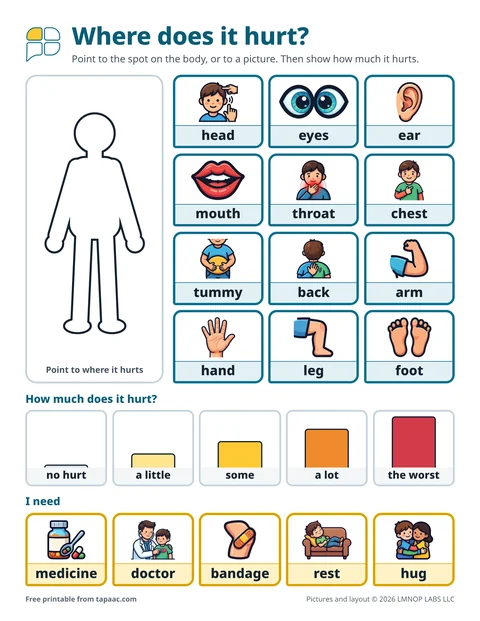 Where does it hurt boardA body outline, 12 body parts and a simple scale for how much it hurts.
Need a different board? Make your own with the free AAC board maker.
These boards and guides are general information, not therapy or medical advice, and they don’t replace a speech therapist. A speech therapist who knows the person can help choose the right words, pictures and layout. The boards are free to print and share; please don’t sell them (terms of use). Questions about the boards? Email support@lmnoplabs.fun.