 Tap AAC
Visual schedule for adults: free printable daily planner
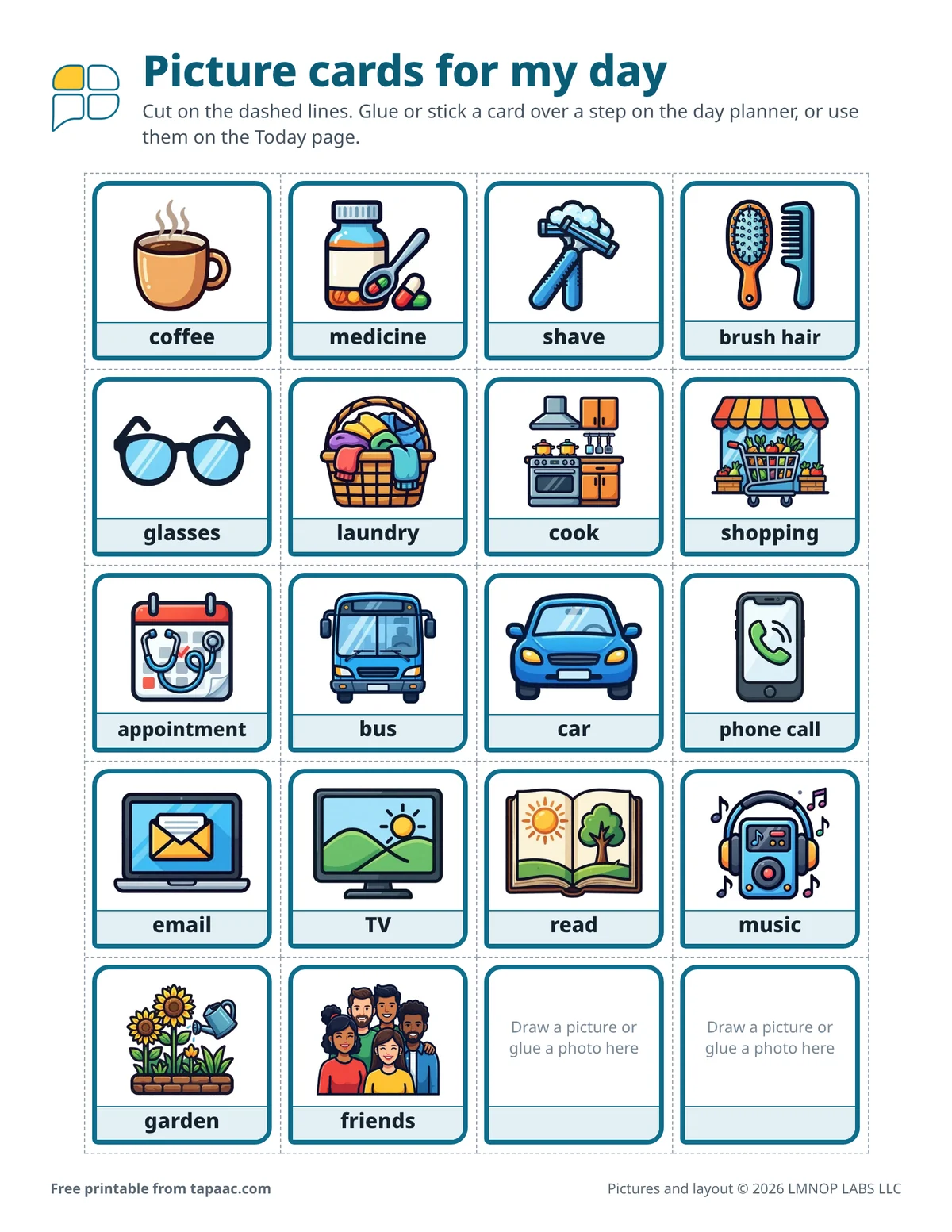
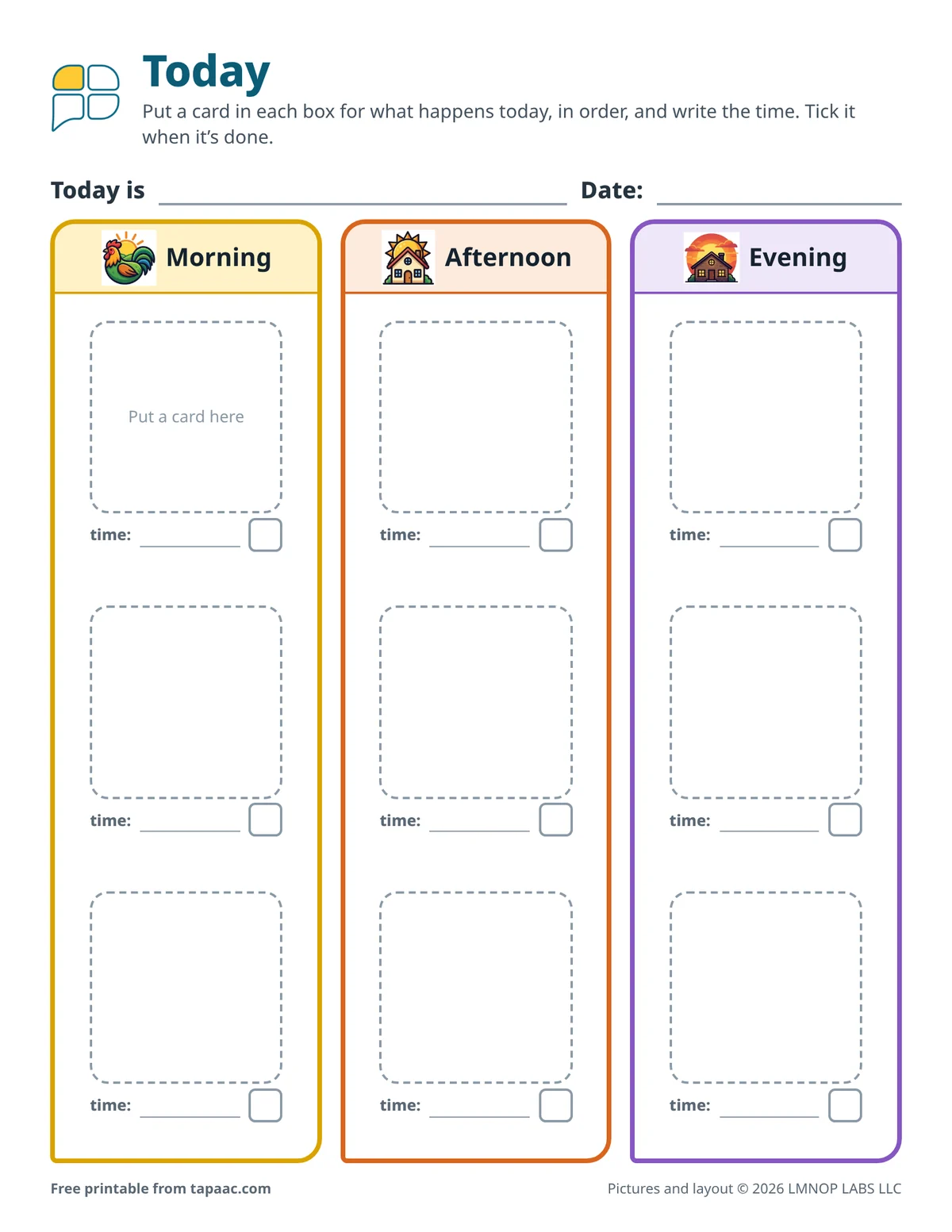
A visual schedule for adults shows the day in pictures and plain words, with no cartoon children: wake up, shower, get dressed, breakfast, go to work, lunch, relax, dinner, brush teeth and bed, each with a line for the time and a box to tick. This free PDF has that day planner, 18 picture cards for the rest of life (appointments, shopping, the bus, a phone call), and a Today page with the date and three slots each for morning, afternoon and evening.
Download the free PDF US Letter, 3 pages, 1,169 KB
Portrait (tall page, 3 pages): US Letter PDF (1,169 KB) · A4 PDF (1,168 KB)
Landscape (wide page, 3 pages): US Letter PDF (1,165 KB) · A4 PDF (1,168 KB)
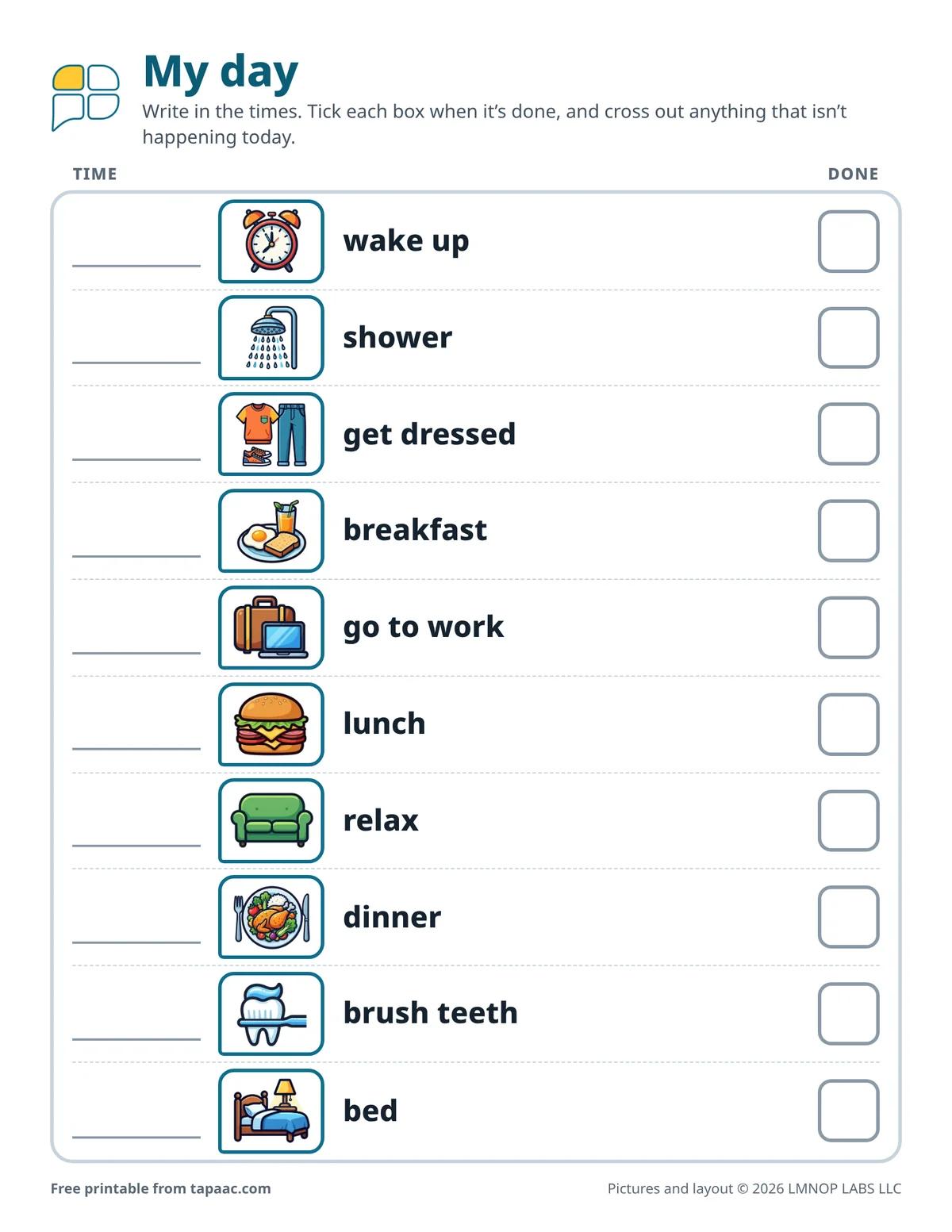
Edit this board in the free board maker: change the words and pictures, then print.
Have Tap AAC? Add to Tap AAC (.obz file, 920 KB) · How to add a board
- Free
- No sign-up
- Print as many as you need
Who it’s for
Adults who find it easier to follow the day in pictures than in words or in their head: autistic adults, adults with an intellectual disability, adults after a stroke or a brain injury, and people living with dementia. It’s also for the family, support workers and care staff who plan the day with them. Every picture is a thing, a place or a grown-up, not a cartoon child, so it looks right on the fridge of an adult’s home.
How to use it
- Plan it together. The schedule belongs to the person using it. Ask what they want on it, and how much: some people like every step, others only the times.
- Change the steps to fit the real day. Glue a card from page 2 over a step: appointment on Tuesdays, shopping on Fridays. Cross out what isn’t happening.
- Write the times in, as clock times or as “after lunch”, whichever is easier to follow.
- Keep it where the day starts, on the fridge, by the bed or in a folder, and tick each box when it’s done.
- Use the Today page for days that change, such as weekends, appointments or visits, and fill it in the night before.
A schedule that respects the person
An adult’s schedule is a tool for them, not a set of orders. Plan it with them, let them change it, and let them choose free time as well as tasks. Keep it in their own room or bag if they’d rather not have it on show. For someone who is autistic, read AAC for autistic adults; for someone living with dementia, communication aids for dementia covers picture cards and boards. A visual schedule isn’t medical advice: for medicines, follow the label and what the doctor or pharmacist says.
The same day in the schedule maker
The day planner is also a routine in the free visual schedule maker. Open “My day” in the schedule maker to change a step, put in photos of the person’s own home, workplace or bus stop, and print a fresh copy whenever the week changes.
Grace is 34 and autistic, and she works three mornings a week at a garden center. On Sunday evenings she and her sister fill in the Today page for Monday: coffee, bus and garden in the morning, phone call after lunch, music in the evening. Grace writes the times herself. On her days off she uses the day planner on the fridge, with go to work crossed out and the read card glued over it.
What’s on the PDF
My day
- wake up
- shower
- get dressed
- breakfast
- go to work
- lunch
- relax
- dinner
- brush teeth
- bed
Picture cards
- coffee
- medicine
- shave
- brush hair
- glasses
- laundry
- cook
- shopping
- appointment
- bus
- car
- phone call
- TV
- read
- music
- garden
- friends
Today
- Morning
- Afternoon
- Evening
Printing tips
- Laminate page 1 and write the times with a dry-erase marker, so they can change with the seasons or a new job.
- Print the Today page a week at a time and keep them in a folder or on a clipboard.
- For talking as well as planning, use the communication board for adults; in a care home, the care home communication board; after a stroke, the aphasia communication board.
- Thinking about a speech device as well? Read what an AAC evaluation is, and how to get an AAC device.
More free boards
-
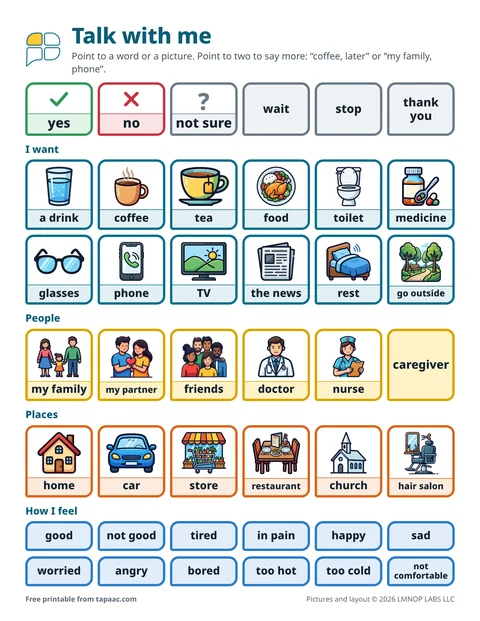 Communication board for adultsGrown-up pictures and plain words: wants, people, places, feelings, and a keyboard page for spelling.
-
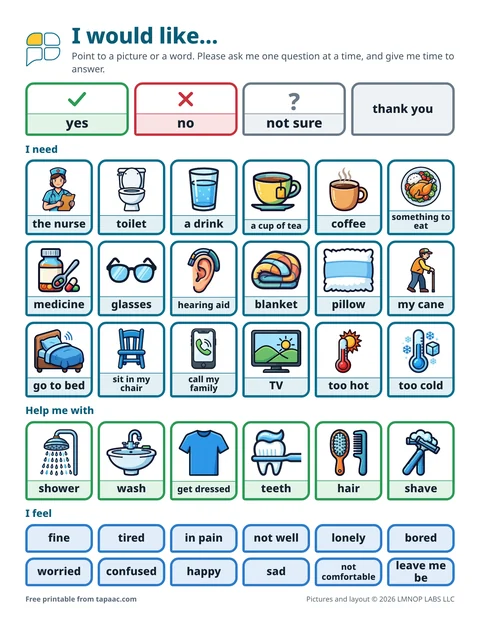 Care home communication boardNeeds and comfort for residents, things they enjoy, and an About me page for staff.
-
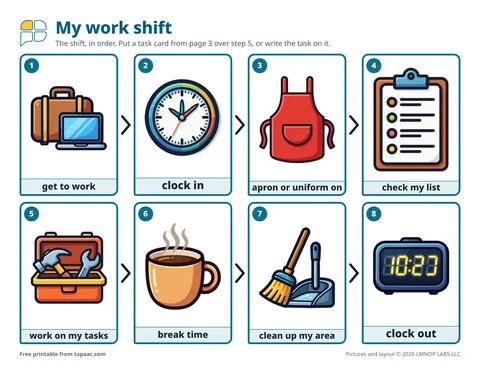 Work visual scheduleFor teens and adults: the steps of a work shift, a talk board for supervisors and coworkers, and 18 job task cards.
-
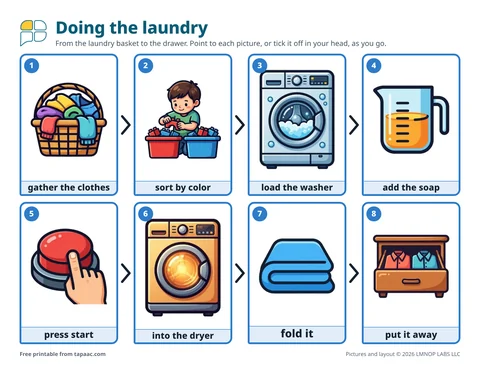 Laundry visual scheduleEight steps from the laundry basket to the drawer, folding steps for a towel and a T-shirt, and laundry words.
Need a different board? Make your own with the free AAC board maker.
Making a schedule? Use the free visual schedule maker: routines ready to open and change.
These boards and guides are general information, not therapy or medical advice, and they don’t replace a speech therapist. A speech therapist who knows the person can help choose the right words, pictures and layout. The boards are free to print and share; please don’t sell them (terms of use). Questions about the boards? Email support@lmnoplabs.fun.