 Tap AAC
Work visual schedule and talk board for teens and adults
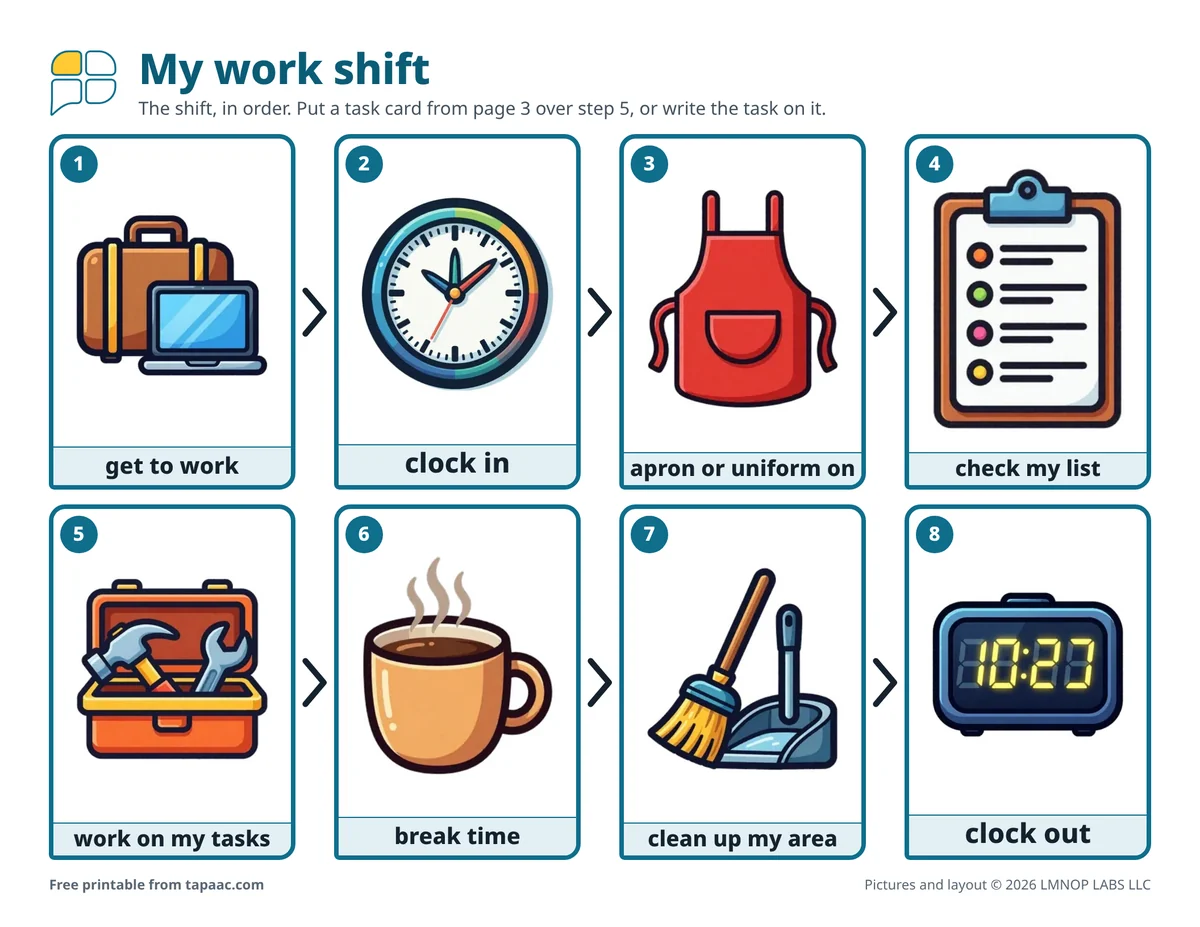
A job comes with its own routine and its own talk: clock in, check the list, say you’re finished, ask what’s next, and take a break at the right time. This free work visual schedule shows a shift in eight steps, from getting to work to clocking out, with a step for the day’s tasks. Page 2 is a talk board for the supervisor and coworkers, and page 3 has 18 task cards, like stock the shelves, fold towels and bring in the carts.
Download the free PDF US Letter, 3 pages, 862 KB
Printing on A4 paper? Download the A4 PDF (3 pages, 863 KB). Or pick one page shape for every page:
Portrait (tall page, 3 pages): US Letter PDF (863 KB) · A4 PDF (863 KB)
Landscape (wide page, 3 pages): US Letter PDF (866 KB) · A4 PDF (866 KB)
Edit this board in the free board maker: change the words and pictures, then print.
Have Tap AAC? Add to Tap AAC (.obz file, 756 KB) · How to add a board
- Free
- No sign-up
- Print as many as you need
Who uses a work schedule
Teens in job training or work experience, students in a school-to-work program, adults in supported employment, at a day program or volunteering, and anyone who works better with the shift laid out in pictures. Job coaches, teachers and supervisors can set it up with the worker. The pictures are of tools and places, so it looks right on a staff room wall.
Setting up the shift
- Walk through a real shift with the worker and the supervisor, and change any step that’s different at this job: a uniform instead of an apron, a badge to scan.
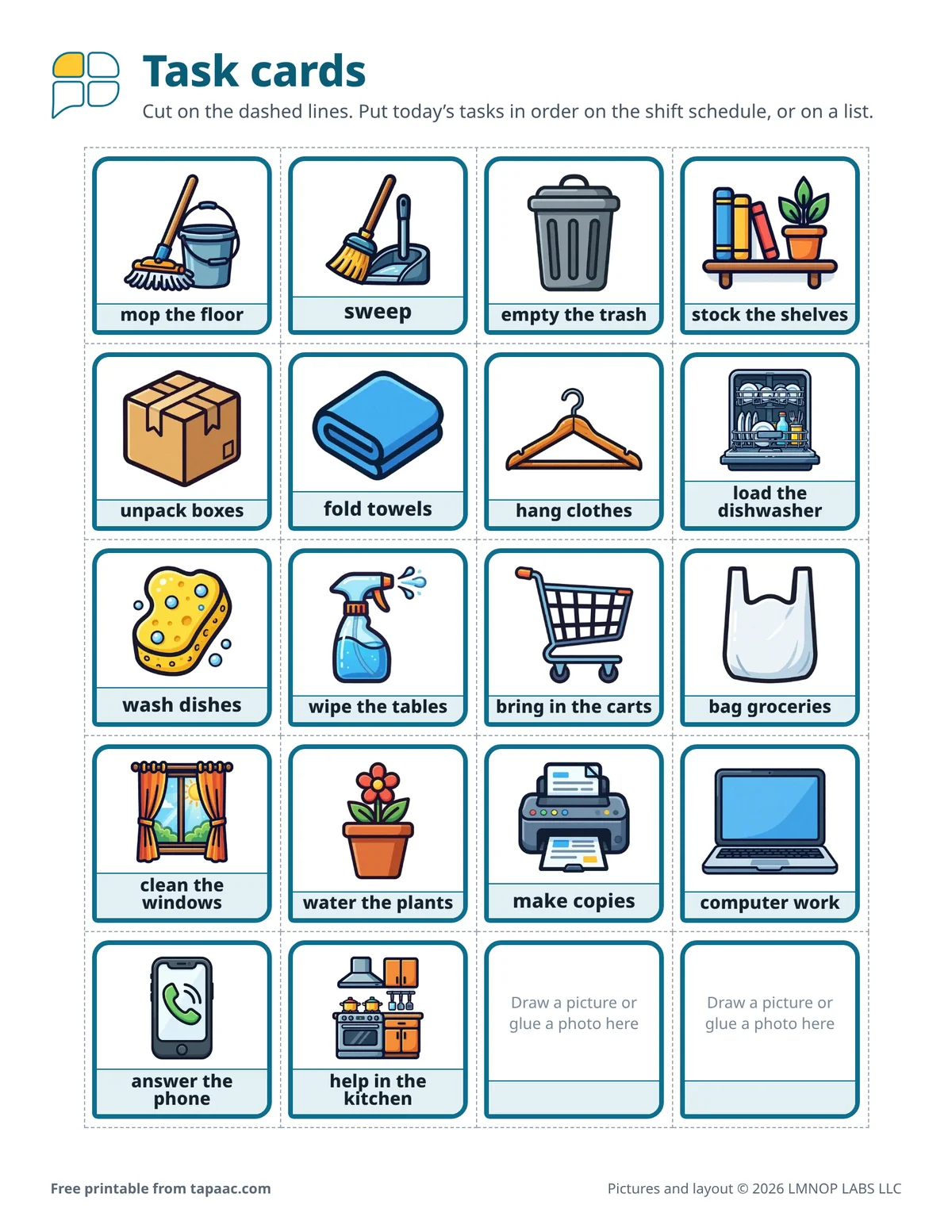
- Choose today’s tasks from the cards on page 3, and put them in order over step 5, or on a list beside the schedule.
- Put the schedule where the work starts: inside a locker door, on a clipboard, or in a badge holder.
- Tick or move each step as it’s done. When the last task card is gone, it’s time for clean up my area.
- Fade the help: as the shift becomes routine, the job coach steps back and the schedule does the reminding.
Talking with a supervisor
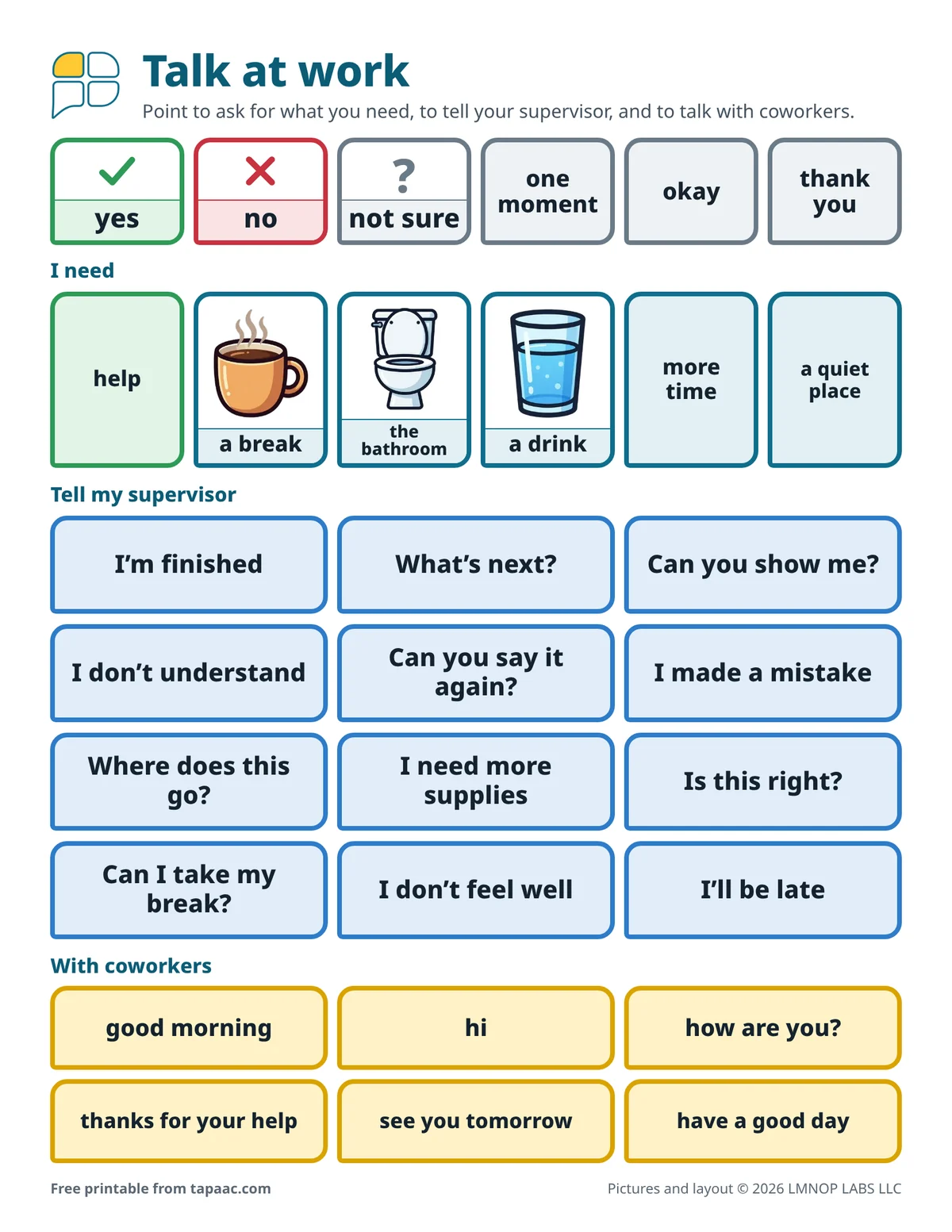
The twelve phrases on page 2 are the ones a new worker needs most and finds hardest to say: I’m finished and What’s next?, so they’re not left standing; Can you show me? and I don’t understand, so a task gets done right; I made a mistake, so it gets fixed early. Show the supervisor the board on day one and practice the phrases together, so they know to look for it and wait for the answer. Can I take my break? and a quiet place are there because a break at the right time keeps the whole shift going.
Coworkers and small talk
Good morning, how are you? and thanks for your help matter more than they look: they’re how coworkers get to know someone. There are six on page 2, and a coworker who sees them used every day often starts to wait for them. For longer chats on a break, the greetings and conversation board has questions and answers.
School-to-work and the IEP
In the US, a student’s IEP must include transition planning for life after school, including work, from age 16 at the latest. How the student will communicate on a job, and with which board or device, can be part of that plan: read AAC and the IEP. For adults, setting it up, in our guide to AAC for autistic adults, covers choosing words for your own life.
Make it match the job
Open “Work shift” in the schedule maker to put in the real tasks, a photo of the time clock or the staff entrance, and the right number of breaks.
Priya is 20 and works three mornings a week in a hotel laundry, through a supported employment program. Her schedule is taped inside her locker door: clock in, apron on, check my list. Today her list has fold towels and hang clothes. When the towels are done she points to I’m finished and What’s next? on page 2, and her supervisor points to the hangers. At ten she points to Can I take my break?, and takes it.
Every word on the sheets
My work shift
- get to work
- clock in
- apron or uniform on
- check my list
- work on my tasks
- break time
- clean up my area
- clock out
Quick words
- yes
- no
- not sure
- one moment
- okay
- thank you
I need
- help
- a break
- the bathroom
- a drink
- more time
- a quiet place
Tell my supervisor
- I’m finished
- What’s next?
- Can you show me?
- I don’t understand
- Can you say it again?
- I made a mistake
- Where does this go?
- I need more supplies
- Is this right?
- Can I take my break?
- I don’t feel well
- I’ll be late
With coworkers
- good morning
- hi
- how are you?
- thanks for your help
- see you tomorrow
- have a good day
Task cards
- mop the floor
- sweep
- empty the trash
- stock the shelves
- unpack boxes
- fold towels
- hang clothes
- load the dishwasher
- wash dishes
- wipe the tables
- bring in the carts
- bag groceries
- clean the windows
- water the plants
- make copies
- computer work
- answer the phone
- help in the kitchen
Printing tips
- Print the task cards on card stock. They’re 1.6 inches (4 cm) square, like the cards on our other boards, so cards from the visual schedule for adults fit the same holders.
- Keep page 2 in a clear sleeve on a lanyard or a clipboard, so it goes wherever the work goes.
- For the trip to work, the city bus visual schedule; for laundry jobs, the folding steps on the laundry visual schedule.
More free boards
-
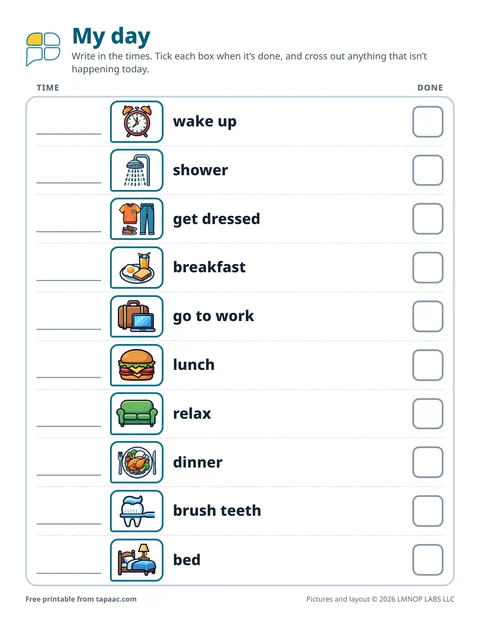 Visual schedule for adultsA day planner from waking up to bed with grown-up pictures, 18 picture cards, and a Today page with the date.
-
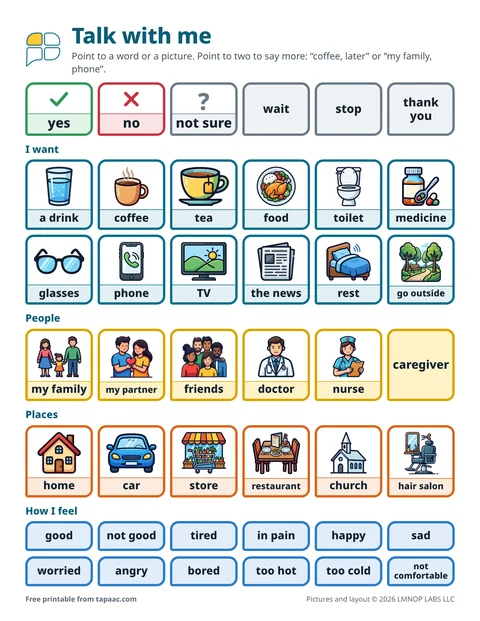 Communication board for adultsGrown-up pictures and plain words: wants, people, places, feelings, and a keyboard page for spelling.
-
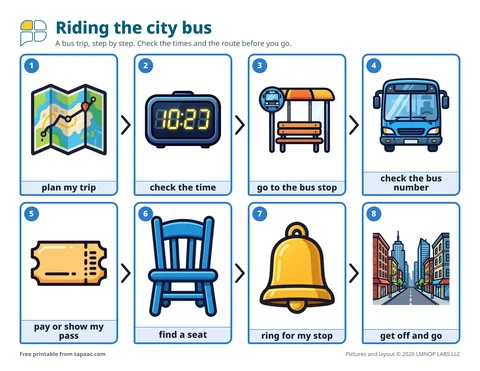 City bus visual scheduleFor teens and adults: the steps of a bus trip, a talk board for the bus and around town, and a trip card to fill in.
-
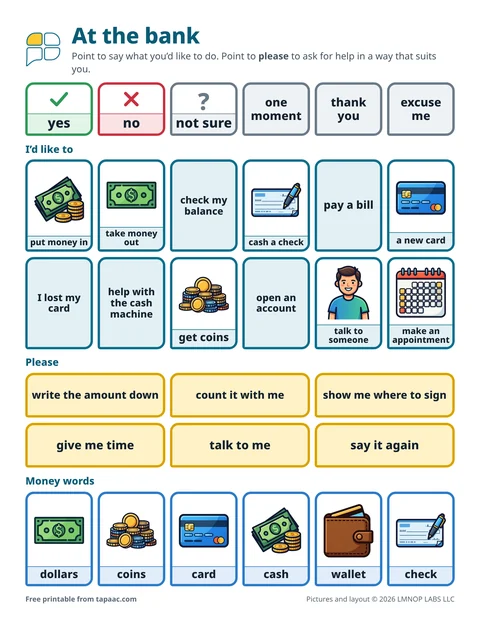 Bank and money communication boardFor teens and adults: words for the bank, the steps of paying in a store with coins and bills, and money cards to show.
Need a different board? Make your own with the free AAC board maker.
Making a schedule? Use the free visual schedule maker: routines ready to open and change.
More boards on this topic: everyday AAC boards for adults.
These boards and guides are general information, not therapy or medical advice, and they don’t replace a speech therapist. A speech therapist who knows the person can help choose the right words, pictures and layout. The boards are free to print and share; please don’t sell them (terms of use). Questions about the boards? Email support@lmnoplabs.fun.