 Tap AAC
Laundry visual schedule: free printable steps with pictures
A laundry visual schedule shows each step of doing the laundry in pictures, in order: gather the clothes, sort by color, load the washer, add the soap, press start, into the dryer, fold it, put it away. This free PDF has those eight steps, folding steps for a towel and a T-shirt with simple drawings, and a board of laundry words for teaching it together.
Download the free PDF US Letter, 3 pages, 1,245 KB
Printing on A4 paper? Download the A4 PDF (3 pages, 1,245 KB). Or pick one page shape for every page:
Portrait (tall page, 3 pages): US Letter PDF (1,246 KB) · A4 PDF (1,245 KB)
Landscape (wide page, 3 pages): US Letter PDF (1,244 KB) · A4 PDF (1,246 KB)
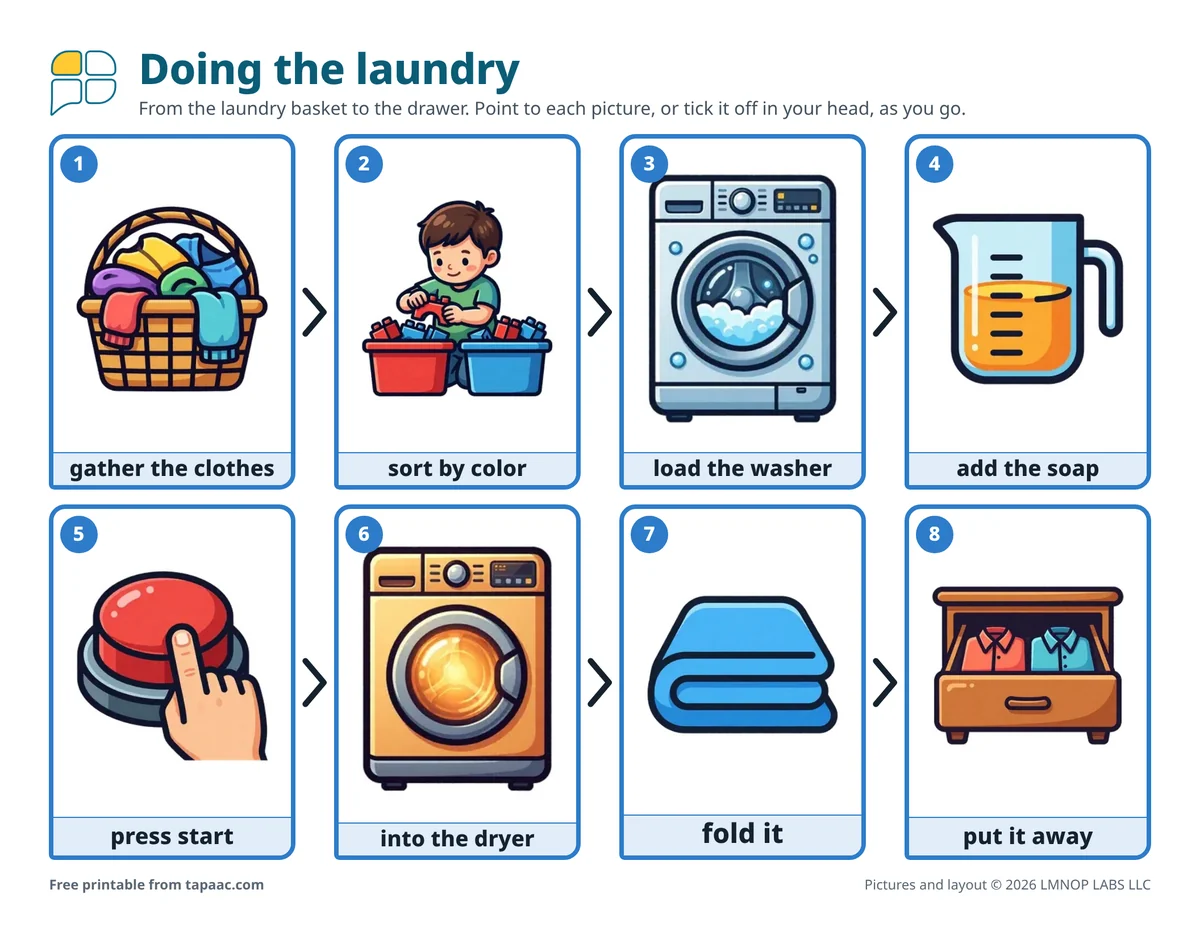
Edit this board in the free board maker: change the words and pictures, then print.
Have Tap AAC? Add to Tap AAC (.obz file, 1,080 KB) · How to add a board
- Free
- No sign-up
- Print as many as you need
Who it’s for
Older children, teens and adults who are learning to do their own laundry, at home, in a life skills class or in supported living, and the people teaching them. The pictures on page 1 are mostly of the machines and the clothes, so the schedule works for grown-ups too. It suits people who learn better from pictures than from spoken steps, including many autistic people and people with an intellectual disability.
How to use it
- Make it match your machines. Washers differ. Write the setting you use next to press start, or glue a photo of your own buttons over the picture.
- Do the whole job together first, pointing to each step as you do it. Then let the learner do the last step alone, then the last two, and so on, until they do it all.
- Tape page 1 above the washer, at eye level, so the next step is always in sight.
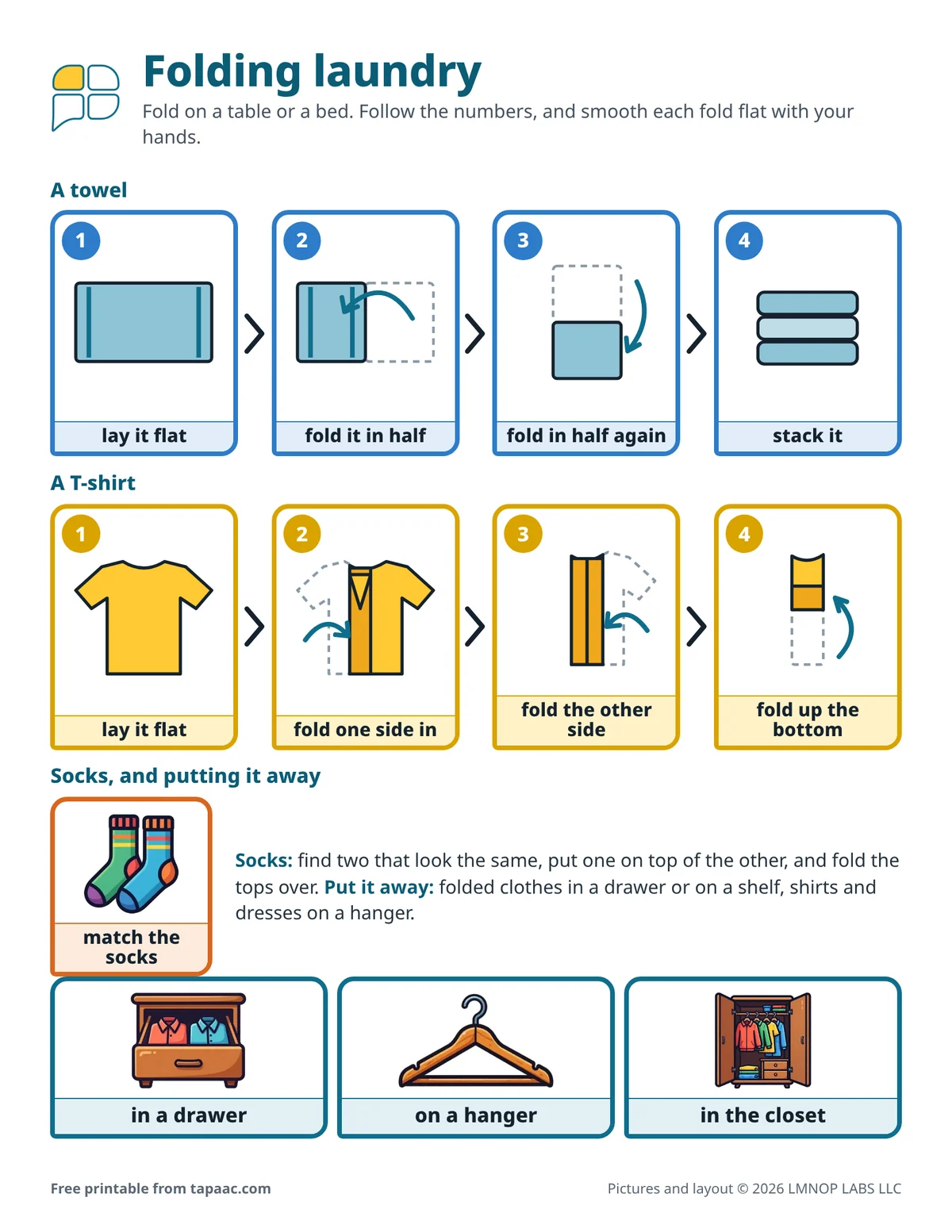
- Practice folding with page 2 on a table, one towel at a time, before a whole basket.
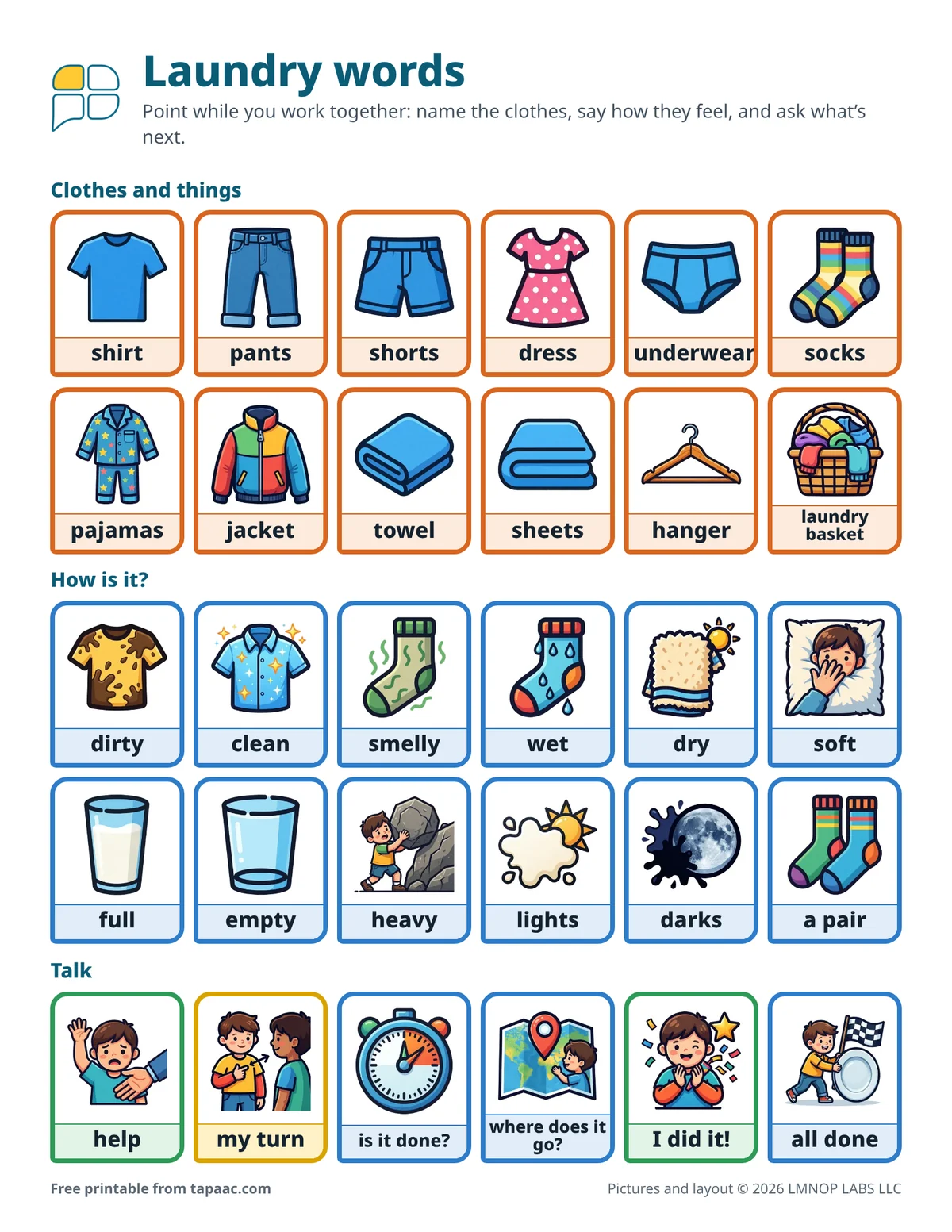
- Talk while you work with page 3: name the clothes, feel whether they are wet or dry, and ask is it done?
Soap, settings and safety
Use the amount of soap the bottle or box says; a measuring cup or the bottle’s own cap makes it the same every time. Keep laundry soap and pods out of reach of young children. Check pockets before washing, and read the labels on new clothes, because some can’t go in the dryer. If the learner is using a shared or coin-operated machine, add a step for paying and practice it on a quiet day.
The same steps in the schedule maker
The eight steps are also a routine in the free visual schedule maker. Open “Laundry” in the schedule maker to add a step for paying at a laundromat, put in a photo of your own washer, or split the job into washing day and folding day.
Jordan is 19 and moving into a supported apartment next year, so laundry is on his weekly plan. His support worker taped the steps above the washer and wrote “cold, normal” next to press start. The first week they did every step together. Now Jordan does it alone up to into the dryer, then points to is it done? on page 3. When the dryer stops, he folds the towels with page 2 on the table and points to I did it!
What’s on the PDF
Laundry steps
- gather the clothes
- sort by color
- load the washer
- add the soap
- press start
- into the dryer
- fold it
- put it away
Folding
- lay it flat
- fold it in half
- fold in half again
- stack it
- lay it flat
- fold one side in
- fold the other side
- fold up the bottom
- match the socks
- in a drawer
- on a hanger
- in the closet
Clothes and things
- shirt
- pants
- shorts
- dress
- underwear
- socks
- pajamas
- jacket
- towel
- sheets
- hanger
- laundry basket
How is it?
- dirty
- clean
- smelly
- wet
- dry
- soft
- full
- empty
- heavy
- lights
- darks
- a pair
Talk
- help
- my turn
- is it done?
- where does it go?
- I did it!
- all done
Printing tips
- Laundry rooms get damp: laminate page 1, or slide it into a sheet protector before you tape it up.
- Print page 2 at actual size so the drawings are big enough to copy on the table.
- For the other end of the job, the getting dressed visual schedule; for jobs around the house, the chore chart with pictures; and for adults, the visual schedule for adults.
- Teaching a skill with pictures, step by step: model first, then wait. The same idea works for laundry.
More free boards
-
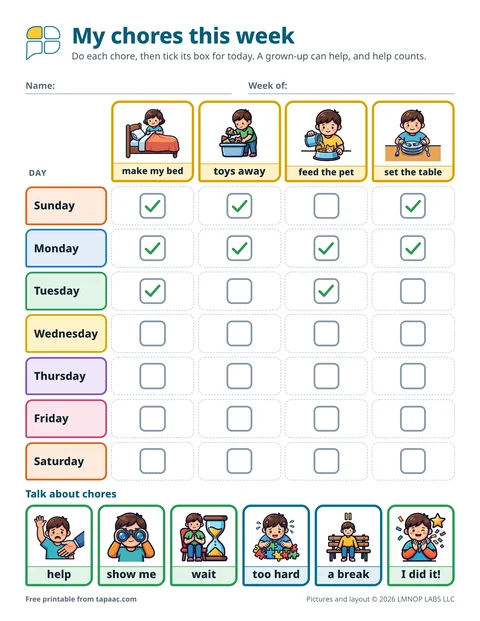 Chore chart with picturesA weekly chore chart, a blank chart for your own chores, and 18 chore cards, plus words for asking for help.
-
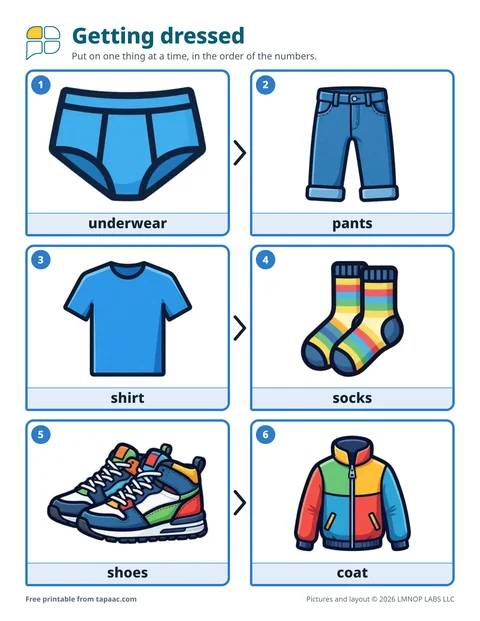 Getting dressed visual scheduleUnderwear to coat, one step at a time, plus clothes cards for any weather.
-
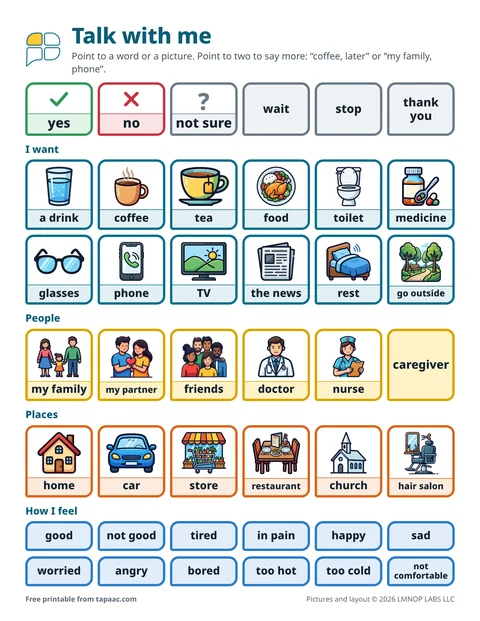 Communication board for adultsGrown-up pictures and plain words: wants, people, places, feelings, and a keyboard page for spelling.
-
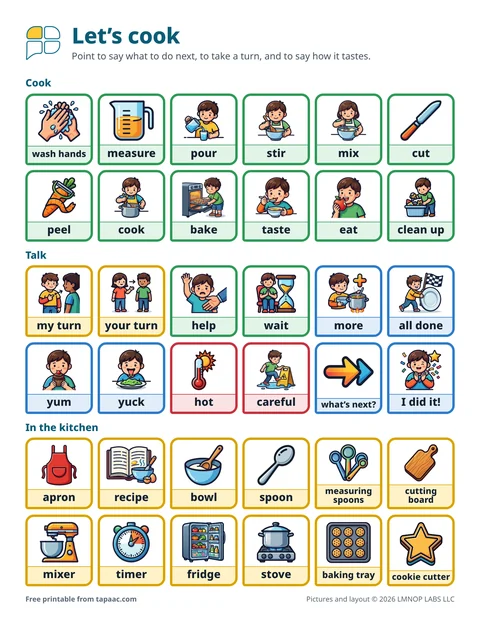 Cooking board and visual recipeCooking, talk and kitchen words, a no-cook visual recipe, and a blank visual recipe to fill in.
Need a different board? Make your own with the free AAC board maker.
Making a schedule? Use the free visual schedule maker: routines ready to open and change.
These boards and guides are general information, not therapy or medical advice, and they don’t replace a speech therapist. A speech therapist who knows the person can help choose the right words, pictures and layout. The boards are free to print and share; please don’t sell them (terms of use). Questions about the boards? Email support@lmnoplabs.fun.