 Tap AAC
Pharmacy communication board for teens and adults
At a pharmacy counter you’re asked your name and date of birth, sometimes your allergies, and whether you have any questions, often with a line behind you. This free pharmacy communication board lets a teen or adult who doesn’t speak, or can’t speak easily, answer and ask for themselves: why they’re here, who the medicine is for, how they’d like to be spoken to, and how they’ll pay. Page 2 has twelve questions for the pharmacist, and page 3 is a card to fill in and show at the counter.
Download the free PDF US Letter, 3 pages, 316 KB
Portrait (tall page, 3 pages): US Letter PDF (316 KB) · A4 PDF (317 KB)
Landscape (wide page, 3 pages): US Letter PDF (319 KB) · A4 PDF (319 KB)
Edit this board in the free board maker: change the words and pictures, then print.
Have Tap AAC? Add to Tap AAC (.obz file, 191 KB) · How to add a board
- Free
- No sign-up
- Print as many as you need
For adults who talk in other ways
This board is for teens and adults who use a talker, a board, writing or signs: after a stroke, with aphasia, with a speech disability, as an autistic adult, or with a voice that’s tired or gone for now. It uses pictures of objects and plain words, nothing childish. A family member or support worker can come along, but the point is for the person to speak for themselves at the counter.
Before you go
- Fill in the card on page 3 together at home, where there’s time. Write what you want the pharmacy staff to know, and leave out anything you’d rather keep private.
- Pick two or three questions on page 2 that matter for this medicine, and circle them.
- Pack the insurance card and the page 3 card with the board, in the same pocket of the bag.
- Choose a quiet time if you can: a counter with no line is easier for everyone.
At the counter
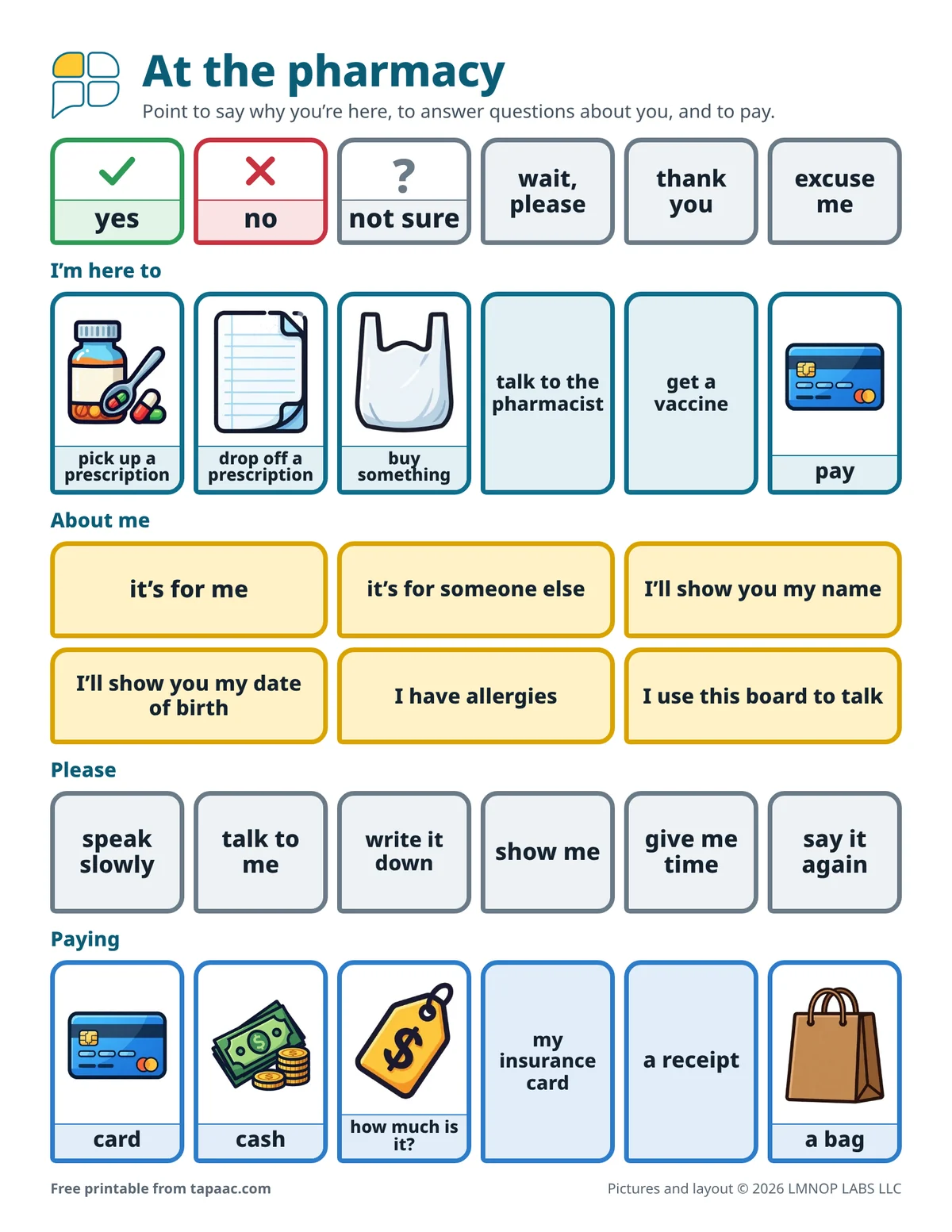
Start with I’m here to: pick up a prescription tells the staff what to look for. When they ask for a name and date of birth, point to I’ll show you my name and hold up the card. If they talk to the person beside you instead of to you, point to talk to me. Write it down and show me are fair requests anywhere, and give me time lets you answer at your own pace. Pharmacy staff talk every day with people who are hard of hearing, who speak another language, or who use a device; a board is one more way.
Questions worth asking
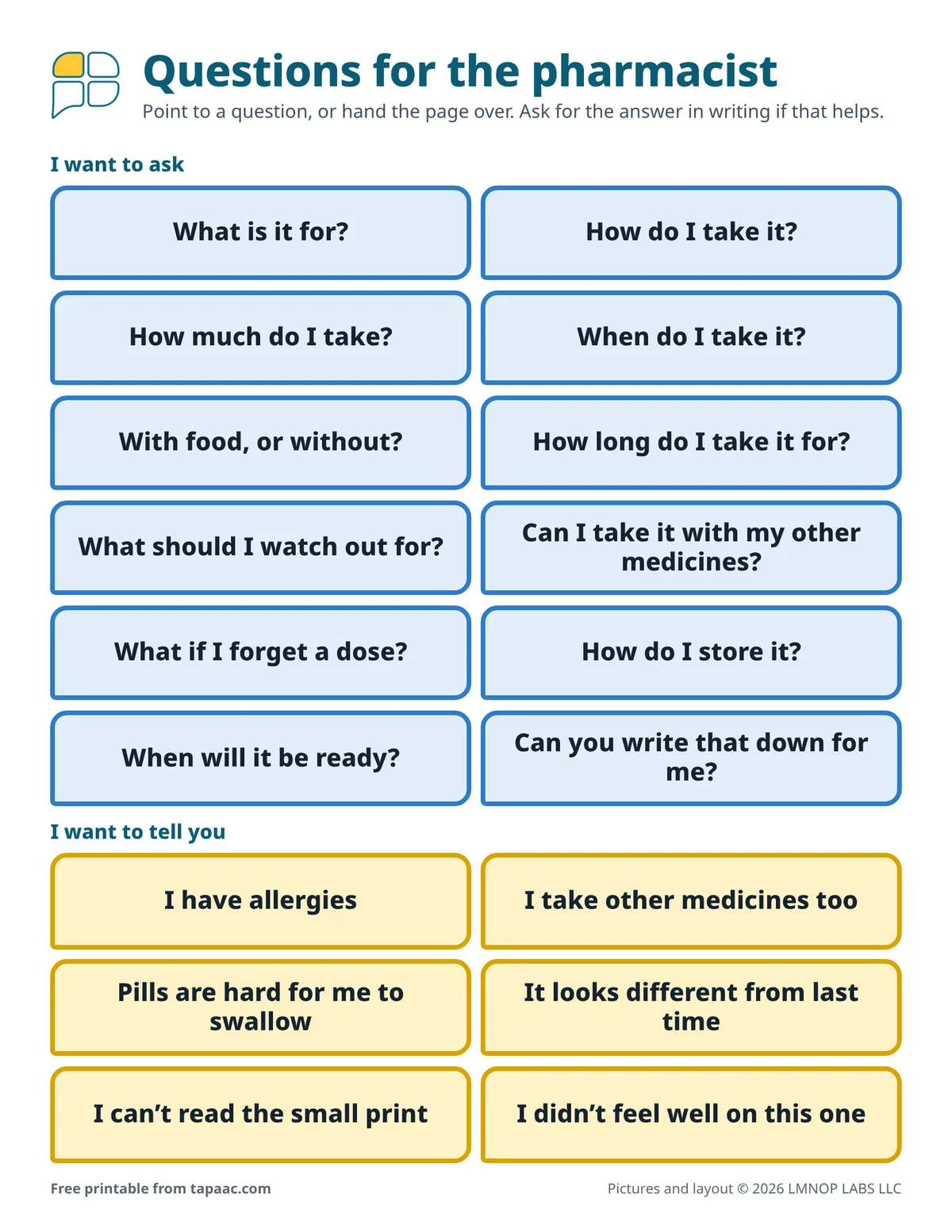
The questions on page 2 are the ones people often forget at the counter: what the medicine is for, how and when to take it, what to watch out for, and whether it’s safe with other medicines. Point to a question, or hand the page over. The answers come from the pharmacist, not from this page, which only helps you ask; it isn’t medical advice. The bottom half is for telling, like it looks different from last time or pills are hard for me to swallow, things a pharmacist would want to know. Ask for the answer in writing, so you can read it again at home.
The card on page 3
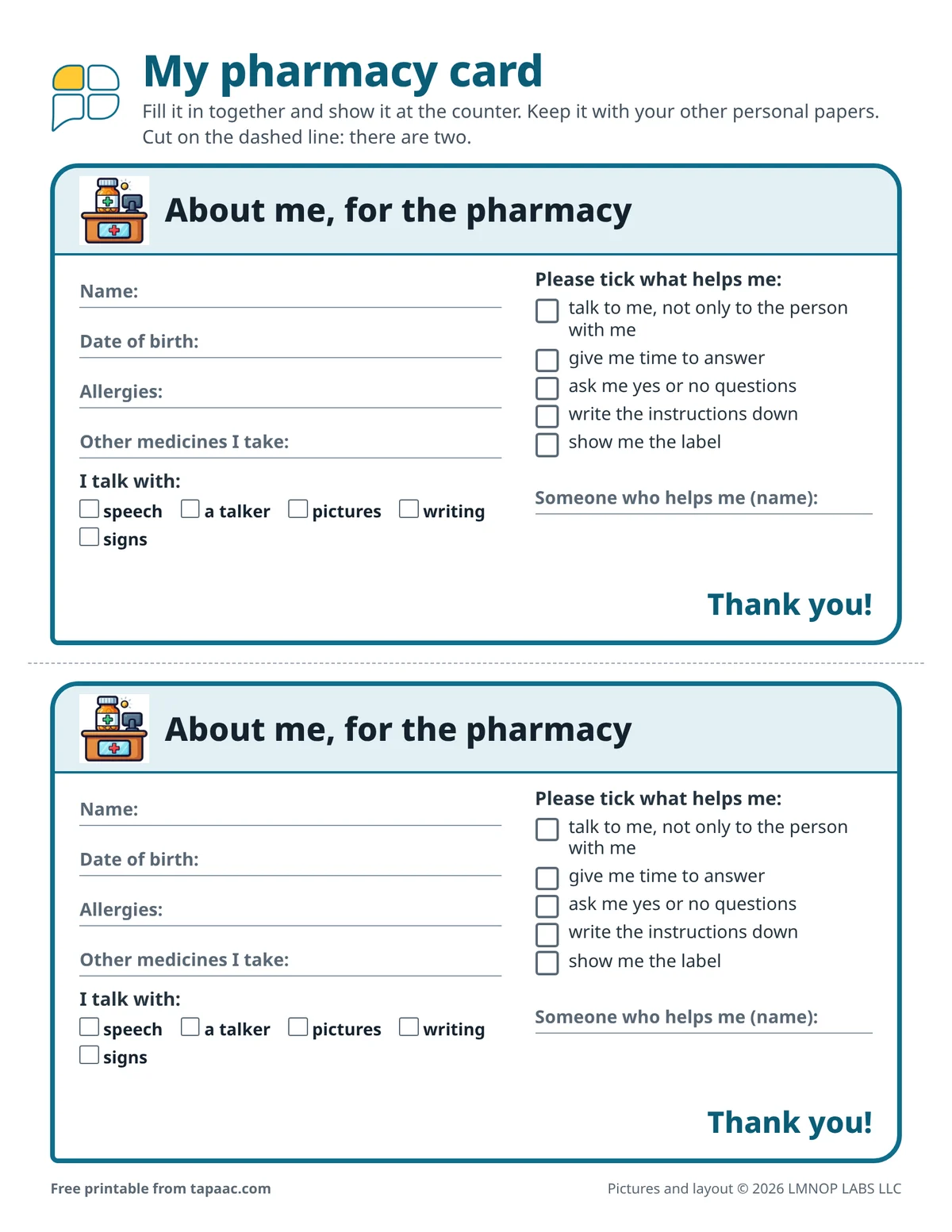
The card puts the usual questions in one place: name, date of birth, allergies, other medicines, and how you talk. It also says what helps, like ask me yes or no questions or show me the label. It holds personal details, so keep it with your wallet or other personal papers, and fill in only what you choose. For doctors, nurses and other new people, new people, health care and emergencies has more ideas, and the “I use AAC” cards explain to anyone how you talk.
Denise had a stroke last year, and spoken words are slow to come. She fills in her card at the kitchen table with her daughter, and circles With food, or without? on page 2. At the counter she points to pick up a prescription and shows the card. The pharmacist starts explaining to her daughter; Denise points to talk to me, and he turns back to her. He answers her question and writes it on the bag.
What’s on the PDF
Quick words
- yes
- no
- not sure
- wait, please
- thank you
- excuse me
I’m here to
- pick up a prescription
- drop off a prescription
- buy something
- talk to the pharmacist
- get a vaccine
- pay
About me
- it’s for me
- it’s for someone else
- I’ll show you my name
- I’ll show you my date of birth
- I have allergies
- I use this board to talk
Please
- speak slowly
- talk to me
- write it down
- show me
- give me time
- say it again
Paying
- card
- cash
- how much is it?
- my insurance card
- a receipt
- a bag
I want to ask
- What is it for?
- How do I take it?
- How much do I take?
- When do I take it?
- With food, or without?
- How long do I take it for?
- What should I watch out for?
- Can I take it with my other medicines?
- What if I forget a dose?
- How do I store it?
- When will it be ready?
- Can you write that down for me?
I want to tell you
- I have allergies
- I take other medicines too
- Pills are hard for me to swallow
- It looks different from last time
- I can’t read the small print
- I didn’t feel well on this one
On the card: what helps me
- talk to me, not only to the person with me
- give me time to answer
- ask me yes or no questions
- write the instructions down
- show me the label
Printing tips
- Print page 1 on card stock and fold it in half to fit a bag; the questions can stay flat in a folder.
- Print the cards on card stock too, and keep the second one for a second pharmacy, or for the next time.
- For the trip there and other errands: the city bus visual schedule and the bank and money communication board.
- For needs, people and places, the communication board for adults; after a stroke, AAC after a stroke or a brain injury.
More free boards
-
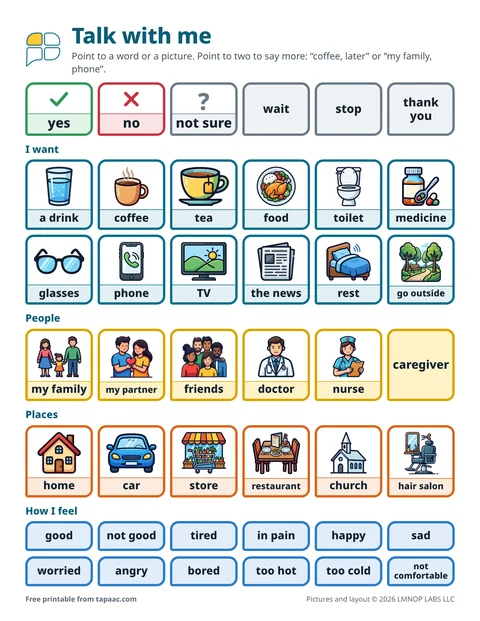 Communication board for adultsGrown-up pictures and plain words: wants, people, places, feelings, and a keyboard page for spelling.
-
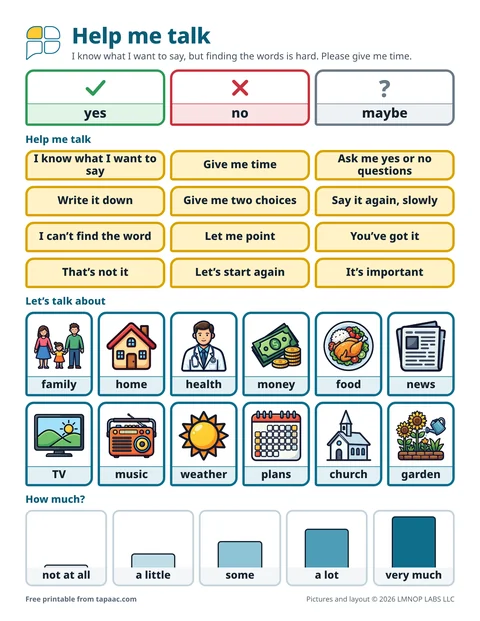 Aphasia communication boardHelp-me-talk phrases, topics and a how-much scale, plus a page for the conversation partner.
-
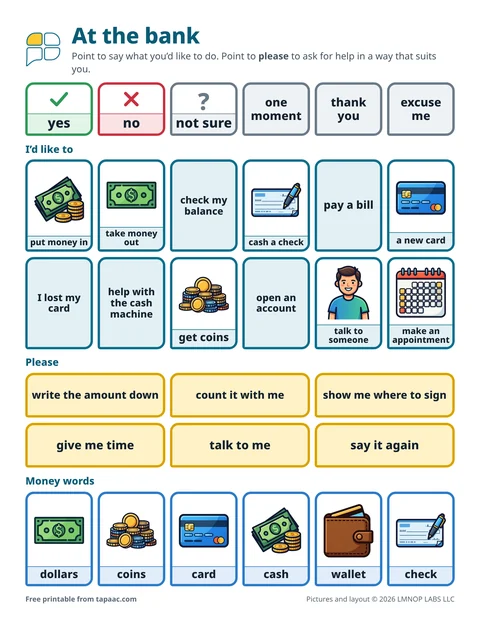 Bank and money communication boardFor teens and adults: words for the bank, the steps of paying in a store with coins and bills, and money cards to show.
-
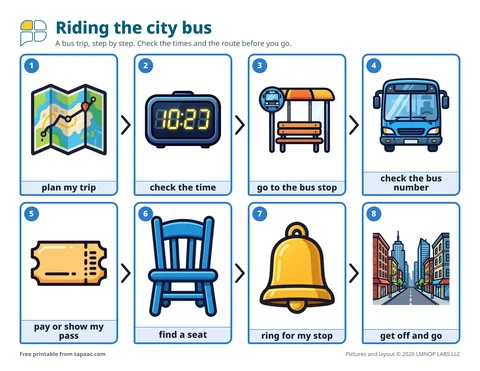 City bus visual scheduleFor teens and adults: the steps of a bus trip, a talk board for the bus and around town, and a trip card to fill in.
Need a different board? Make your own with the free AAC board maker.
More boards on this topic: everyday AAC boards for adults.
These boards and guides are general information, not therapy or medical advice, and they don’t replace a speech therapist. A speech therapist who knows the person can help choose the right words, pictures and layout. The boards are free to print and share; please don’t sell them (terms of use). Questions about the boards? Email support@lmnoplabs.fun.