 Tap AAC
Bank and money communication board for teens and adults
Handling your own money means talking to people about it: a bank teller, a cashier, someone at a help desk. This free board gives a teen or adult who doesn’t speak, or doesn’t speak easily, the words for those moments: what they’d like to do at the bank, how they’d like to be helped, and the money words. Page 2 shows paying in a store, step by step, with US coins and bills, and page 3 has six money cards to show at the counter.
Download the free PDF US Letter, 3 pages, 631 KB
Portrait (tall page, 3 pages): US Letter PDF (631 KB) · A4 PDF (631 KB)
Landscape (wide page, 3 pages): US Letter PDF (632 KB) · A4 PDF (632 KB)
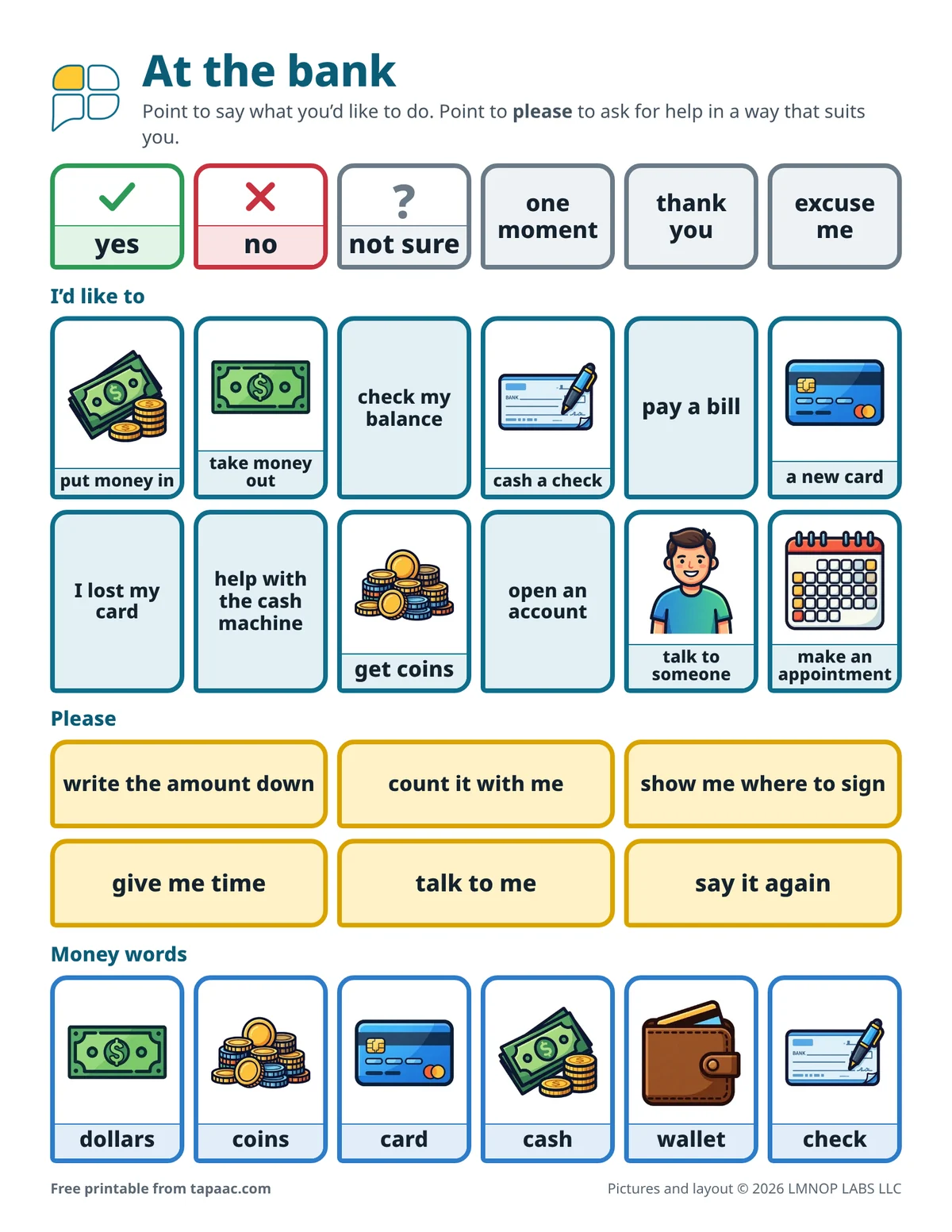
Edit this board in the free board maker: change the words and pictures, then print.
Have Tap AAC? Add to Tap AAC (.obz file, 518 KB) · How to add a board
- Free
- No sign-up
- Print as many as you need
Who it helps
Teens learning to manage their own money, adults in supported living or a day program, and any adult who talks with a device, a board or writing: after a stroke, with aphasia, or as an autistic adult. Families and support staff can practice with it at home first. The pictures are of money, cards and places, so it doesn’t look like a children’s board in a bank line.
Banking with a board: habits that help
- Decide before you go what you’re there to do, and point to it first, so the teller knows straight away.
- Ask for numbers in writing. Write the amount down makes it easy to check, and a number on paper can be read again later.
- Count together. Count it with me slows the moment down, so a mistake gets caught at the counter, not at home.
- Keep your PIN to yourself. A PIN is for typing in, out of sight; it never needs to go on a board or a card. For help at the cash machine, ask staff inside the bank.
- Speak for yourself. If staff talk to a helper instead of you, point to talk to me. Support staff will find tips for stepping back in for family, friends and support staff.
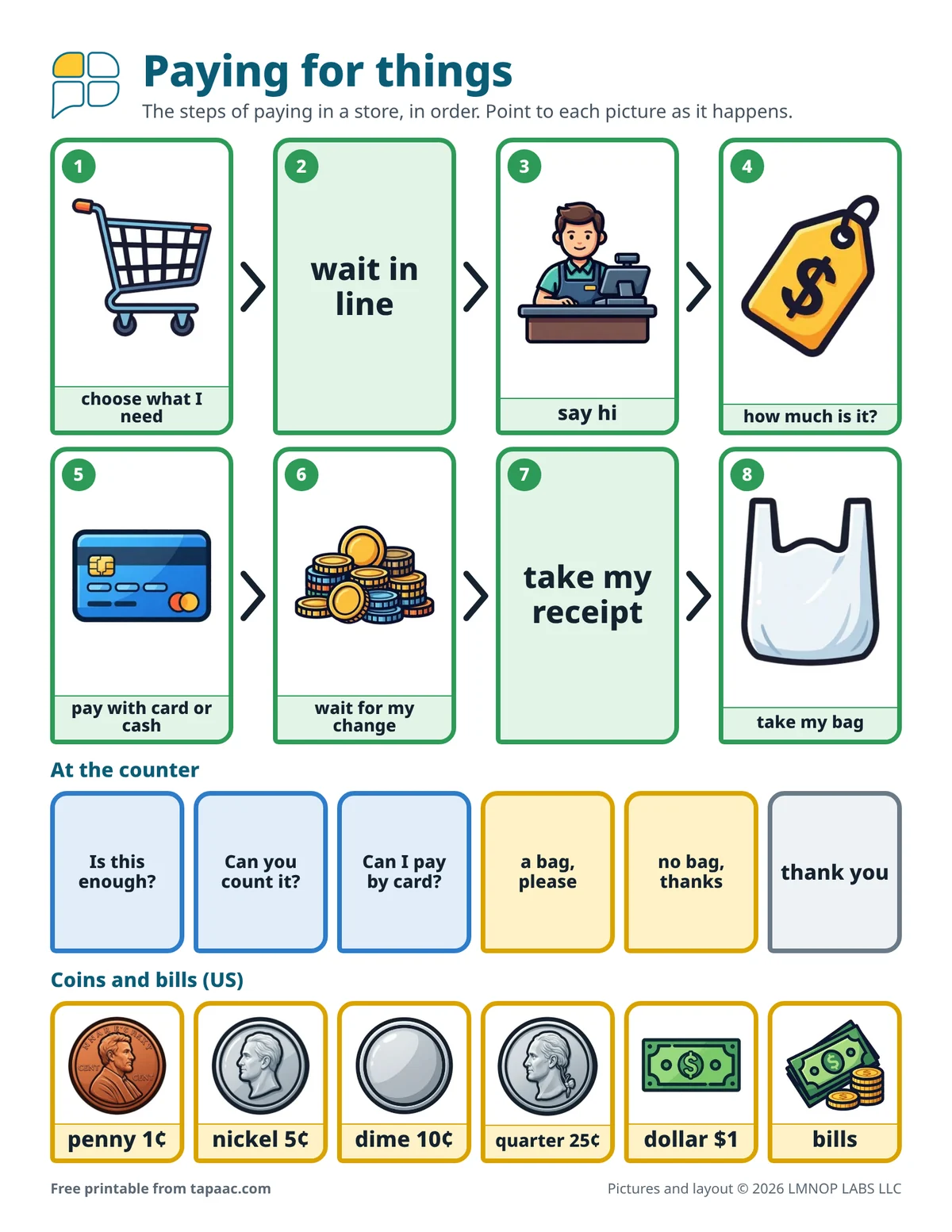
Paying in a store
Page 2 breaks paying into eight steps, from choosing what you need to taking the bag, with the questions that come up at the counter: Is this enough?, Can you count it?, Can I pay by card? Practice the steps at home with real coins, then try them at a quiet time in a small store. The coins and bills are US money; anywhere else, open the board in the board maker and put your own coins in. For a weekly shop, the grocery store communication board adds a picture shopping list.
Money cards
Each card on page 3 says a whole request at once, so it can be shown without a word: I’d like to take out money, with a line for the amount, or I lost my card. Write the amount on just before you go, and keep the cards with your wallet. The cards are for everyday visits. For a bigger decision, like a loan or a new kind of account, take someone you trust, ask the bank to explain it in writing, and take your time.
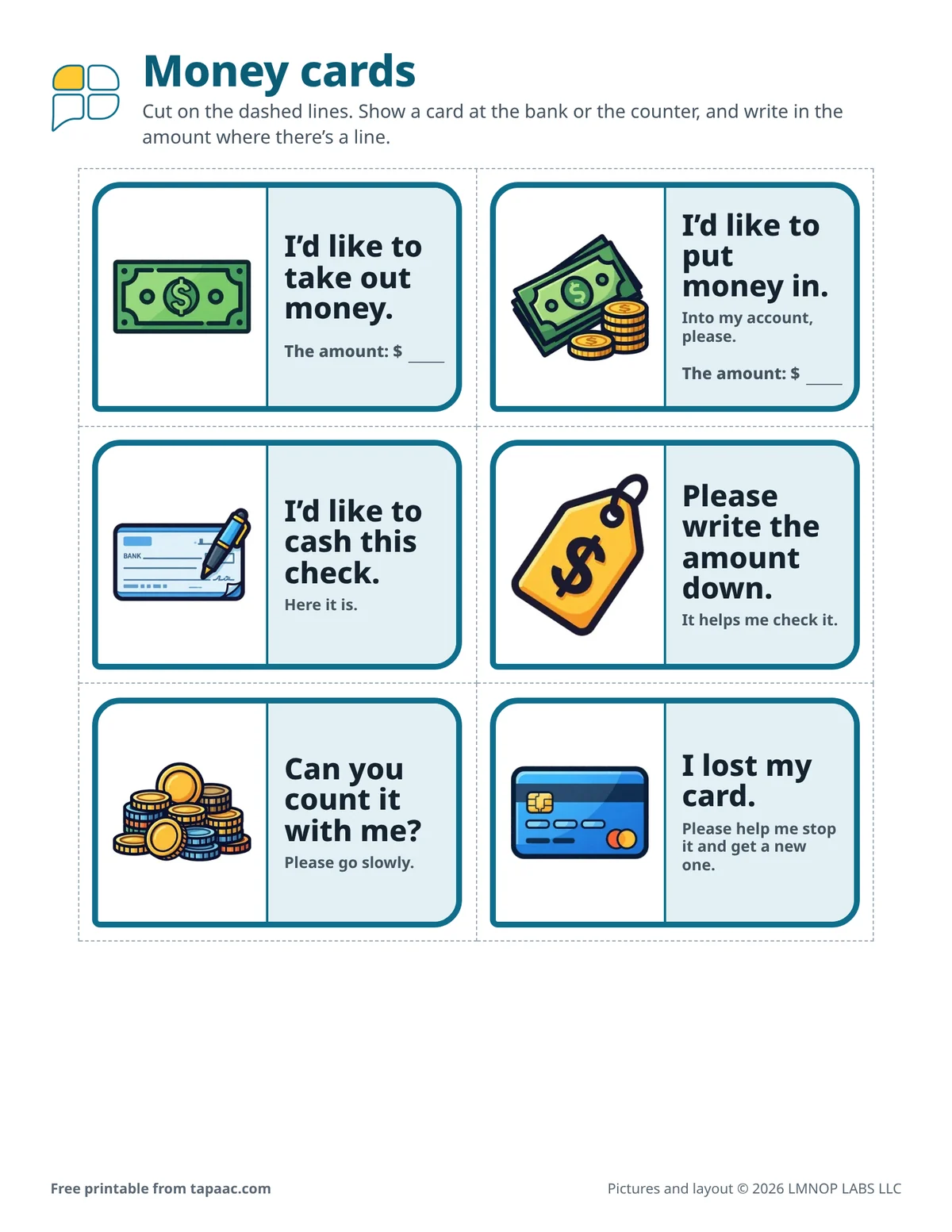
Sam is 24 and lives in a supported apartment. On Fridays he takes out money for the week. He writes the amount on his card at home, shows it at the counter, and points to count it with me. The teller counts the bills out one at a time, and Sam checks them against the card. Then he points to thank you and puts the money in his wallet.
Every word on the sheets
Quick words
- yes
- no
- not sure
- one moment
- thank you
- excuse me
I’d like to
- put money in
- take money out
- check my balance
- cash a check
- pay a bill
- a new card
- I lost my card
- help with the cash machine
- get coins
- open an account
- talk to someone
- make an appointment
Please
- write the amount down
- count it with me
- show me where to sign
- give me time
- talk to me
- say it again
Money words
- dollars
- coins
- card
- cash
- wallet
- check
Paying for things
- choose what I need
- wait in line
- say hi
- how much is it?
- pay with card or cash
- wait for my change
- take my receipt
- take my bag
At the counter
- Is this enough?
- Can you count it?
- Can I pay by card?
- a bag, please
- no bag, thanks
- thank you
Coins and bills (US)
- penny 1¢
- nickel 5¢
- dime 10¢
- quarter 25¢
- dollar $1
- bills
Money cards
- I’d like to take out money.
- I’d like to put money in.
- I’d like to cash this check.
- Please write the amount down.
- Can you count it with me?
- I lost my card.
Printing tips
- Laminate the money cards and write the amounts with a dry-erase marker, so they wipe clean and work again next week.
- Fold page 1 in half to fit a bag or a jacket pocket.
- Getting there: the city bus visual schedule. Earning it: the work visual schedule. For the whole day: the visual schedule for adults.
More free boards
-
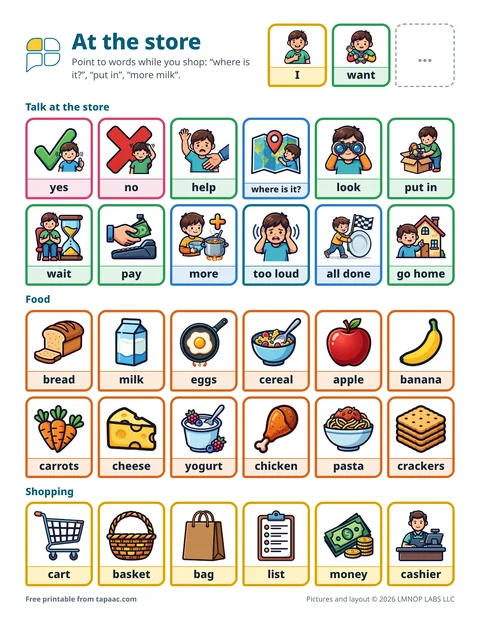 Grocery store board and shopping listWords for the store, 12 foods, and a picture shopping list with 18 cards.
-
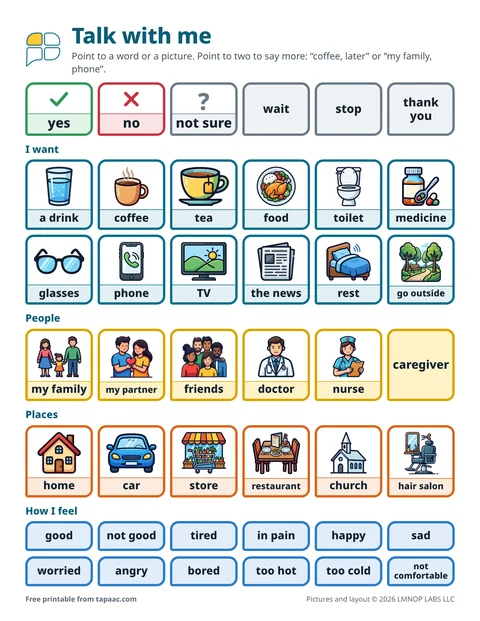 Communication board for adultsGrown-up pictures and plain words: wants, people, places, feelings, and a keyboard page for spelling.
-
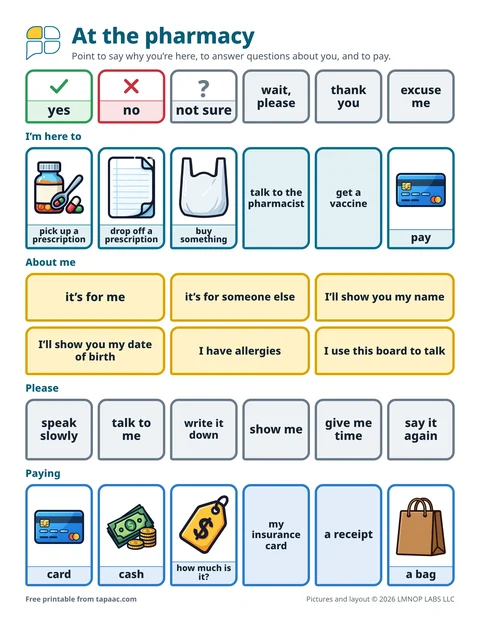 Pharmacy communication boardFor teens and adults at the pharmacy counter: why you’re here, about me, paying, questions for the pharmacist, and a card to fill in.
-
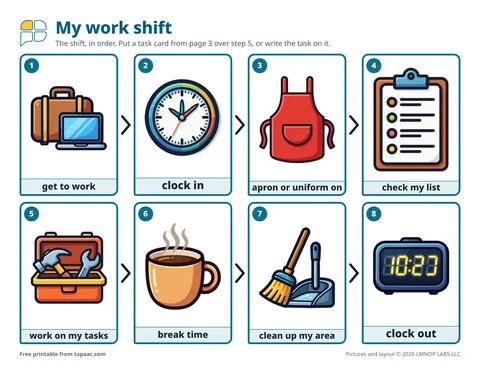 Work visual scheduleFor teens and adults: the steps of a work shift, a talk board for supervisors and coworkers, and 18 job task cards.
Need a different board? Make your own with the free AAC board maker.
More boards on this topic: everyday AAC boards for adults.
These boards and guides are general information, not therapy or medical advice, and they don’t replace a speech therapist. A speech therapist who knows the person can help choose the right words, pictures and layout. The boards are free to print and share; please don’t sell them (terms of use). Questions about the boards? Email support@lmnoplabs.fun.