 Tap AAC
Speech therapy visual schedule: free printable with talk board
A speech therapy visual schedule shows a child what will happen in a therapy session, in pictures and in order: say hello, work time, play a game, a break, more work, my choice, clean up and say goodbye. This free PDF has those eight steps, a talk board with words for the session like my turn, too hard and a break, and 18 activity cards a therapist can swap in.
Download the free PDF US Letter, 3 pages, 1,949 KB
Printing on A4 paper? Download the A4 PDF (3 pages, 1,950 KB). Or pick one page shape for every page:
Portrait (tall page, 3 pages): US Letter PDF (1,950 KB) · A4 PDF (1,950 KB)
Landscape (wide page, 3 pages): US Letter PDF (1,953 KB) · A4 PDF (1,953 KB)
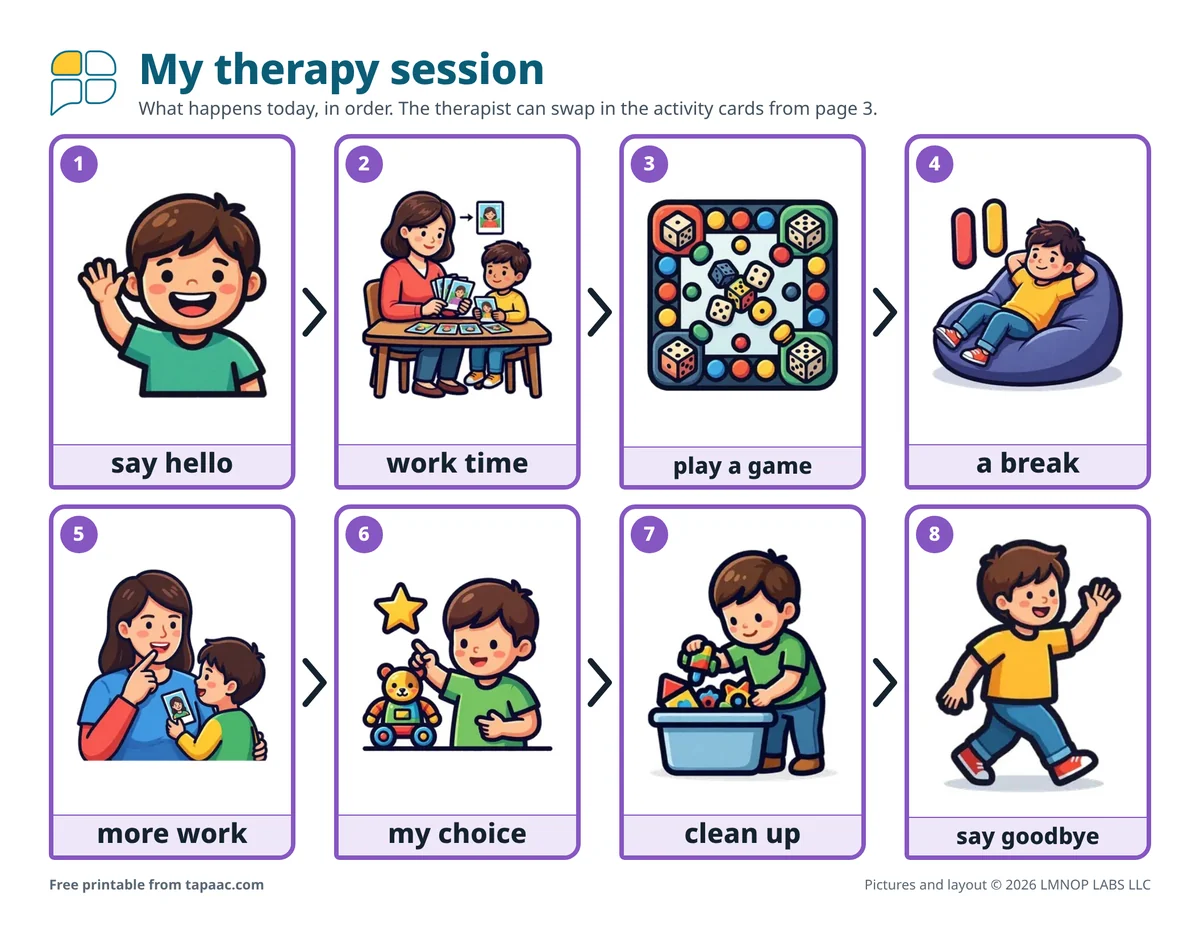
Edit this board in the free board maker: change the words and pictures, then print.
Have Tap AAC? Add to Tap AAC (.obz file, 1,828 KB) · How to add a board
- Free
- No sign-up
- Print as many as you need
Who it’s for
Speech therapists, occupational therapists and other therapists who see children, and the parents who sit in on sessions or practice at home. A child who knows what’s coming, and when it ends, can spend less effort wondering and more on the session. The schedule suits children who use pictures to know what comes next, including autistic children and children who don’t speak or don’t speak much. Change the words and it works for occupational, physical and other therapy too.
How to use it
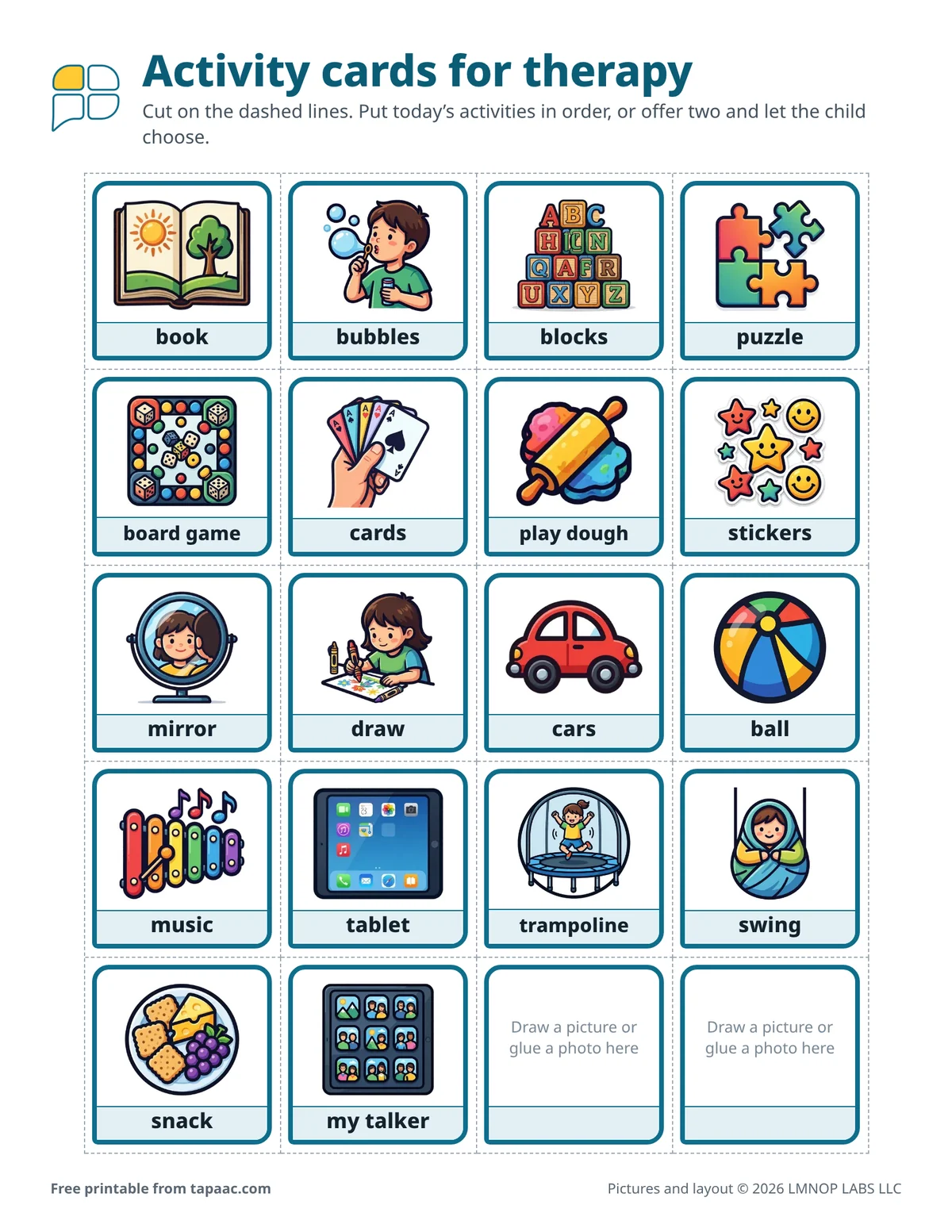
- Plan the session on the schedule before the child arrives. Glue or stick activity cards from page 3 over play a game or my choice to show today’s activities.
- Go through it at the start, pointing to each picture: “First hello, then work time, then a game.”
- Point to each step as it starts, and to the next one before it’s time to change.
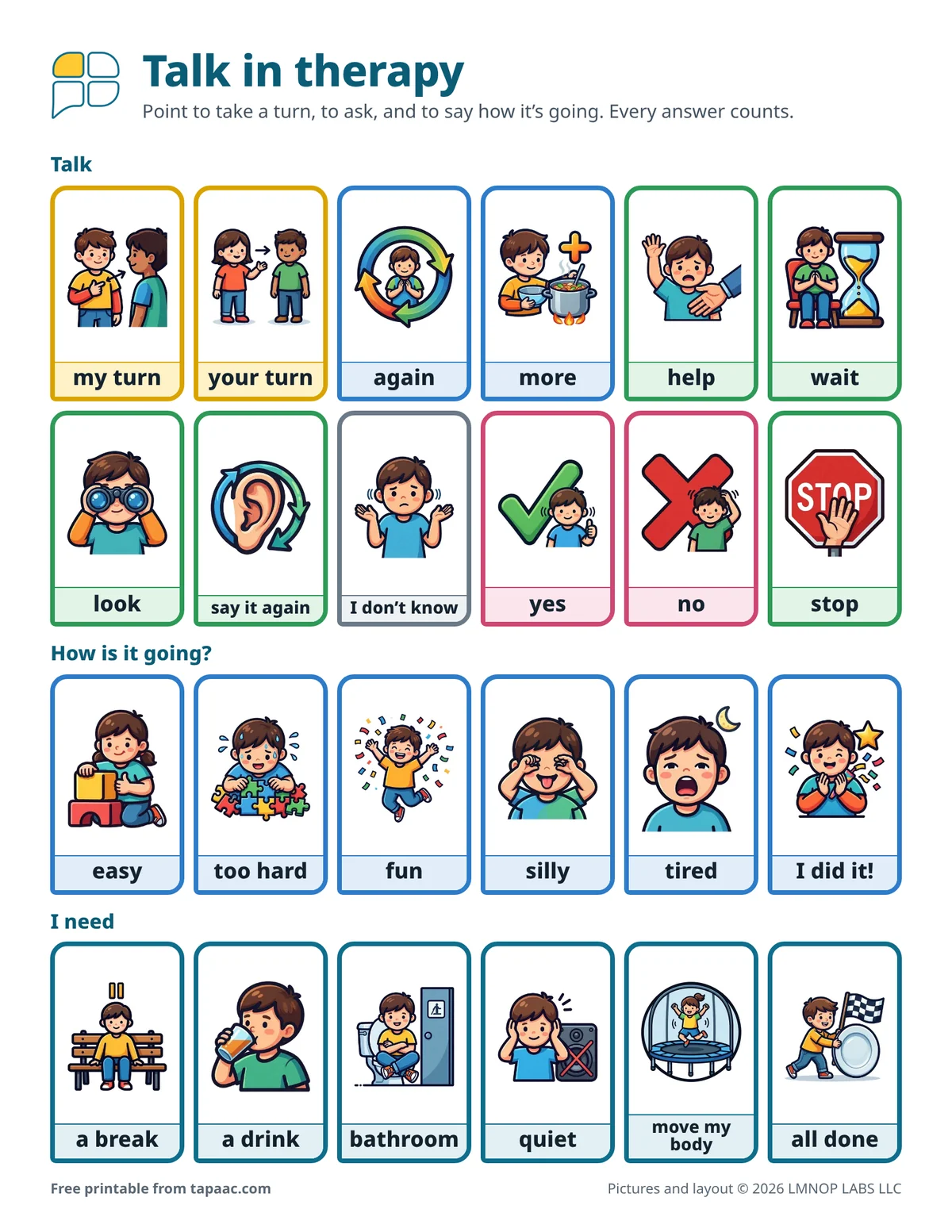
- Keep the talk board on the table, and model on it while you talk: point to my turn and your turn during a game, again when something is fun.
- Answer every message. If the child points to a break or too hard, that’s communication, so respond to it, then come back to the plan.
Choices and breaks
My choice on the schedule is the child’s turn to decide. Offer two activity cards and let them point. The break is on the schedule from the start, so the child doesn’t have to ask to stop; the talk board also has a break and move my body for when one is needed early. A child who knows a break is coming, and that the session ends with say goodbye, can often manage a hard part in between.
If the child uses a talker, a picture board or an app, keep it within reach for the whole session, not just for “AAC time”. Should we save it for therapy? explains why it belongs everywhere.
The same session in the schedule maker
The eight steps are also a routine in the free visual schedule maker. Open “Therapy session” in the schedule maker to put in photos of your own therapy room and toys, take steps out for a short session, or turn it into a first-then board.
Mila is five and comes to speech therapy every Thursday. Her therapist puts the bubbles card over play a game before Mila arrives, and goes through the schedule with her at the table. Halfway through work time, Mila points to too hard. Her therapist says, “Too hard. Let’s do one more,” and points to the next step: a break. After the break, Mila looks at the schedule herself and points to more work. At my choice, she picks stickers over puzzle.
What’s on the PDF
Therapy session steps
- say hello
- work time
- play a game
- a break
- more work
- my choice
- clean up
- say goodbye
Talk
- my turn
- your turn
- again
- more
- help
- wait
- look
- say it again
- I don’t know
- yes
- no
- stop
How is it going?
- easy
- too hard
- fun
- silly
- tired
- I did it!
I need
- a break
- a drink
- bathroom
- quiet
- move my body
- all done
Activity cards
- book
- bubbles
- blocks
- puzzle
- board game
- cards
- play dough
- stickers
- mirror
- draw
- cars
- ball
- music
- tablet
- trampoline
- swing
- snack
- my talker
Printing tips
- Laminate page 1 and put hook-and-loop dots on each step and on the back of the activity cards, so the plan changes every session.
- Send a copy of page 2 home, so the same words are used at home between sessions.
- For one hard moment, use the first-then board; for picking an activity, the choice board; and for everyday words, the core word board.
- Parents: what an AAC evaluation is, and questions to ask the speech-language pathologist.
More free boards
-
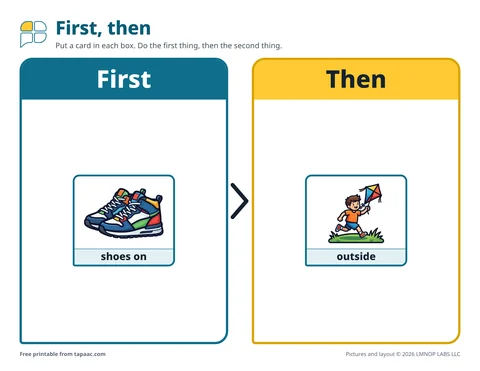 First-then boardShows what happens first and what comes next. With 12 picture cards to cut out.
-
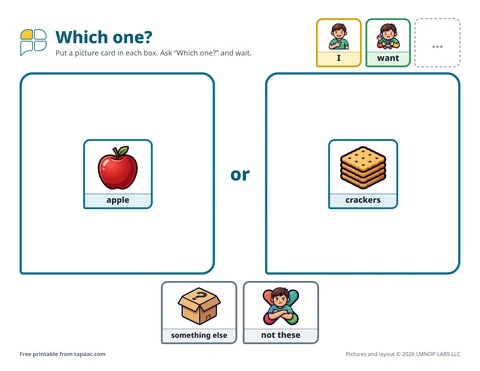 Choice boardsTwo-choice and four-choice boards, with 18 snack, drink and toy cards to cut out.
-
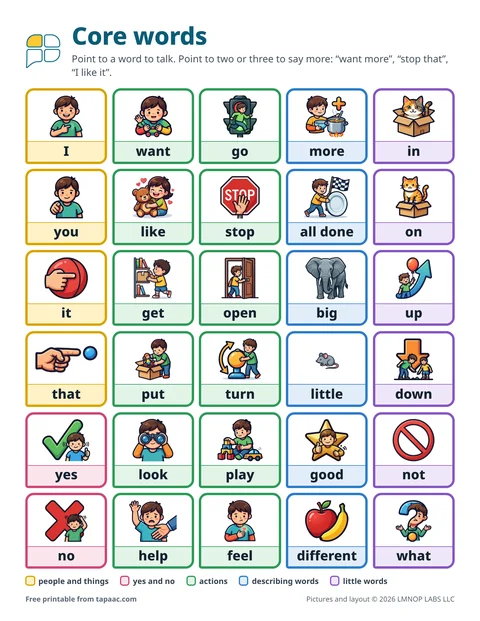 Core word board30 everyday words like I, want, more, stop and help, for building short sentences.
-
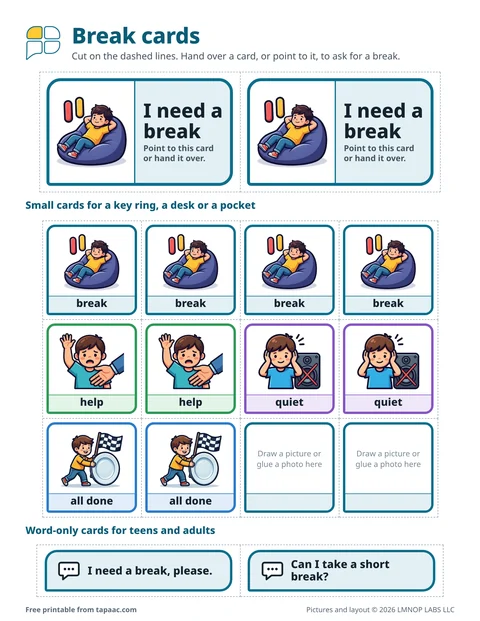 Break cards“I need a break” cards in three sizes, and a board of things to do on a break.
Need a different board? Make your own with the free AAC board maker.
Making a schedule? Use the free visual schedule maker: routines ready to open and change.
These boards and guides are general information, not therapy or medical advice, and they don’t replace a speech therapist. A speech therapist who knows the person can help choose the right words, pictures and layout. The boards are free to print and share; please don’t sell them (terms of use). Questions about the boards? Email support@lmnoplabs.fun.