 Tap AAC
School bus visual schedule: free printable with bus rules
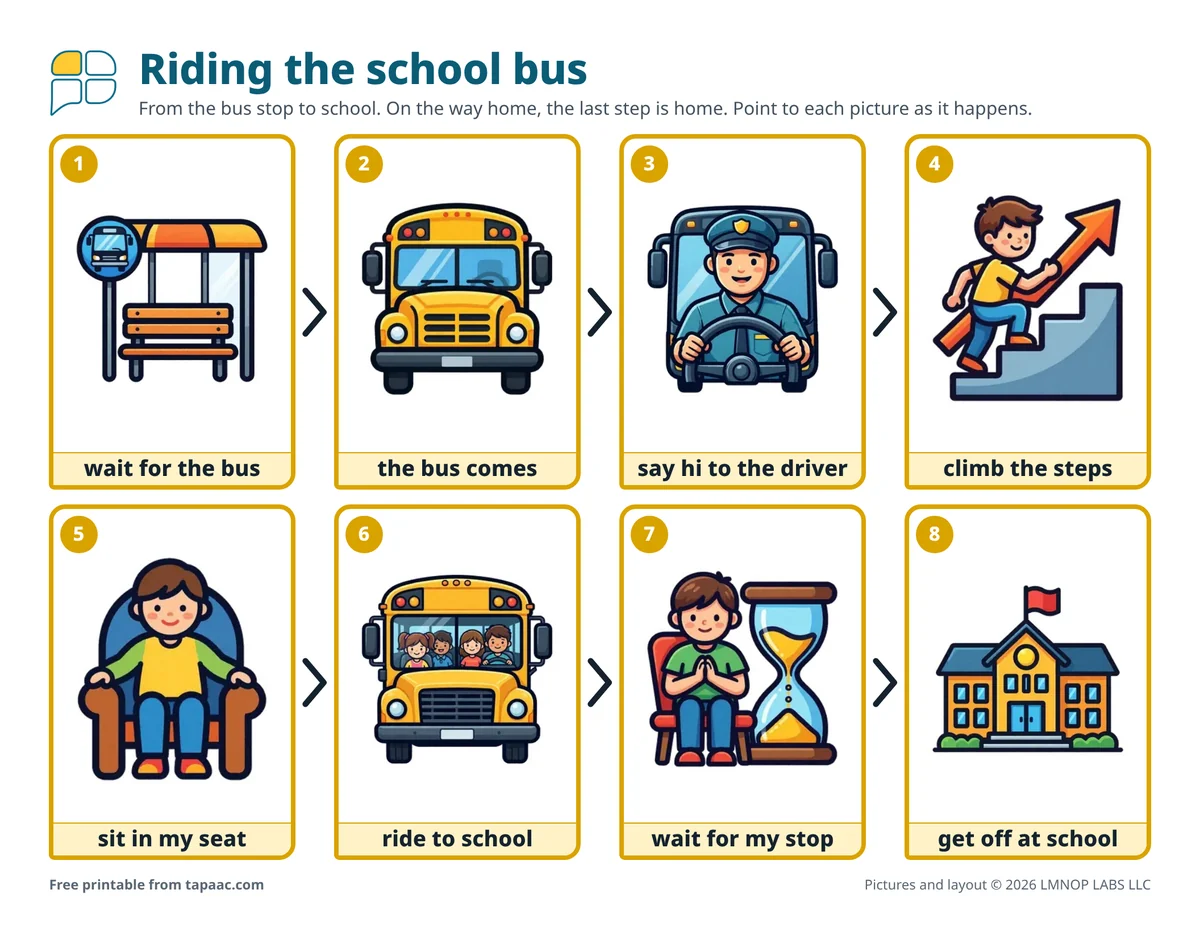
A school bus visual schedule shows a child, in pictures, what happens on the way to school by bus: wait for the bus, the bus comes, say hi to the driver, climb the steps, sit in my seat, ride to school, wait for my stop, and get off at school. This free PDF has those eight steps, a board with the bus rules and words for the ride, and a note to fill in for the bus driver.
Download the free PDF US Letter, 3 pages, 1,182 KB
Printing on A4 paper? Download the A4 PDF (3 pages, 1,184 KB). Or pick one page shape for every page:
Portrait (tall page, 3 pages): US Letter PDF (1,182 KB) · A4 PDF (1,183 KB)
Landscape (wide page, 3 pages): US Letter PDF (1,184 KB) · A4 PDF (1,184 KB)
Edit this board in the free board maker: change the words and pictures, then print.
Have Tap AAC? Add to Tap AAC (.obz file, 1,078 KB) · How to add a board
- Free
- No sign-up
- Print as many as you need
Who it’s for
Children starting to ride the school bus, or moving to a new bus or a new driver, and children who find the bus hard: the noise, the waiting, a long ride, and not knowing when the stop is coming. That includes many autistic children, and children who don’t speak or don’t speak much and can’t tell the driver what they need. Parents, teachers and transportation staff can all use it.
How to use it
- Go through the steps a few days before the first ride. If you can, visit the bus stop together and watch a bus come and go.
- Practice the parts you can: climbing steps, finding a seat, holding the bag on your lap, pointing to is this my stop?
- Fill in the note on page 3 together, and give one to the driver and one to the bus aide, if there is one.
- Show page 1 at the bus stop and point to each step as it happens. On the way home, the last step is home: glue a photo of your front door over it, or cross it out and write it in.
- Keep page 2 in the backpack, where your child can reach it on the bus, with the talker if they have one.
Talking with the driver
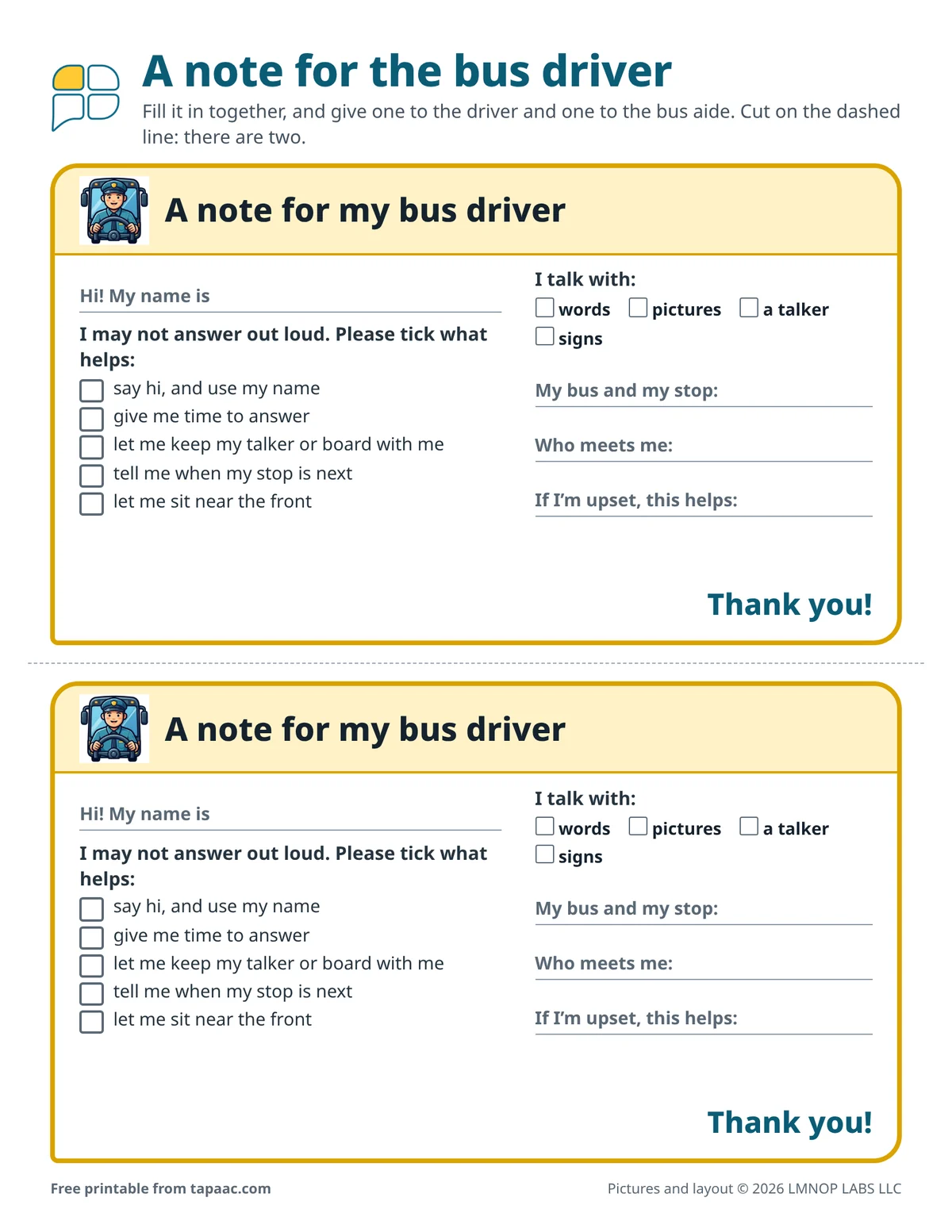
A bus driver has a lot to watch and little time at each stop. The note on page 3 tells them, in one look, how your child talks, what helps, and who meets them. Ask the school who to send it to; many districts have a transportation office that can pass it on, and some buses have an aide. If your child has an IEP, bus transportation and the supports on the bus can be part of it: read AAC and the IEP.
Bus rules, in pictures
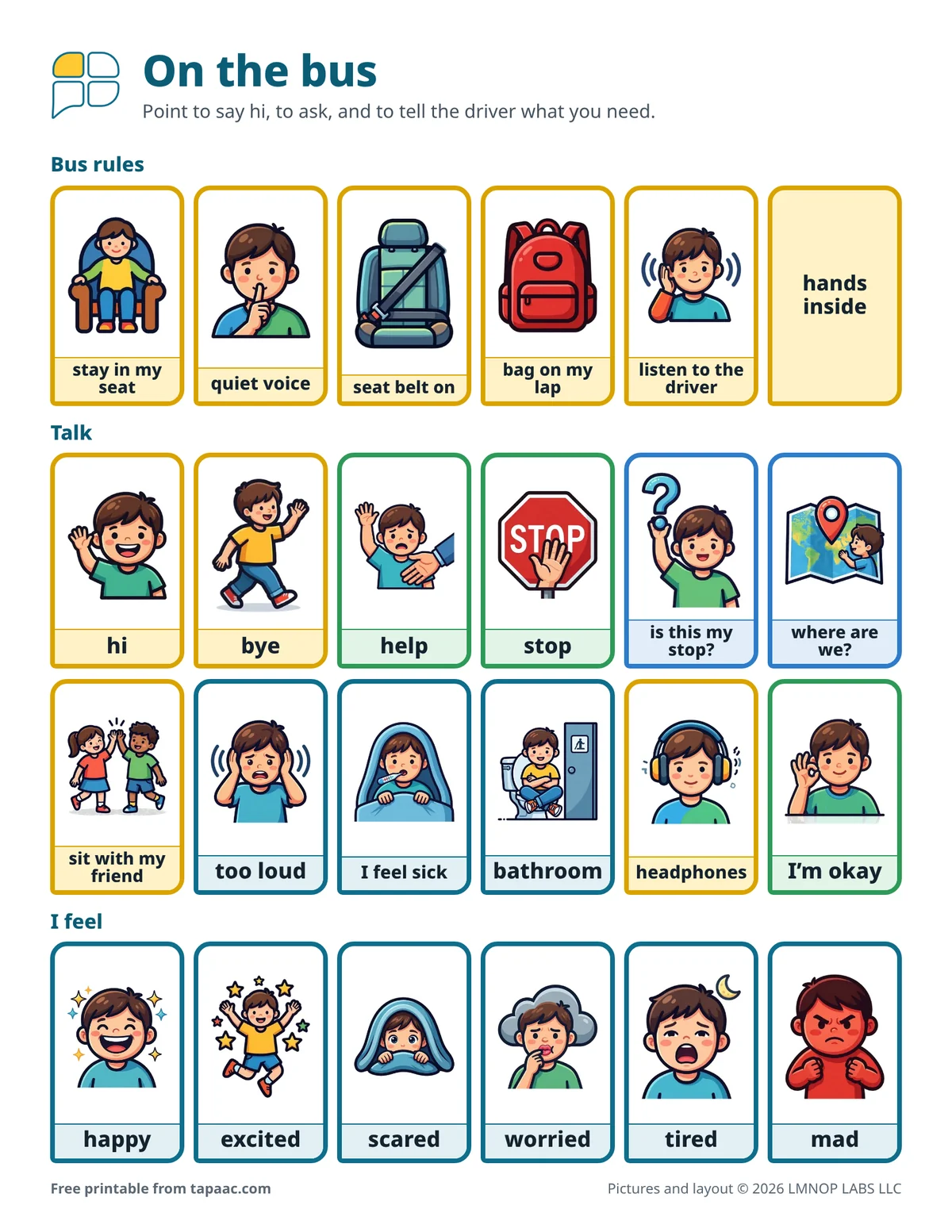
The six rules on page 2 are the ones most school buses ask for: stay in your seat, use a quiet voice, buckle up if the bus has seat belts, keep your bag on your lap, listen to the driver, and keep hands inside. Every bus is different, so ask the school or the driver for theirs, and change the board in the board maker if yours differ. Teach the rules at home with a chair for a seat, and practice too loud and headphones for the noisy days.
The same steps in the schedule maker
The bus ride is also a routine in the free visual schedule maker. Open “School bus” in the schedule maker to make a going-home version, or to put in photos of your own bus stop, bus and school.
Isaac is six and starting the bus in second grade. For a week his mom showed him the schedule at breakfast, and on Sunday they watched the bus go by from the stop. His driver, Ms. Kay, got the note on the first morning: Isaac talks with a talker, likes to sit near the front, and needs to be told when his stop is next. On the ride home, Isaac points to is this my stop? on his board. Ms. Kay smiles: “Two more, then yours.”
What’s on the PDF
Bus steps
- wait for the bus
- the bus comes
- say hi to the driver
- climb the steps
- sit in my seat
- ride to school
- wait for my stop
- get off at school
Bus rules
- stay in my seat
- quiet voice
- seat belt on
- bag on my lap
- listen to the driver
- hands inside
Talk
- hi
- bye
- help
- stop
- is this my stop?
- where are we?
- sit with my friend
- too loud
- I feel sick
- bathroom
- headphones
- I’m okay
I feel
- happy
- excited
- scared
- worried
- tired
- mad
A note for the bus driver
- say hi, and use my name
- give me time to answer
- let me keep my talker or board with me
- tell me when my stop is next
- let me sit near the front
Printing tips
- Laminate page 2 and clip it to the backpack strap with a key ring, so it’s easy to reach in a seat.
- Print the note on card stock so it survives a clipboard or a sun visor.
- For new people along the way, the “I use AAC” cards; for the school day, the classroom visual schedule; for getting home, the after school routine chart.
- The bus is part of the school day too: keep AAC with the student all day, and home and school, working together.
More free boards
-
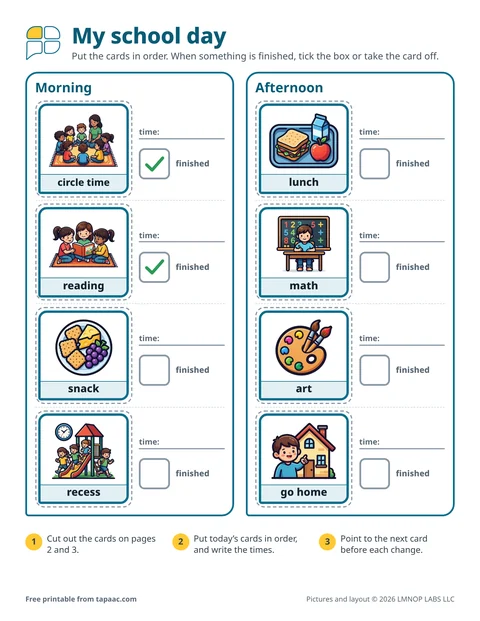 Classroom visual scheduleA school day schedule with times and tick boxes, and 38 picture cards from circle time to go home.
-
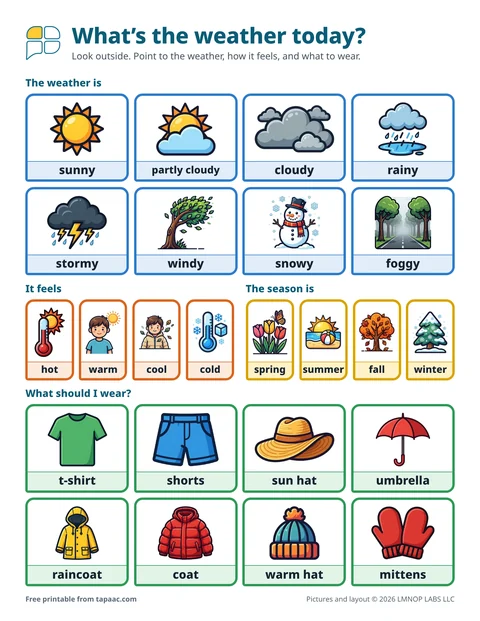 Weather and calendar boardToday’s weather, how it feels, what to wear and the season, plus a calendar page.
-
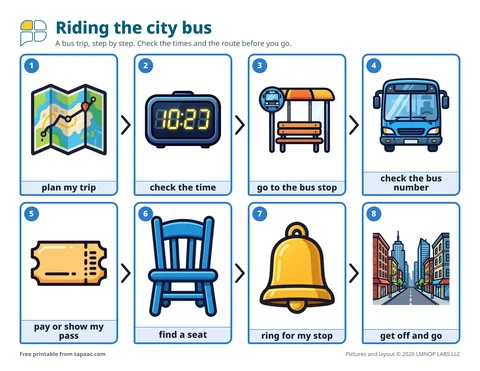 City bus visual scheduleFor teens and adults: the steps of a bus trip, a talk board for the bus and around town, and a trip card to fill in.
-
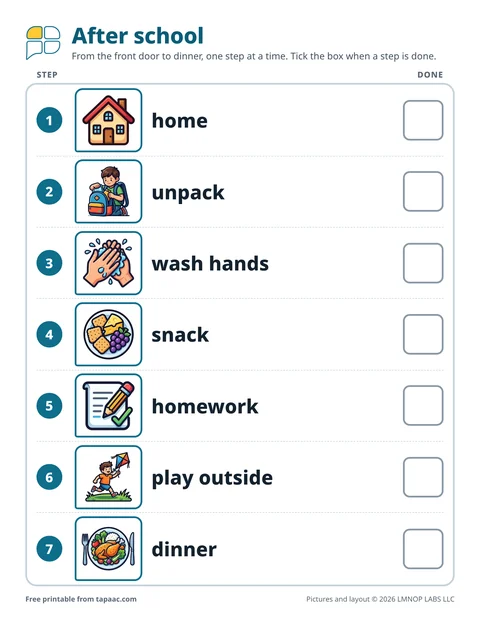 After school routine chartSeven steps from the front door to dinner, 18 picture cards, and a board for telling about the school day.
Need a different board? Make your own with the free AAC board maker.
Making a schedule? Use the free visual schedule maker: routines ready to open and change.
These boards and guides are general information, not therapy or medical advice, and they don’t replace a speech therapist. A speech therapist who knows the person can help choose the right words, pictures and layout. The boards are free to print and share; please don’t sell them (terms of use). Questions about the boards? Email support@lmnoplabs.fun.