 Tap AAC
After school routine chart: free printable visual schedule
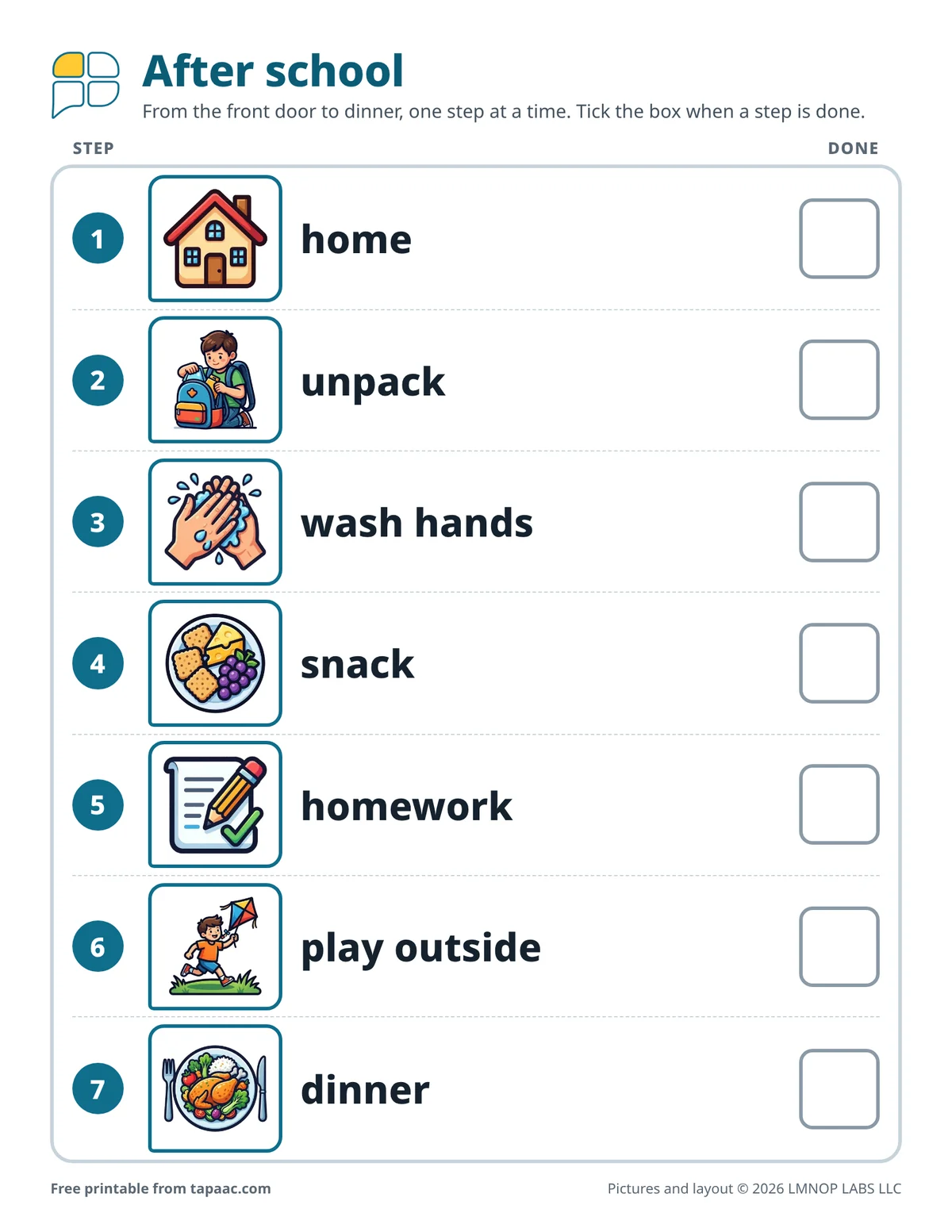
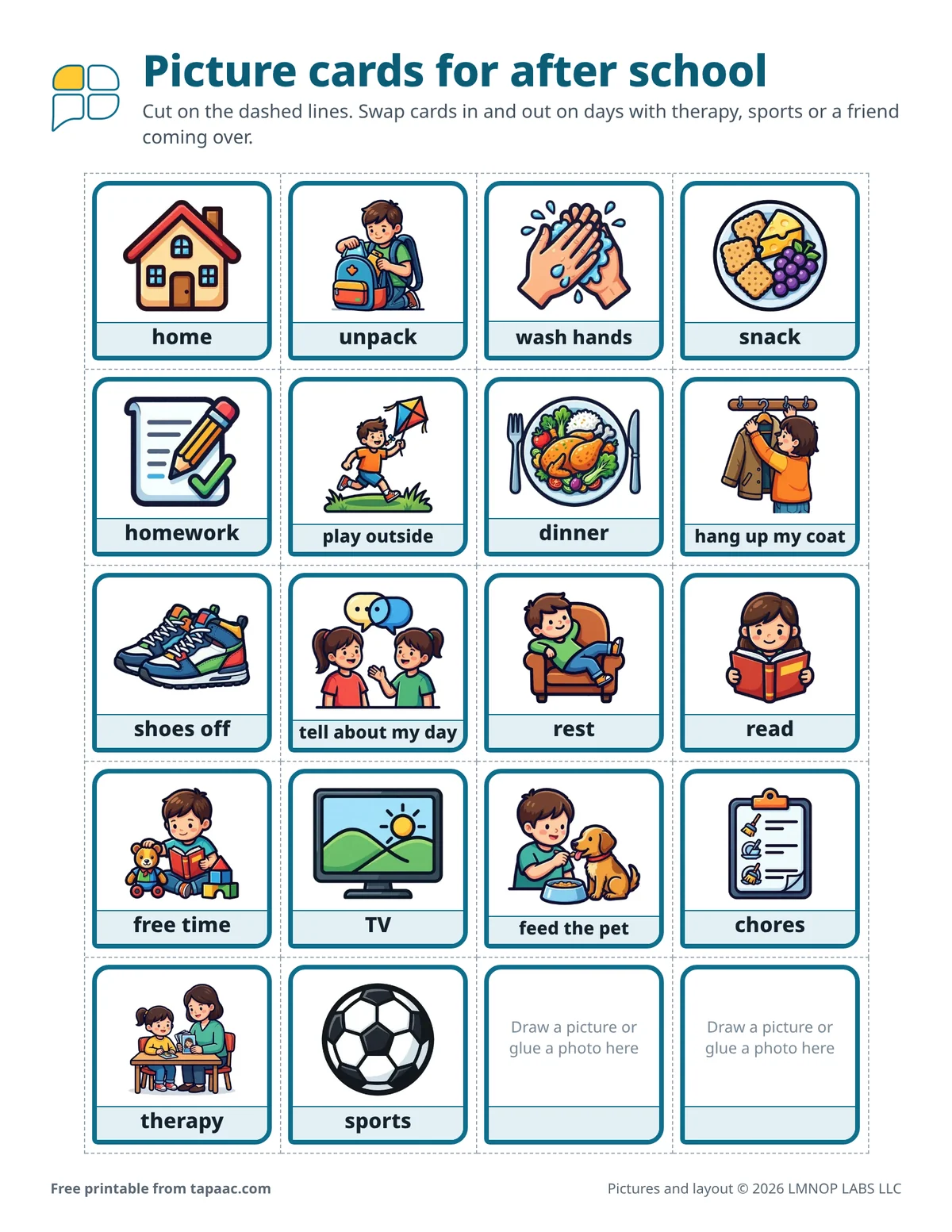
An after school routine chart shows, step by step, what happens between getting home and dinner: home, unpack, wash hands, snack, homework, play outside, dinner, with a box to tick as each step is done. This free PDF has the chart, 18 picture cards for building your own afternoon, and a board for telling about the school day: what we had, who with, how it was, and what happened.
Download the free PDF US Letter, 3 pages, 1,946 KB
Portrait (tall page, 3 pages): US Letter PDF (1,946 KB) · A4 PDF (1,946 KB)
Landscape (wide page, 3 pages): US Letter PDF (1,945 KB) · A4 PDF (1,948 KB)
Edit this board in the free board maker: change the words and pictures, then print.
Have Tap AAC? Add to Tap AAC (.obz file, 1,806 KB) · How to add a board
- Free
- No sign-up
- Print as many as you need
Who it’s for
Children who come home from school tired, hungry and finished with being asked to do things, and the grown-ups who would like the afternoon to go more smoothly. The chart suits children who use pictures to know what comes next, including autistic children and children who don’t speak or don’t speak much. Older children can tick the boxes on their own.
How to use it
- Make the steps your own. Cross out what you don’t do, and glue a card from page 2 over any step that changes during the week: therapy on Tuesdays, sports on Thursdays.
- Put the chart by the front door, where the afternoon starts, at your child’s eye level.
- Show the first step before you go in: “First, home. Next, unpack.” Point to each step as it happens, and let your child tick the box.
- Keep the order the same every day, so your child can count on it. With play outside after homework, the harder step comes first and the fun one is waiting.
- Leave room for a rest. A snack and a few quiet minutes before homework can matter more than getting through the list fast.
The same steps in the schedule maker
The chart has the same seven steps as the after school routine in the free visual schedule maker. Open the after school routine in the schedule maker to change a step, add a photo of your own front door or your child’s favorite snack, or turn the steps to go across the page, then print it.
Talking about the school day
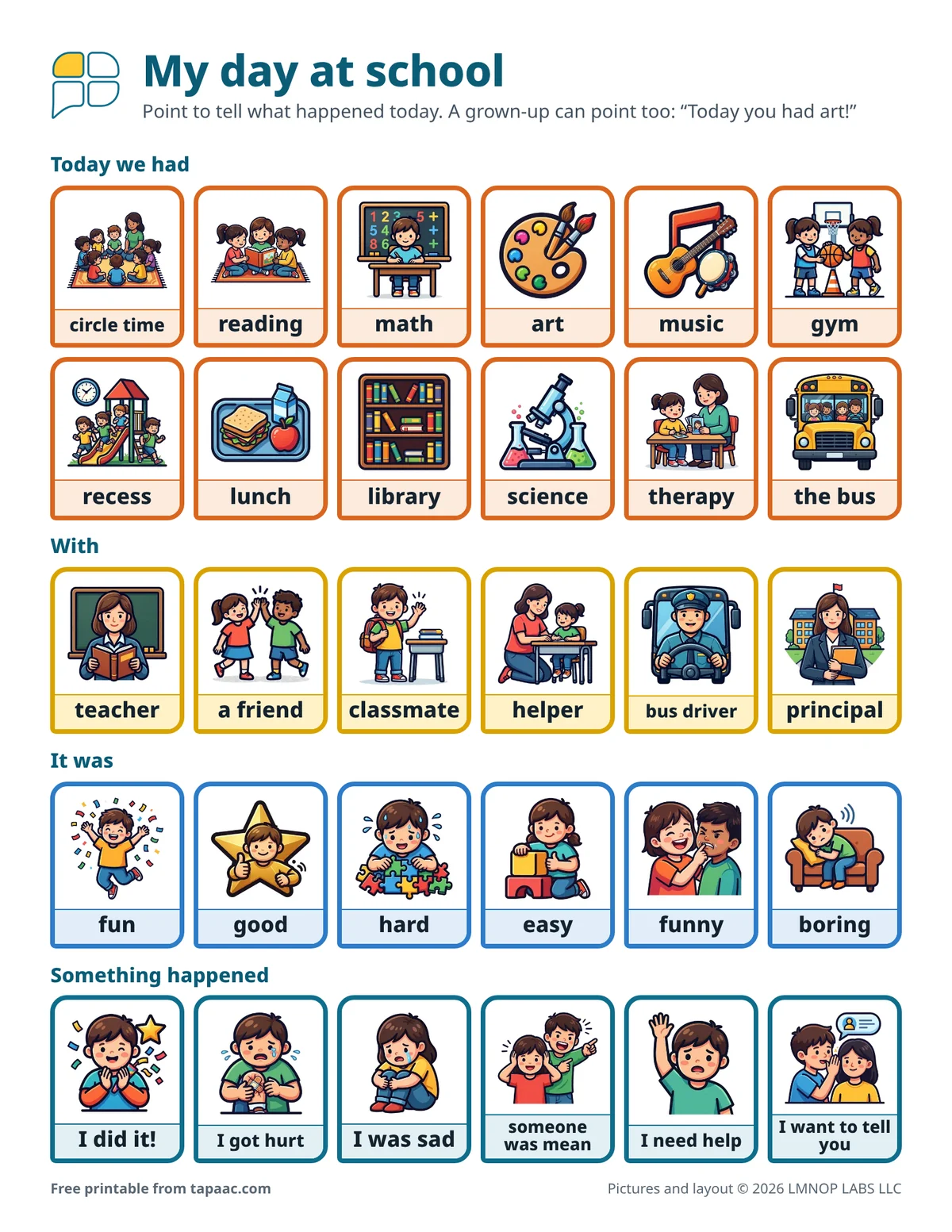
“What did you do at school today?” is a hard question for anyone, and harder for a child who uses AAC: the answer has to be found before it can be said. Page 3 gives the words: what we had, who it was with, how it was, and the things a child most needs a way to say, like I got hurt or someone was mean.
Ask the teacher for one thing that happened today, in a note, a photo or a line in the communication book, so you have somewhere to start: “You had music today! Was it fun?” Point to the words as you ask, and wait. If your child points to I got hurt or someone was mean, take it seriously, ask a few yes-or-no questions, and talk to the school.
Maya is eight, and afternoons used to end in tears in the hallway. Now the chart hangs by the door at her height. She drops her bag, points to unpack and ticks the box. After her snack, her dad opens page 3: “Your teacher wrote that you went to the library.” Maya points to library, then fun, then a friend. On Tuesdays the therapy card covers play outside, and Maya puts it there herself.
What’s on the PDF
After school steps
- home
- unpack
- wash hands
- snack
- homework
- play outside
- dinner
More picture cards (page 2)
- hang up my coat
- shoes off
- tell about my day
- rest
- read
- free time
- TV
- feed the pet
- chores
- therapy
- sports
Today we had
- circle time
- reading
- math
- art
- music
- gym
- recess
- lunch
- library
- science
- therapy
- the bus
With
- teacher
- a friend
- classmate
- helper
- bus driver
- principal
It was
- fun
- good
- hard
- easy
- funny
- boring
Something happened
- I did it!
- I got hurt
- I was sad
- someone was mean
- I need help
- I want to tell you
Printing tips
- Laminate the chart, or slide it into a sheet protector, and tick with a dry-erase marker, so it wipes clean for tomorrow.
- The cards are the same size as the cards for the morning routine chart and the bedtime routine chart, so one set of hook-and-loop dots works for the whole day.
- For the school day itself, use the classroom visual schedule; for one hard step, a first-then board.
- New to pointing while you talk? The one-page AAC modeling handout for parents shows how. For notes and photos that travel between school and home, read home and school, working together.
More free boards
-
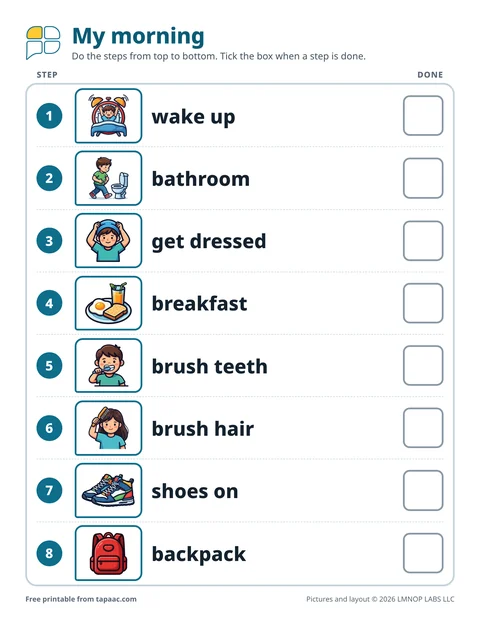 Morning routine chartEight steps from wake up to backpack, with picture cards and a make-your-own schedule.
-
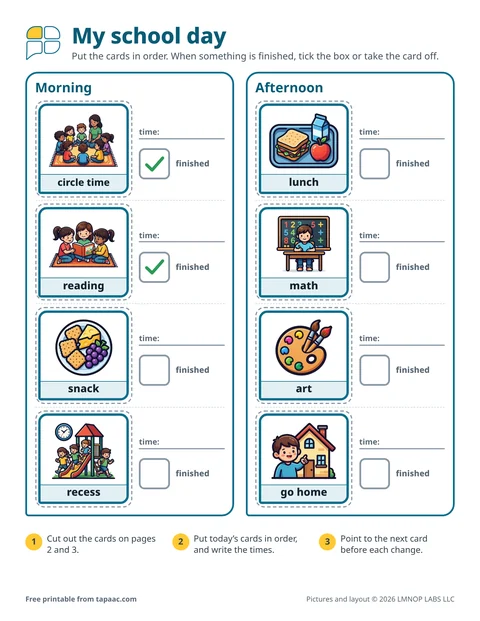 Classroom visual scheduleA school day schedule with times and tick boxes, and 38 picture cards from circle time to go home.
-
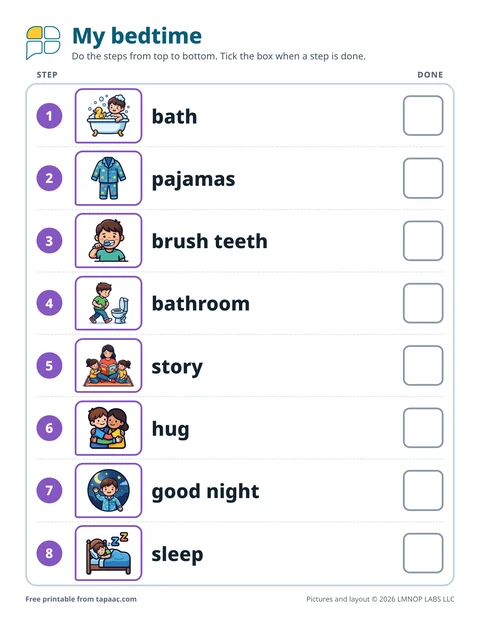 Bedtime routine chartBath, pajamas, teeth, story and sleep, as a checklist or as picture cards.
-
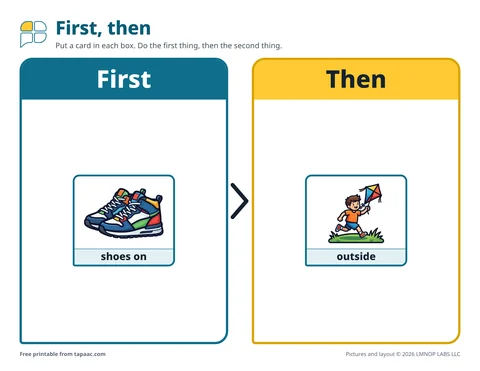 First-then boardShows what happens first and what comes next. With 12 picture cards to cut out.
Need a different board? Make your own with the free AAC board maker.
Making a schedule? Use the free visual schedule maker: routines ready to open and change.
These boards and guides are general information, not therapy or medical advice, and they don’t replace a speech therapist. A speech therapist who knows the person can help choose the right words, pictures and layout. The boards are free to print and share; please don’t sell them (terms of use). Questions about the boards? Email support@lmnoplabs.fun.