 Tap AAC
Where does it hurt? Free printable pain board
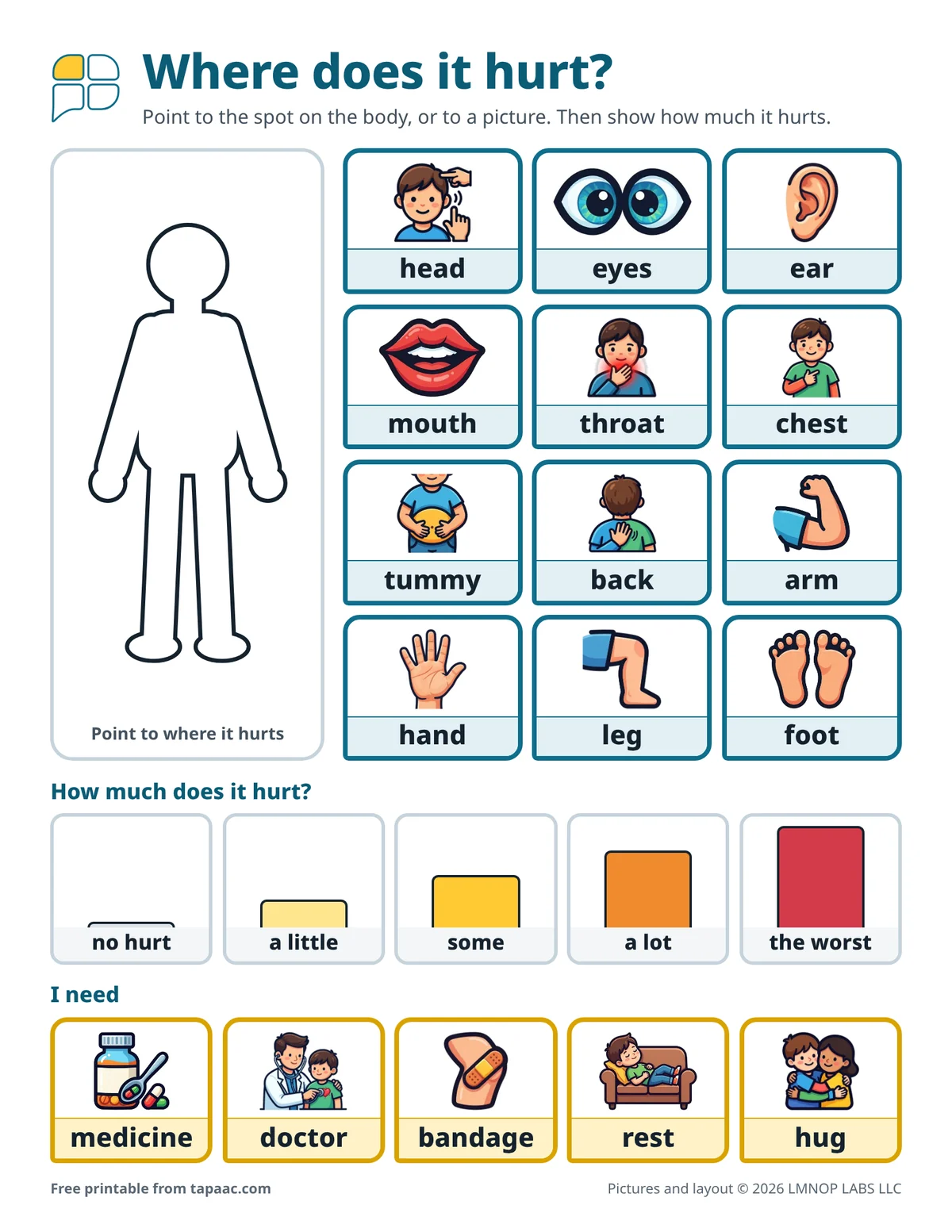
A where-does-it-hurt board helps a person show where the pain is, and how bad it is, without speech. Point to the spot on the body outline, or to a picture like head, ear, throat or tummy. Then point to how much it hurts, from no hurt to the worst.
Download the free PDF US Letter, 1 page, 566 KB
Portrait (tall page, 1 page): US Letter PDF (566 KB) · A4 PDF (566 KB)
Landscape (wide page, 1 page): US Letter PDF (566 KB) · A4 PDF (567 KB)
Edit this board in the free board maker: change the words and pictures, then print.
Have Tap AAC? Add to Tap AAC (.obz file, 500 KB) · How to add a board
- Free
- No sign-up
- Print as many as you need
If someone may be badly hurt or very sick, call their doctor, or call 911 or your local emergency number.
Who it’s for
Children and adults who can’t easily say where they hurt: people who don’t speak or don’t speak much, young children who don’t know the names of body parts yet, and adults whose speech is affected, for example after a stroke. Parents, teachers, school nurses and caregivers use it to find out what’s wrong, and to tell a doctor or nurse what the person showed them.
When it helps
- Bumps and falls: at the playground, at school or at home, when crying is the only answer to “What happened?”
- Aches that can’t be seen: an earache, a toothache, a tummy ache or a headache, when a person can only show that something is wrong.
- At appointments: bring the board so the person can answer the questions themselves. The doctor visit visual schedule shows the steps of the visit, and the getting a shot visual schedule helps with shots.
- Sick days: pain and feeling unwell can come together; the I feel sick communication board covers the rest.
How to use it
- Practice when nothing hurts. Play “Where’s your tummy?” and point to tummy on the board, then on your own body.
- Ask one thing at a time. First “Where does it hurt?” Wait for a point. Then “How much?”
- Point or draw. On a laminated copy, the person (or you) can circle the spot on the body outline with a dry-erase marker.
- Check the answer another way. Point to two choices: “A little, or a lot?” Watch the face and body as well.
- Bring it along. Take it to the doctor, the dentist or the school nurse, and show them how the person points.
The how-much scale
The scale has five steps, no hurt, a little, some, a lot and the worst, shown as bars that get taller, not as faces. Five words can be easier to choose from than ten numbers, especially for a young child. Practice with things that aren’t pain: “How much do you like ice cream? A little, or a lot?” Adults in the hospital may be asked for a number instead; the hospital communication board has a 0 to 10 scale.
Children and adults
The body outline is plain, with no clothes, hair or face, so it works for anyone. With a child, games like “Where’s your nose?” teach body words before they’re needed. With an adult, ask directly, give time to answer, and believe what they show you, even when it’s not what you expected. Point to your own body to check: “Here?”
Ben is five and doesn’t have many words yet. For two nights he has been rubbing his ear and crying. His dad brings the board: “Where does it hurt?” Ben points to ear, then to his own left ear. “How much?” Ben points to a lot. His dad calls the doctor’s office in the morning, and at the visit Ben shows the nurse the same two pictures while his dad explains what he saw at night.
What’s on the PDF
One page: the body outline on the left, with “Point to where it hurts”, and 12 body-part pictures beside it. Below are the how-much scale and an I need row. Pointing to medicine is a way to ask: a grown-up decides, and gives medicine only as the label or the doctor says.
Body parts
- head
- eyes
- ear
- mouth
- throat
- chest
- tummy
- back
- arm
- hand
- leg
- foot
How much does it hurt?
- no hurt
- a little
- some
- a lot
- the worst
I need
- medicine
- doctor
- bandage
- rest
- hug
Printing tips and where to keep it
- Laminate it, so the spot can be circled with a dry-erase marker and wiped clean.
- Keep one with the first-aid kit at home, and one in the bag you take to appointments.
- At school, give a copy to the teacher and the school nurse, and show them how the person points.
More free boards
-
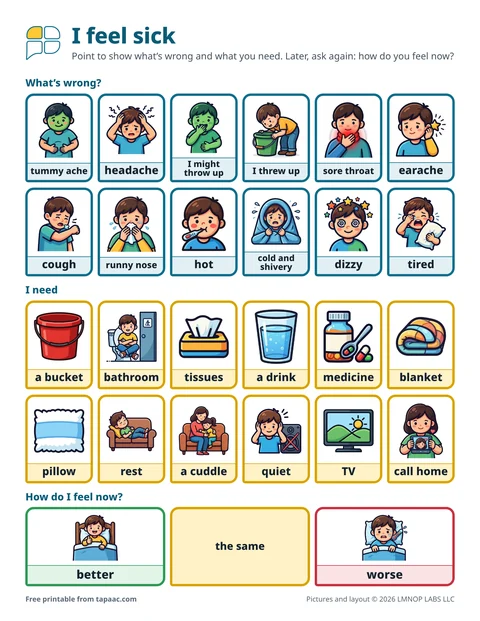 I feel sick communication boardWhat’s wrong, what I need, how I feel now, and sick cards for school to hand to a teacher or the nurse.
-
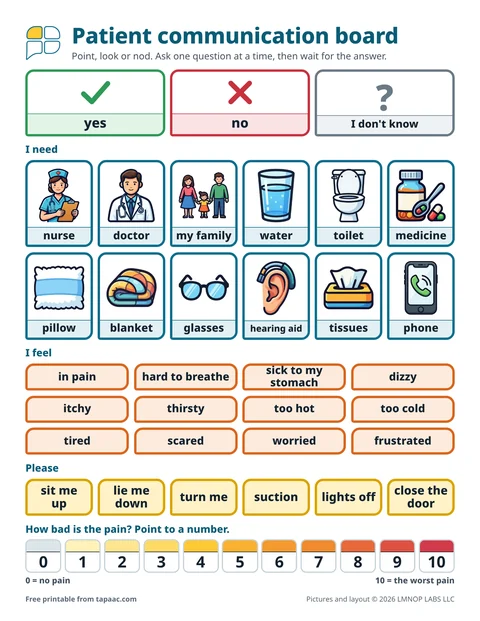 Hospital communication boardFor adult patients: needs, feelings, a 0 to 10 pain scale, letters and questions.
-
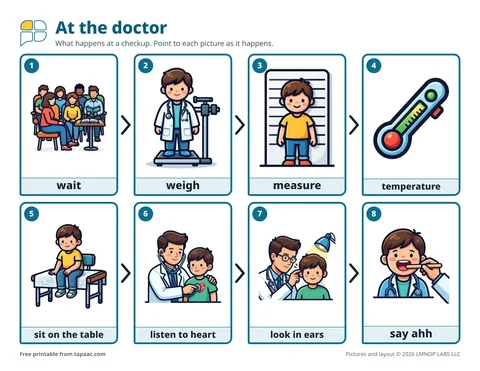 Doctor visit visual scheduleWhat happens at a checkup, words to talk to the doctor, and 20 cards for any visit.
-
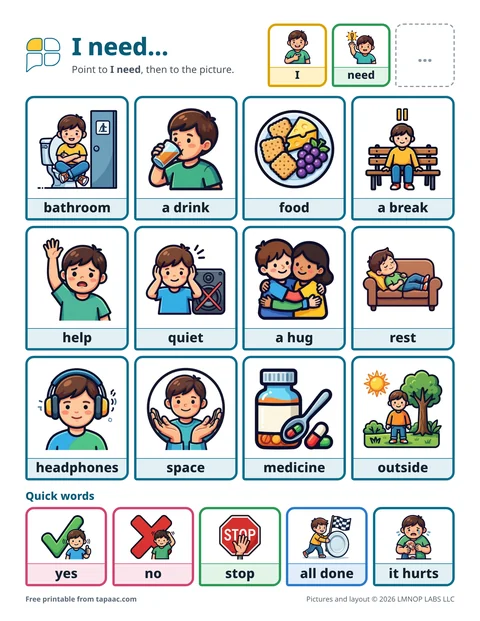 Needs boardBathroom, a drink, food, a break, help, quiet and more, with yes, no and stop.
Need a different board? Make your own with the free AAC board maker.
These boards and guides are general information, not therapy or medical advice, and they don’t replace a speech therapist. A speech therapist who knows the person can help choose the right words, pictures and layout. The boards are free to print and share; please don’t sell them (terms of use). Questions about the boards? Email support@lmnoplabs.fun.