 Tap AAC
Feelings board: free printable PDF
A feelings board lets a person point to how they feel when the words are hard to find. This free board has 16 feelings, from happy and calm to mad, worried and frustrated. Below them are four things that might help: a hug, a break, quiet and help.
Download the free PDF US Letter, 1 page, 836 KB
Portrait (tall page, 1 page): US Letter PDF (836 KB) · A4 PDF (836 KB)
Landscape (wide page, 1 page): US Letter PDF (836 KB) · A4 PDF (836 KB)
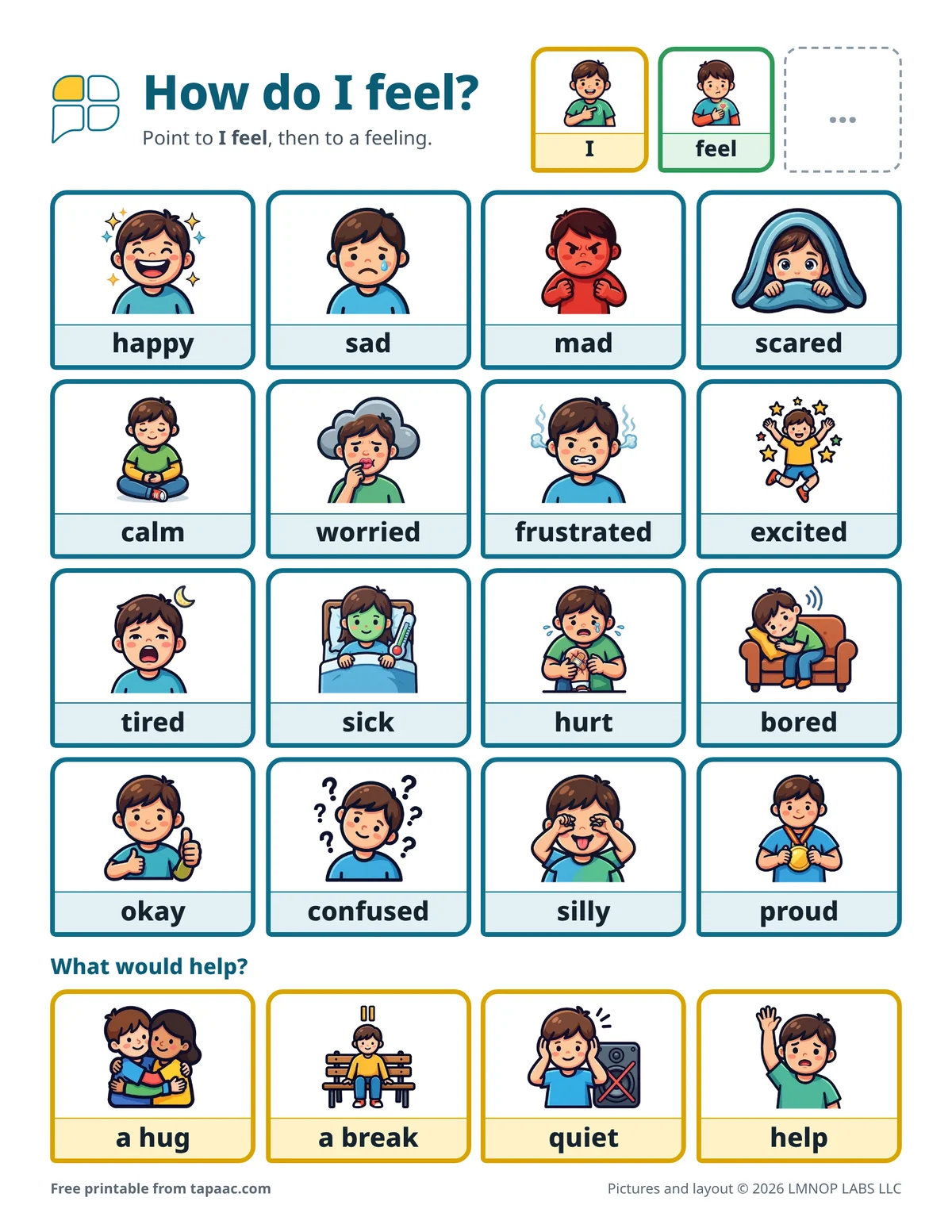
Edit this board in the free board maker: change the words and pictures, then print.
Have Tap AAC? Add to Tap AAC (.obz file, 778 KB) · How to add a board
- Free
- No sign-up
- Print as many as you need
Who it’s for
Children and adults who find feelings hard to put into words: people who don’t speak or don’t speak much, people for whom naming a feeling takes time, and anyone who loses their words when they’re upset. It’s also for the people around them, who see the tears or the shouting and want to know what’s behind it.
When to use it
- In calm moments, every day: after school, at dinner or at bedtime, “How was today?”
- When something changes: a new school, a move, a new baby in the family, or a night like Halloween that is exciting and scary at once.
- After a hard moment, once things are calm again, to talk about what happened.
- At the doctor or the dentist, where scared, worried and hurt matter.
How to use it
- Practice when things are calm. Name feelings as they happen: “You’re laughing. You feel happy,” and point to happy.
- Name your own feelings too. “I feel tired,” pointing to I, feel and tired. This is called modeling, and it shows how the board works.
- In a hard moment, say less. Hold up the board, point and ask one short question: “Mad?” Then wait.
- Move to what would help. After the feeling, point to the bottom row: a hug, a break, quiet or help.
- Accept the answer. If the person points to mad, believe them. Say it back: “You feel mad.”
Tired, sick and hurt
Tired, sick and hurt are on the board because from the outside they can look like a bad mood. Someone who seems cross may be worn out or in pain. If a person points to hurt, the where does it hurt board can help find out where; for being unwell, use the I feel sick communication board.
From the feeling to what would help
The bottom row, “What would help?”, turns a feeling into something you can do. Not everyone wants a hug when they’re upset, so let the person choose, and respect quiet. For more ways to calm down, the calm down choices board has 16 choices, and the break card is a one-card way to ask for a break.
Children and adults
The faces are simple and the words are plain, so teenagers and adults can use the board without it feeling childish. With a young child, name feelings for them many times, as they happen, before you expect them to point. With an adult, ask, wait and believe the answer: an adult after a stroke, for example, may know exactly how they feel and only need a way to say it.
Theo is twelve. One evening he is slamming doors. His mom brings the feelings board and asks, “Mad?” He shakes his head and points to worried, then confused. She asks yes-or-no questions: “About school?” Yes. “The trip tomorrow?” Yes. She finds the trip letter, and they read it through together. Then he points to quiet, and she leaves him with his music.
What’s on the PDF
One page, headed How do I feel?, with the words I and feel to point to first. The 16 feelings are in a four-by-four grid, and the four things that help are along the bottom.
Feelings
- happy
- sad
- mad
- scared
- calm
- worried
- frustrated
- excited
- tired
- sick
- hurt
- bored
- okay
- confused
- silly
- proud
What would help?
- a hug
- a break
- quiet
- help
Printing tips
- Keep one copy where hard moments often happen, and one in a bag for outings. Most printers can print two pages on one sheet, which makes a half-size copy for a bag.
- Laminate it, or use a sheet protector, so it can be wiped clean.
- Want different feelings? Glue a drawing or photo over a picture and write the new word.
More free boards
-
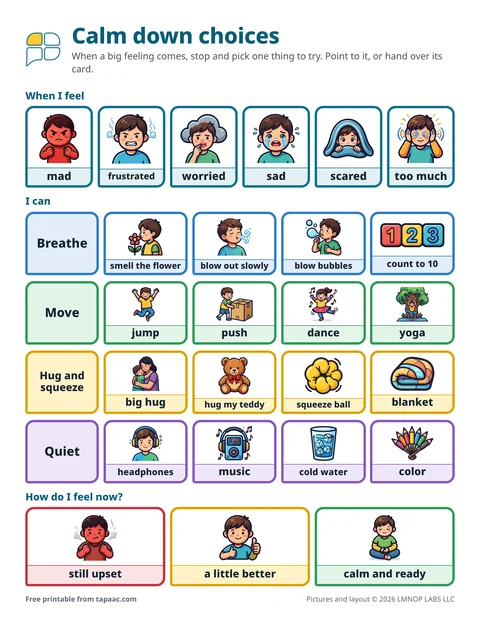 Calm down choices board16 calm down choices in four groups, a breathing square to trace, and calm down cards to cut out.
-
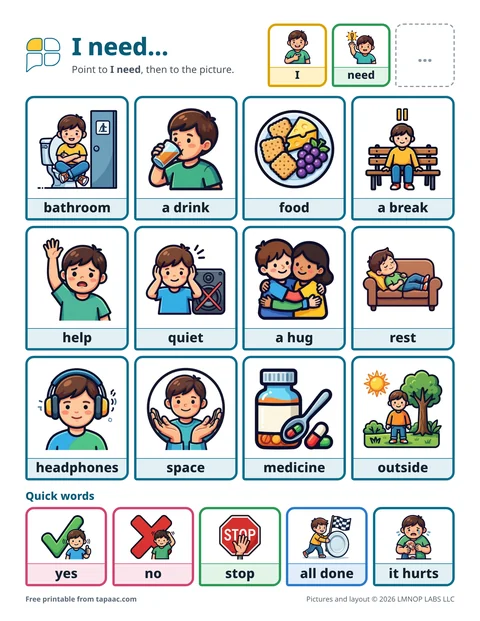 Needs boardBathroom, a drink, food, a break, help, quiet and more, with yes, no and stop.
-
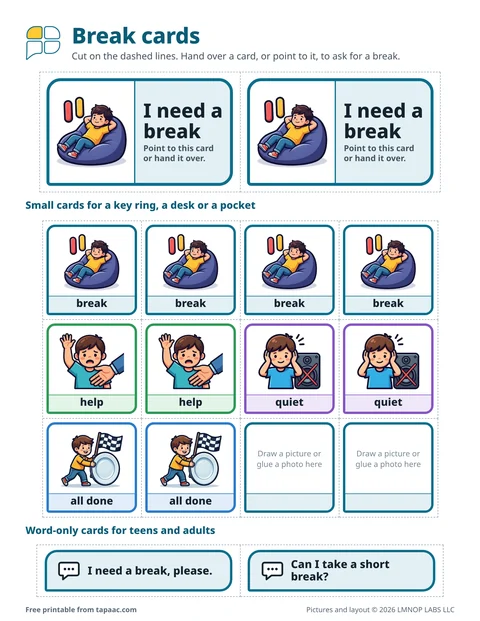 Break cards“I need a break” cards in three sizes, and a board of things to do on a break.
-
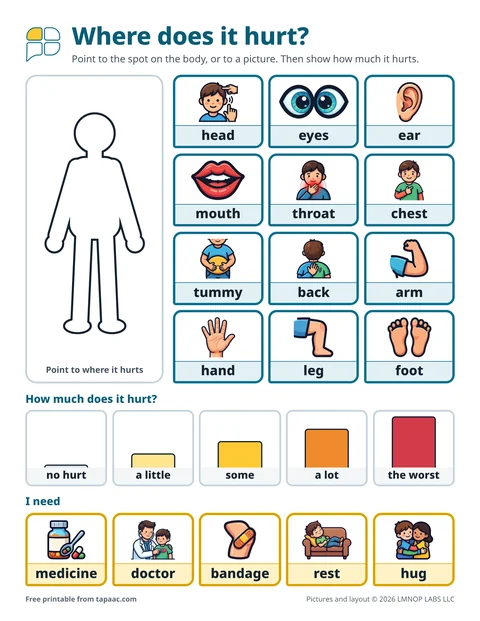 Where does it hurt boardA body outline, 12 body parts and a simple scale for how much it hurts.
Need a different board? Make your own with the free AAC board maker.
These boards and guides are general information, not therapy or medical advice, and they don’t replace a speech therapist. A speech therapist who knows the person can help choose the right words, pictures and layout. The boards are free to print and share; please don’t sell them (terms of use). Questions about the boards? Email support@lmnoplabs.fun.