 Tap AAC
Partner-assisted scanning board with pictures: free printable
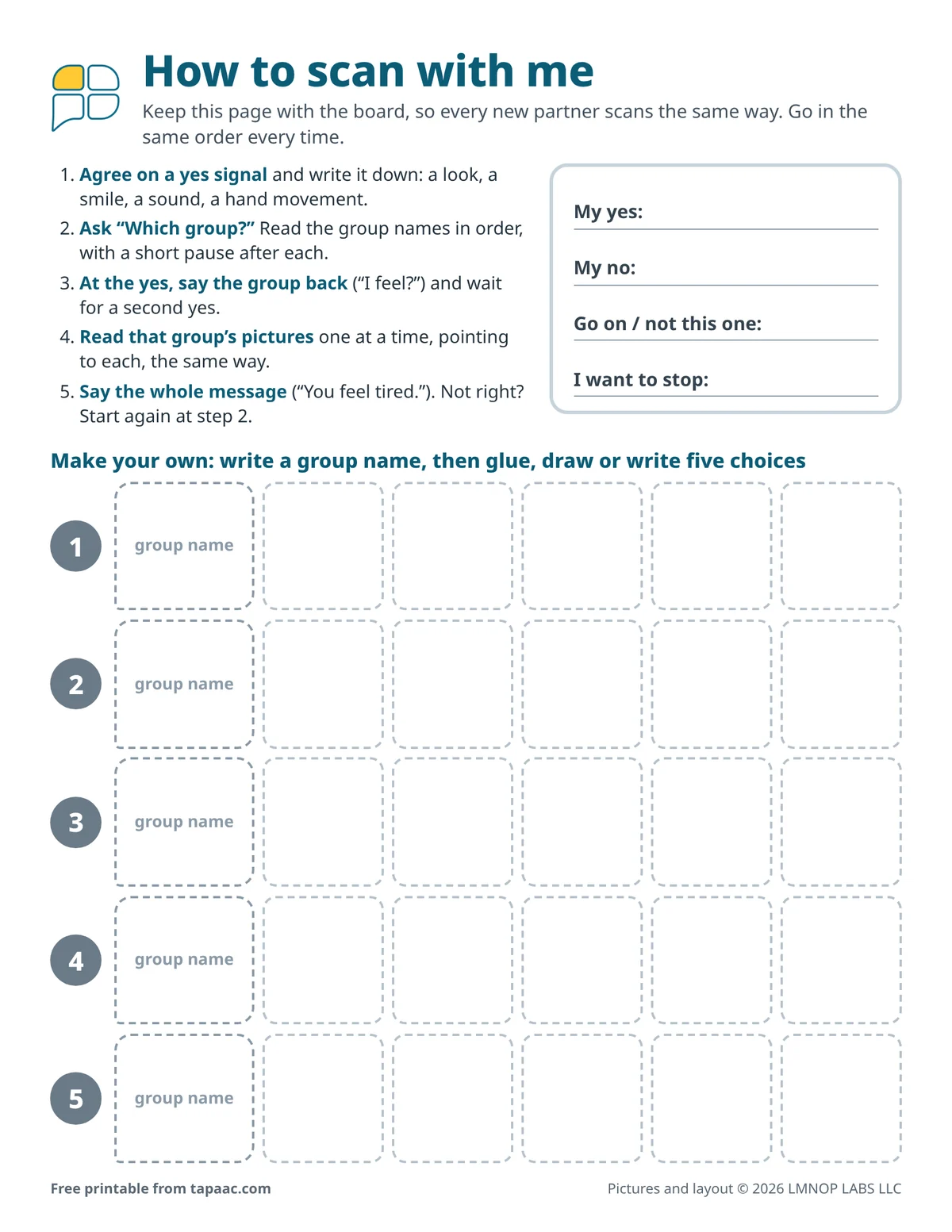
Partner-assisted scanning is a way to choose from a board without pointing: a partner reads the choices out loud, one at a time, and the person gives a yes signal at the one they want. This free board has five numbered picture groups (I want, I feel, people, quick words and something else), so the partner reads the group names first, then the pictures in the chosen group. Page 2 has the steps for the partner and a blank board to fill in.
Download the free PDF US Letter, 2 pages, 957 KB
Portrait (tall page, 2 pages): US Letter PDF (957 KB) · A4 PDF (960 KB)
Landscape (wide page, 2 pages): US Letter PDF (964 KB) · A4 PDF (964 KB)
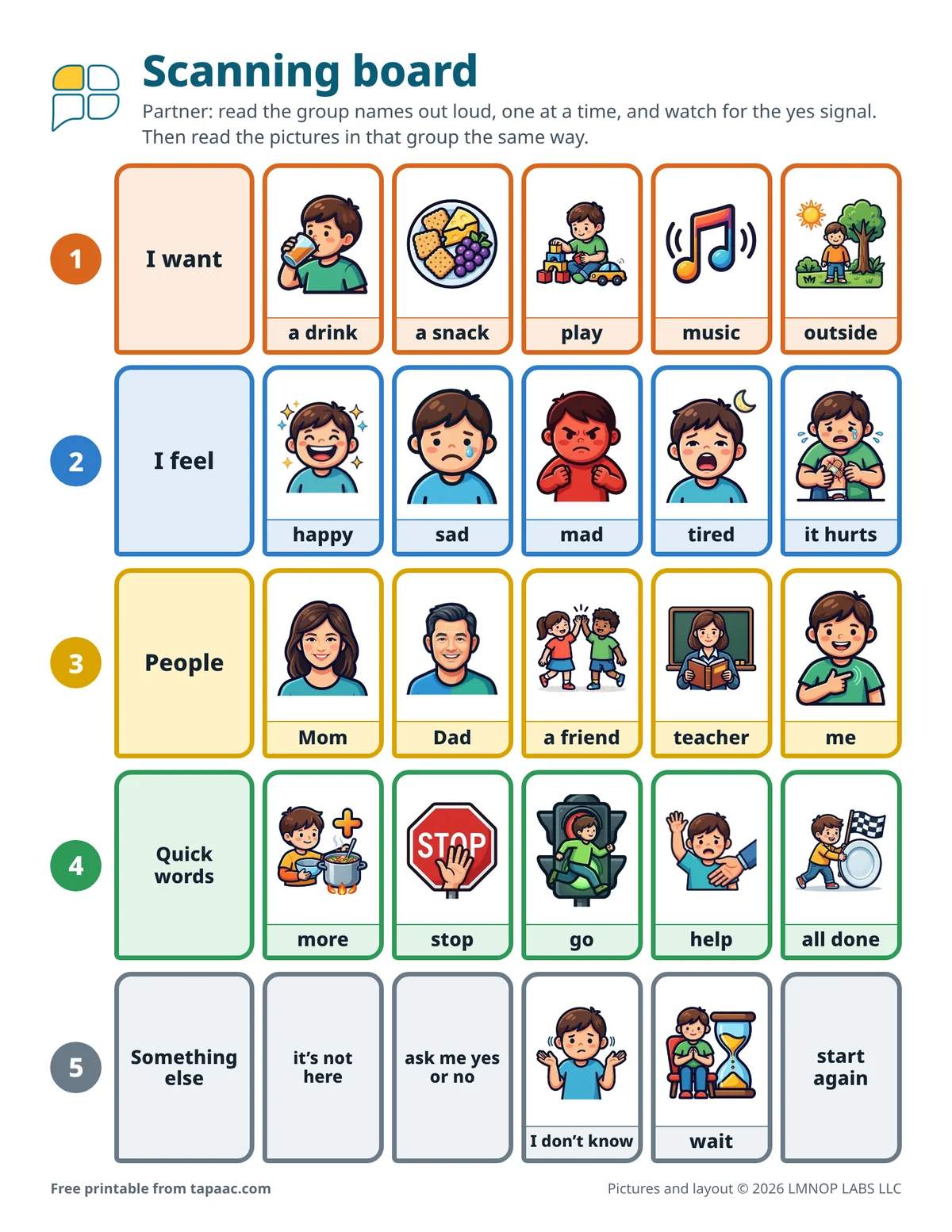
Edit this board in the free board maker: change the words and pictures, then print.
Have Tap AAC? Add to Tap AAC (.obz file, 802 KB) · How to add a board
- Free
- No sign-up
- Print as many as you need
Who it’s for
Children and adults who can’t point, or for whom pointing is slow, tiring or hard to read, but who can give a clear yes: a look, a smile, a sound, a hand or foot movement. Everything on this board is a picture or a short phrase, so it works for people who don’t spell. For spelling, use the partner scanning letter board, page 2 of the eye gaze board.
How partner-assisted scanning works
- Agree on a yes signal and write it on page 2, so every partner knows it. A no signal helps too; some people use no response as no.
- Ask “Which group?” and read the group names in order, pointing to each: “I want… I feel… people… quick words… something else.” Pause after each one.
- At the yes, check it. Say the group back (“I feel?”) and wait for a second yes.
- Read the pictures in that group the same way, one at a time.
- Say the whole message: “You feel tired.” If that isn’t it, start again at the groups.
Read at the same steady pace and in the same order every time. Knowing the order lets the person get ready before you reach the choice they want.
Why groups, and why “something else”
Reading 25 pictures one by one takes a long time, and the person has to stay ready all the way through. With five groups of five, every picture is two choices away: the group, then the picture. The last group matters most. It’s not here tells you the board doesn’t have the word, so you can ask questions instead of guessing. Ask me yes or no invites those questions, and start again fixes a wrong pick without fuss. Read the last group every time, even when you think you know the answer.
Show how it works
People learn a board by seeing it used. Now and then, scan for yourself, out loud: “I feel… tired. I’m tired too.” Use the board at ordinary moments, not only to ask questions, and answer every yes, even one you weren’t expecting.
After school, Leo’s aunt sits beside his wheelchair with the board. “Which group? I want… I feel…” Leo looks up and smiles: his yes. “I feel?” Another smile. “Happy… sad… mad… tired…” Smile. “You feel tired.” A big smile. “Me too. Let’s rest, then play.” Later she scans again, and Leo picks group 5, it’s not here. She switches to yes and no questions and finds out he wants the dog.
What’s on the board
1. I want
- a drink
- a snack
- play
- music
- outside
2. I feel
- happy
- sad
- mad
- tired
- it hurts
3. People
- Mom
- Dad
- a friend
- teacher
- me
4. Quick words
- more
- stop
- go
- help
- all done
5. Something else
- it’s not here
- ask me yes or no
- I don’t know
- wait
- start again
Printing tips
- Print on card stock and laminate it. Hold it where the person can see it, even if they mostly listen.
- Keep page 2 with the board, so a new partner, like a substitute, a babysitter or a nurse, scans the same way.
- Use the blank board for the person’s own groups: favorite people, shows, places. Keep five groups or fewer, and always keep a something else group.
- For quick answers, use the yes and no board; for two or four real choices, the choice boards.
- For more ways to talk without pointing, read AAC and cerebral palsy: touch, switches, eye gaze and partner-assisted scanning.
More free boards
-
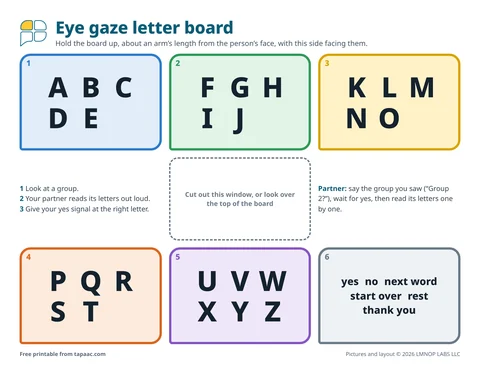 Eye gaze boardSpell with the eyes: a six-group letter board, and a partner scanning board for when looking is hard.
-
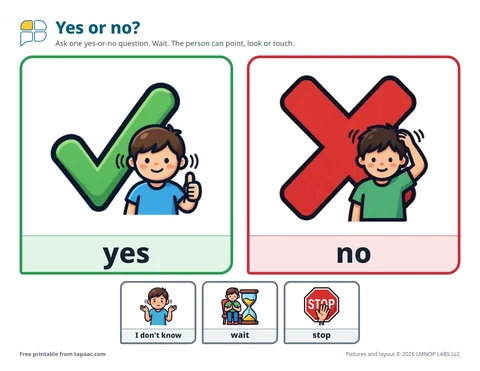 Yes and no boardA big yes and no to point to or look at, plus 20 cards to cut out.
-
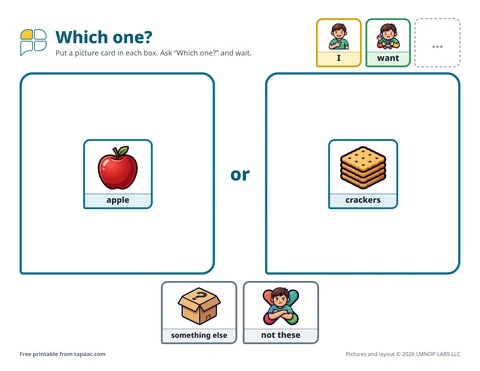 Choice boardsTwo-choice and four-choice boards, with 18 snack, drink and toy cards to cut out.
-
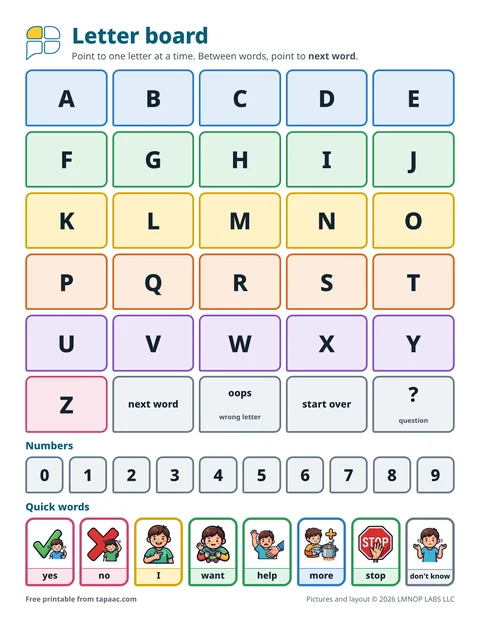 Alphabet boardA to Z for spelling, in alphabet order and keyboard order, with quick words.
Need a different board? Make your own with the free AAC board maker.
These boards and guides are general information, not therapy or medical advice, and they don’t replace a speech therapist. A speech therapist who knows the person can help choose the right words, pictures and layout. The boards are free to print and share; please don’t sell them (terms of use). Questions about the boards? Email support@lmnoplabs.fun.