 Tap AAC
Library communication board: free printable
A library communication board gives a person who doesn’t speak, or doesn’t speak much, the words to ask for the book they want and to talk about it: a book about dinosaurs, where is it?, read to me, next page, again. This free PDF has the board, with 12 book topics and 18 words for the library, and a visual schedule for a library visit, from quiet voice to bring it back.
Download the free PDF US Letter, 2 pages, 1,450 KB
Printing on A4 paper? Download the A4 PDF (2 pages, 1,450 KB). Or pick one page shape for every page:
Portrait (tall page, 2 pages): US Letter PDF (1,451 KB) · A4 PDF (1,450 KB)
Landscape (wide page, 2 pages): US Letter PDF (1,452 KB) · A4 PDF (1,452 KB)
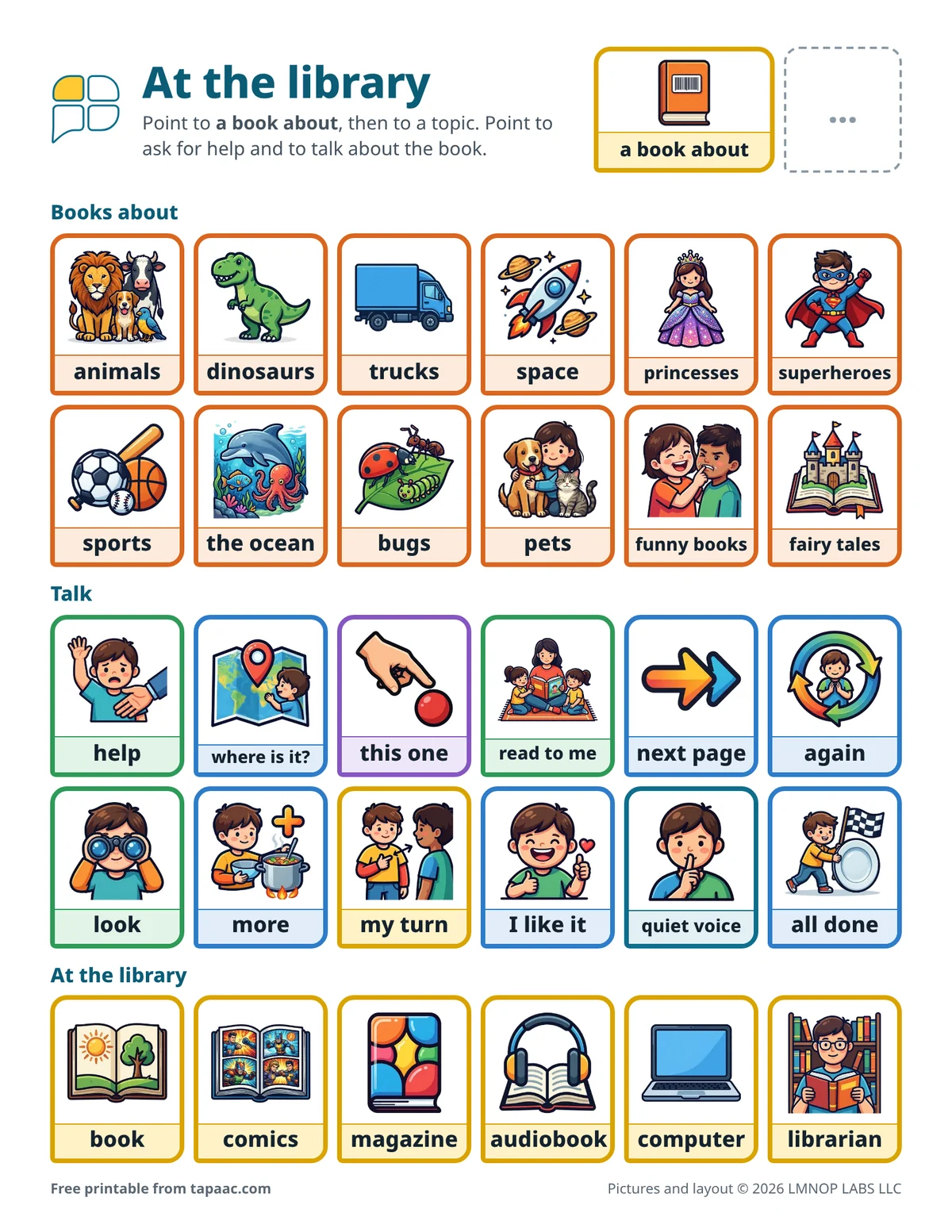
Edit this board in the free board maker: change the words and pictures, then print.
Have Tap AAC? Add to Tap AAC (.obz file, 1,361 KB) · How to add a board
- Free
- No sign-up
- Print as many as you need
Who it’s for
Children who use pictures or a speech device, on a visit to the public library, at a school library lesson or at story time, and the parents, teachers and librarians with them. Choosing a book is one of the best chances in the week to say what you like; this board makes sure the choice is the child’s.
How to use it
- Before you go, look at the schedule together. The library is a place with its own rules, and quiet voice and bring it back make more sense when they’re expected.
- At the shelves, point to a book about, then wait. Let the person find the topic. If it isn’t there, offer two shelves to choose from.
- Ask the librarian together. The person points to a book about and dinosaurs; you can add “Could you show us where they are?”
- While you read, keep the board open next to the book. Model next page, again and look as you go, and pause so the person can say them.
- At the end, ask “Did you like it?” and wait for I like it, or something else.
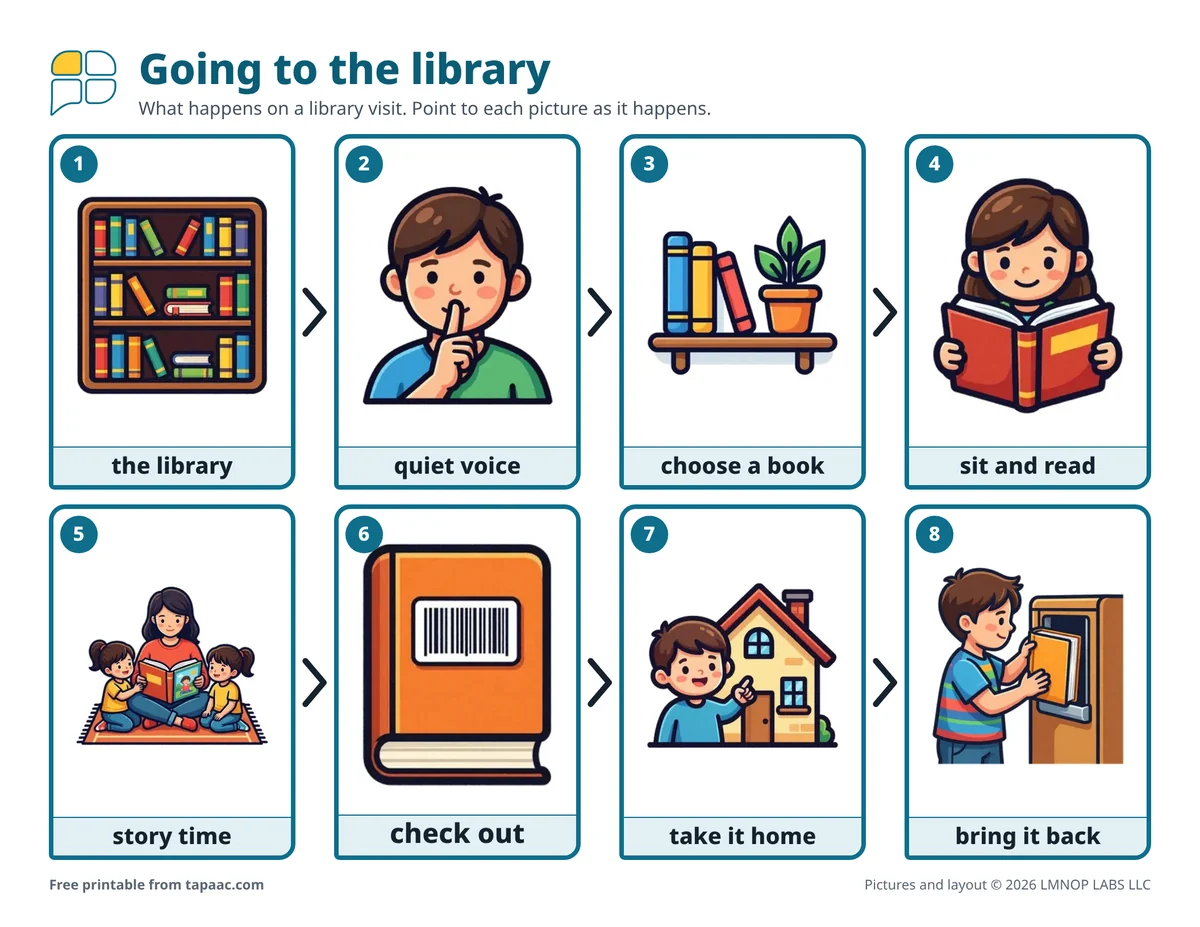
Talking about books
Reading together isn’t only for listening. A child who can point to next page, again and look is leading the reading, and a child who points to that’s funny or I like it is talking about the story. Stop on a picture and point to look, then wait. Read the same favorite book again and again: knowing what comes next gives a child something to say. If the person reads, add the words of the story to a page of the board with sticky notes.
Book topics
The 12 topics on the board (animals, dinosaurs, trucks, space, princesses, superheroes, sports, the ocean, bugs, pets, funny books and fairy tales) cover a lot of children’s shelves. Cross out what your child never chooses, and glue a photo of a favorite book series, character or hobby over it. The library’s own catalog can help you find more books on the topics they pick.
On Saturday morning, Sofia and her grandpa go to the library. At the door he points to quiet voice, and she nods. At the shelves, Sofia points to a book about and then space. They ask the librarian, who walks them to the right shelf. Sofia picks a book about rockets, and on the beanbag she taps next page every time Grandpa stops. At the desk, she hands over the book to check out.
What’s on the board
Books about
- a book about
- animals
- dinosaurs
- trucks
- space
- princesses
- superheroes
- sports
- the ocean
- bugs
- pets
- funny books
- fairy tales
Talk
- help
- where is it?
- this one
- read to me
- next page
- again
- look
- more
- my turn
- I like it
- quiet voice
- all done
At the library
- book
- comics
- magazine
- audiobook
- computer
- librarian
Going to the library (page 2)
- the library
- quiet voice
- choose a book
- sit and read
- story time
- check out
- take it home
- bring it back
Printing tips
- Laminate page 1 and keep it in the library bag, so it goes on every visit.
- Ask your library for a photo of the children’s area or the desk, and glue it over steps 1 and 6.
- For choosing between two books, use the choice board. The core word board has more words for talking about any story.
- Teachers: our guide to AAC in the classroom has ideas for library lessons and story time.
More free boards
-
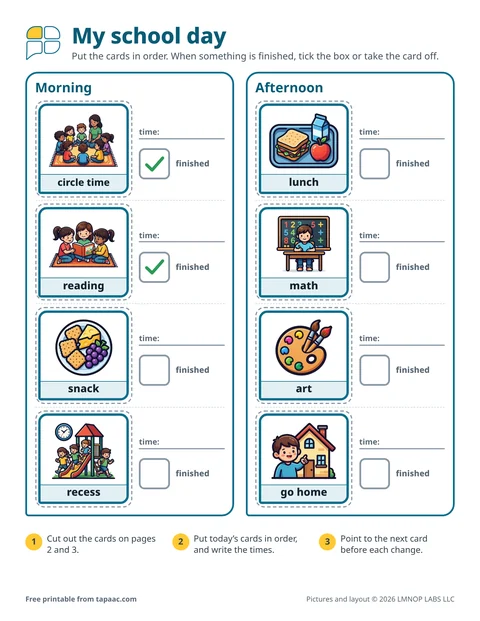 Classroom visual scheduleA school day schedule with times and tick boxes, and 38 picture cards from circle time to go home.
-
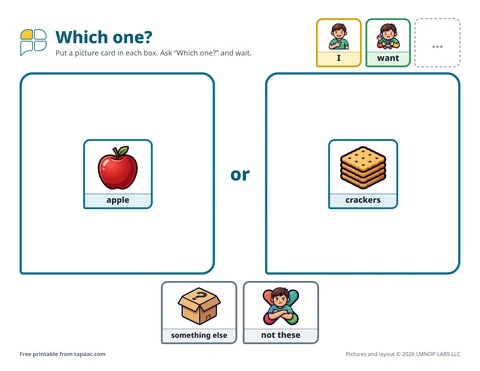 Choice boardsTwo-choice and four-choice boards, with 18 snack, drink and toy cards to cut out.
-
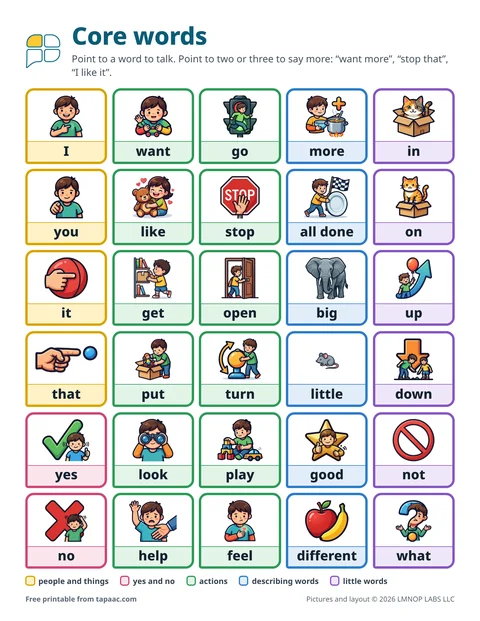 Core word board30 everyday words like I, want, more, stop and help, for building short sentences.
-
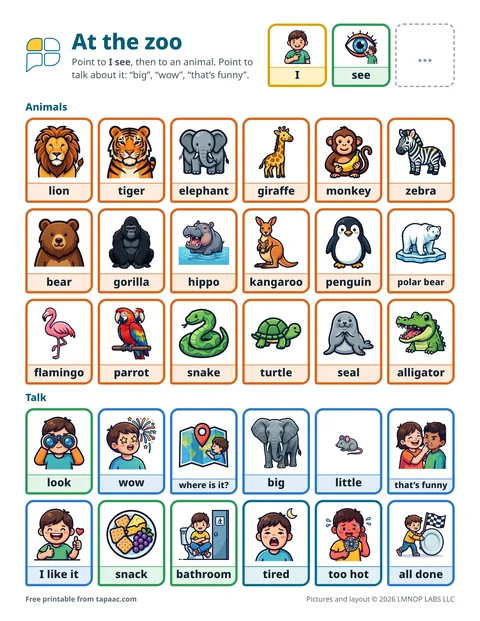 Zoo and field trip board18 zoo animals and zoo talk, a field trip visual schedule, and 18 cards for any trip.
Need a different board? Make your own with the free AAC board maker.
These boards and guides are general information, not therapy or medical advice, and they don’t replace a speech therapist. A speech therapist who knows the person can help choose the right words, pictures and layout. The boards are free to print and share; please don’t sell them (terms of use). Questions about the boards? Email support@lmnoplabs.fun.