 Tap AAC
Zoo communication board and field trip visual schedule
A zoo communication board lets a person who doesn’t speak, or doesn’t speak much, say what they see and what they think of it: I see a giraffe, big, wow, that’s funny. This free PDF has 18 zoo animals and 12 words for talking, a field trip visual schedule from the bus to back at school, and 18 cards that turn it into a schedule for any trip: the farm, a museum, the aquarium or the fire station.
Download the free PDF US Letter, 3 pages, 2,046 KB
Printing on A4 paper? Download the A4 PDF (3 pages, 2,047 KB). Or pick one page shape for every page:
Portrait (tall page, 3 pages): US Letter PDF (2,046 KB) · A4 PDF (2,047 KB)
Landscape (wide page, 3 pages): US Letter PDF (2,050 KB) · A4 PDF (2,050 KB)
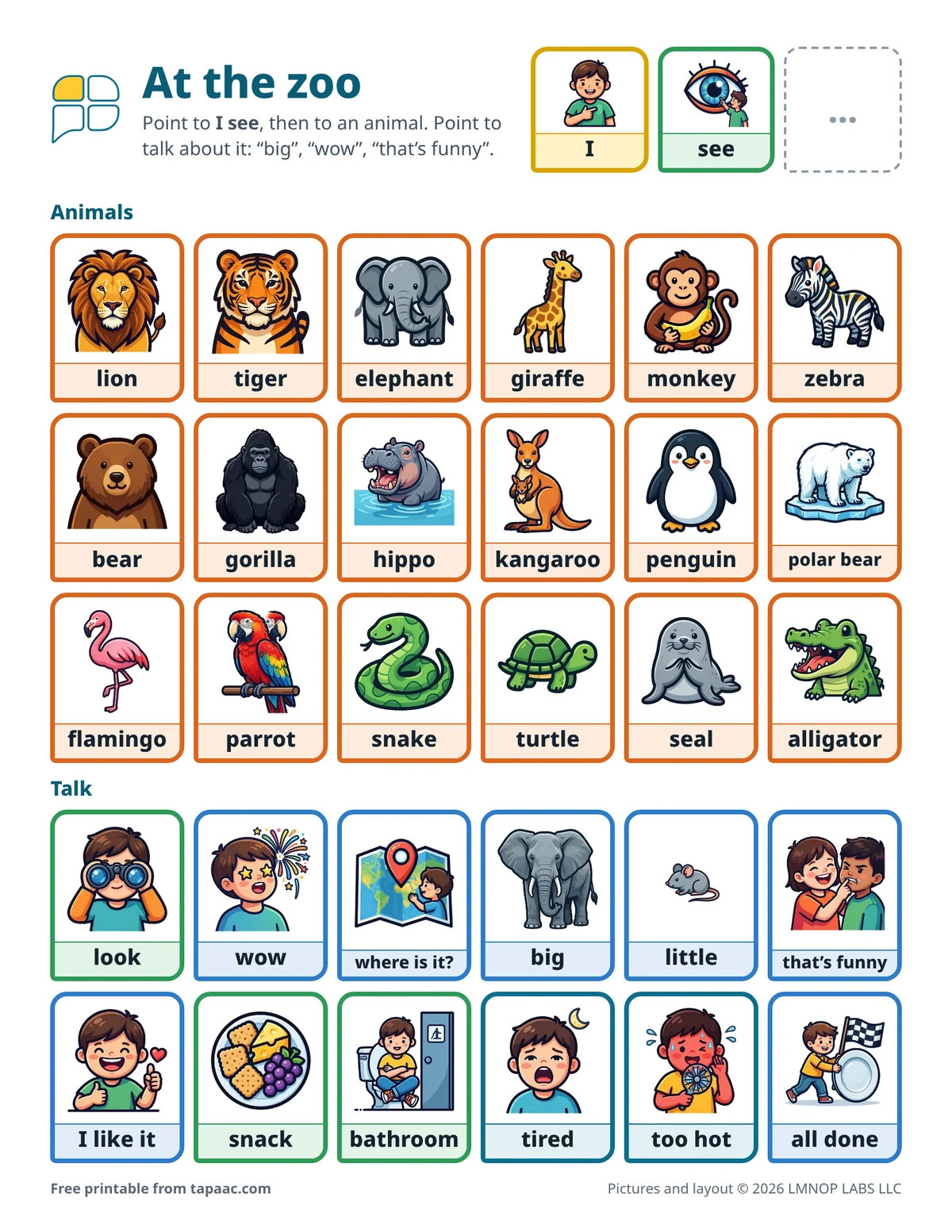
Edit this board in the free board maker: change the words and pictures, then print.
Have Tap AAC? Add to Tap AAC (.obz file, 1,913 KB) · How to add a board
- Free
- No sign-up
- Print as many as you need
Who it’s for
Children who use pictures or a speech device, on a family day at the zoo or a school field trip, and the teachers, aides and parent helpers who go with them. A trip is a day full of new places, crowds and changes of plan; the schedule shows the day, and the board gives the person something to say about the animals besides “yes” and “no”.
How to use it
- Before the trip, go through the schedule and look at the animals together. Circle the ones you’ll go and see first.
- At the zoo, point to I see and then to the animal: “I see a penguin!” Then add a word about it: big, little, wow, that’s funny.
- Wait at each enclosure. Give the person time to find the animal on the board and point to it, before you move on.
- Answer the needs straight away: bathroom, snack, tired and too hot come up on every trip.
- Back home or at school, use the board to tell someone about the day: “I see gorilla. Big!”
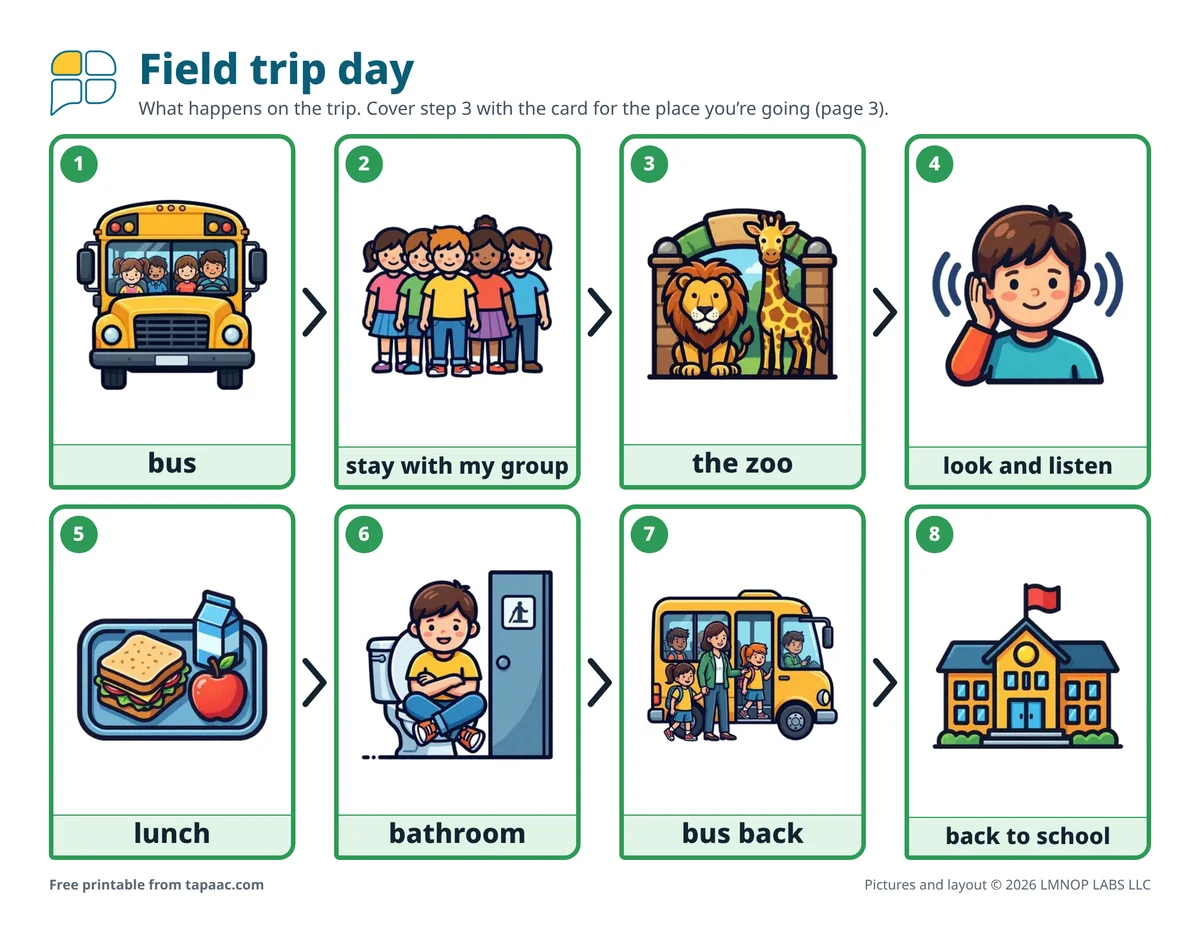
A schedule for any field trip
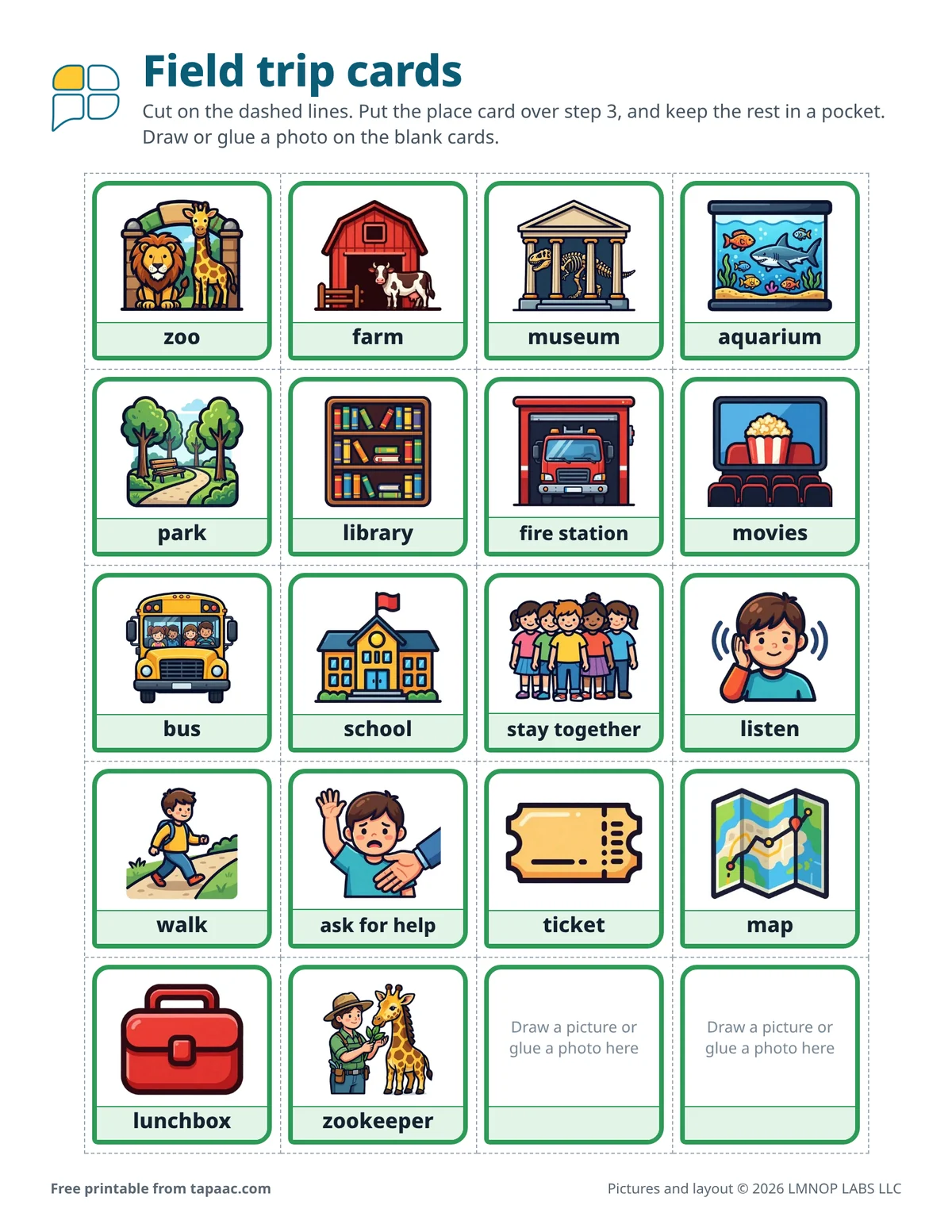
Page 2 is a field trip day: bus, stay with my group, the place, look and listen, lunch, bathroom, bus back, back to school. Step 3 says the zoo; for another trip, cut out the place card from page 3 (farm, museum, aquarium, park, library, fire station or movies) and stick it over step 3. The other cards (stay together, listen, walk, ask for help) are for the rules the teacher goes through on the bus. Teachers can send the schedule home a few days before, so families can talk about the trip too.
For teachers and helpers
Give the adult in the student’s group a copy of page 1 and one sentence: “He points to talk. Give him time.” Put a name tag on the student’s bag with the teacher’s name and the school, and keep the board in a clear sleeve on a lanyard or clipped to the bag, so it’s out when it’s needed and not in the bottom of the backpack.
It’s Ethan’s first school trip. On the bus, his aide points to step 2, stay with my group, and to the zoo card. At the penguins he points to I see, penguin, then that’s funny, and his friend laughs too. By lunch he points to tired and too hot, so they sit in the shade. Back at school, he tells his teacher about the day: I see, gorilla, big.
What’s on the PDF
Animals
- lion
- tiger
- elephant
- giraffe
- monkey
- zebra
- bear
- gorilla
- hippo
- kangaroo
- penguin
- polar bear
- flamingo
- parrot
- snake
- turtle
- seal
- alligator
Talk
- I
- see
- look
- wow
- where is it?
- big
- little
- that’s funny
- I like it
- snack
- bathroom
- tired
- too hot
- all done
Field trip day (page 2)
- bus
- stay with my group
- the zoo
- look and listen
- lunch
- bathroom
- bus back
- back to school
The cards on page 3: zoo, farm, museum, aquarium, park, library, fire station, movies, bus, school, stay together, listen, walk, ask for help, ticket, map, lunchbox and zookeeper, plus two blank cards. They are 1.6 inches (4 cm) square, like the cards on our other boards.
Printing tips
- Laminate page 1 and fold it in half, so it fits in a bag pocket.
- Print the trip schedule on card stock, and fix the place card with removable tape so the schedule can be used again.
- For the school day around the trip, use the classroom visual schedule; for the playground at the zoo, the playground communication board.
- Teachers: see plan the words before the lesson, in our guide to AAC in the classroom.
More free boards
-
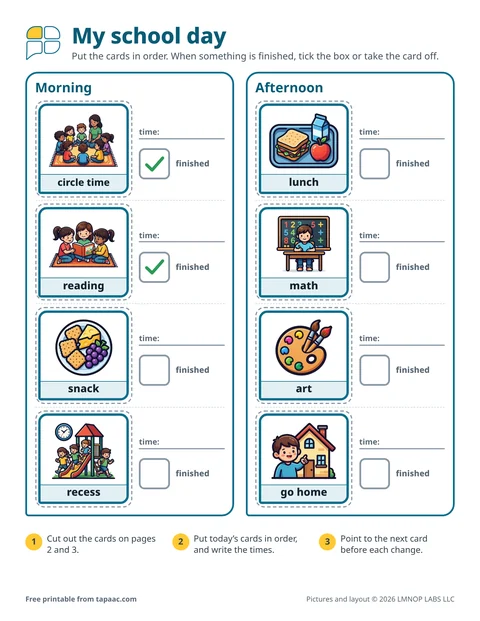 Classroom visual scheduleA school day schedule with times and tick boxes, and 38 picture cards from circle time to go home.
-
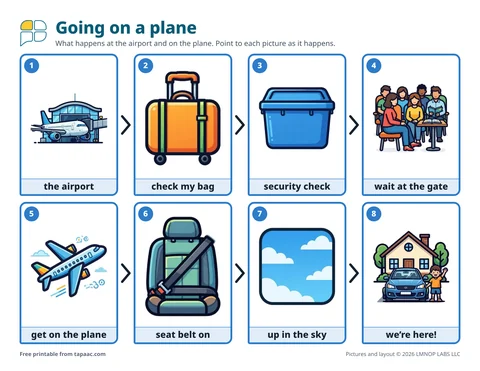 Airport visual scheduleThe steps of a plane trip, a board for the flight, and a travel bag list with pictures to tick.
-
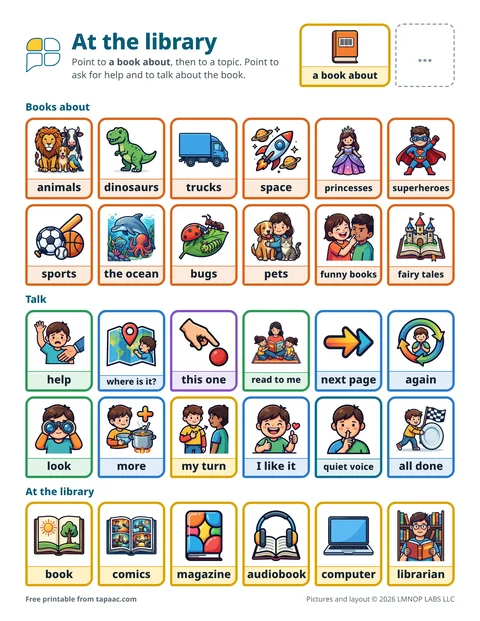 Library communication boardAsk for a book about dinosaurs, space or trucks, talk about the book, and follow the steps of a visit.
-
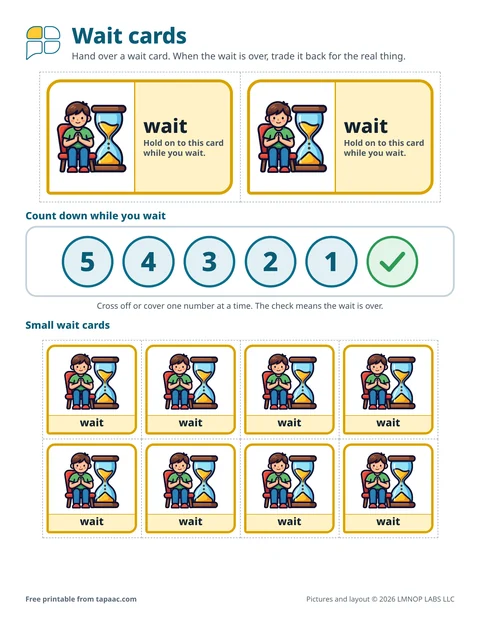 Wait cardsWait cards, a 5-to-1 countdown, and my turn and your turn cards with a Now and Next board.
Need a different board? Make your own with the free AAC board maker.
These boards and guides are general information, not therapy or medical advice, and they don’t replace a speech therapist. A speech therapist who knows the person can help choose the right words, pictures and layout. The boards are free to print and share; please don’t sell them (terms of use). Questions about the boards? Email support@lmnoplabs.fun.