 Tap AAC
Cooking communication board and visual recipes: free printable
A cooking communication board gives a person who doesn’t speak, or doesn’t speak much, the words to cook with someone: my turn, stir, pour, more, what’s next?, yum. This free PDF has the board, with 36 words for cooking, talking and the kitchen; a visual recipe for a no-cook yogurt fruit cup, in eight picture steps; and a blank visual recipe to make your own.
Download the free PDF US Letter, 3 pages, 1,496 KB
Portrait (tall page, 3 pages): US Letter PDF (1,496 KB) · A4 PDF (1,498 KB)
Landscape (wide page, 3 pages): US Letter PDF (1,498 KB) · A4 PDF (1,500 KB)
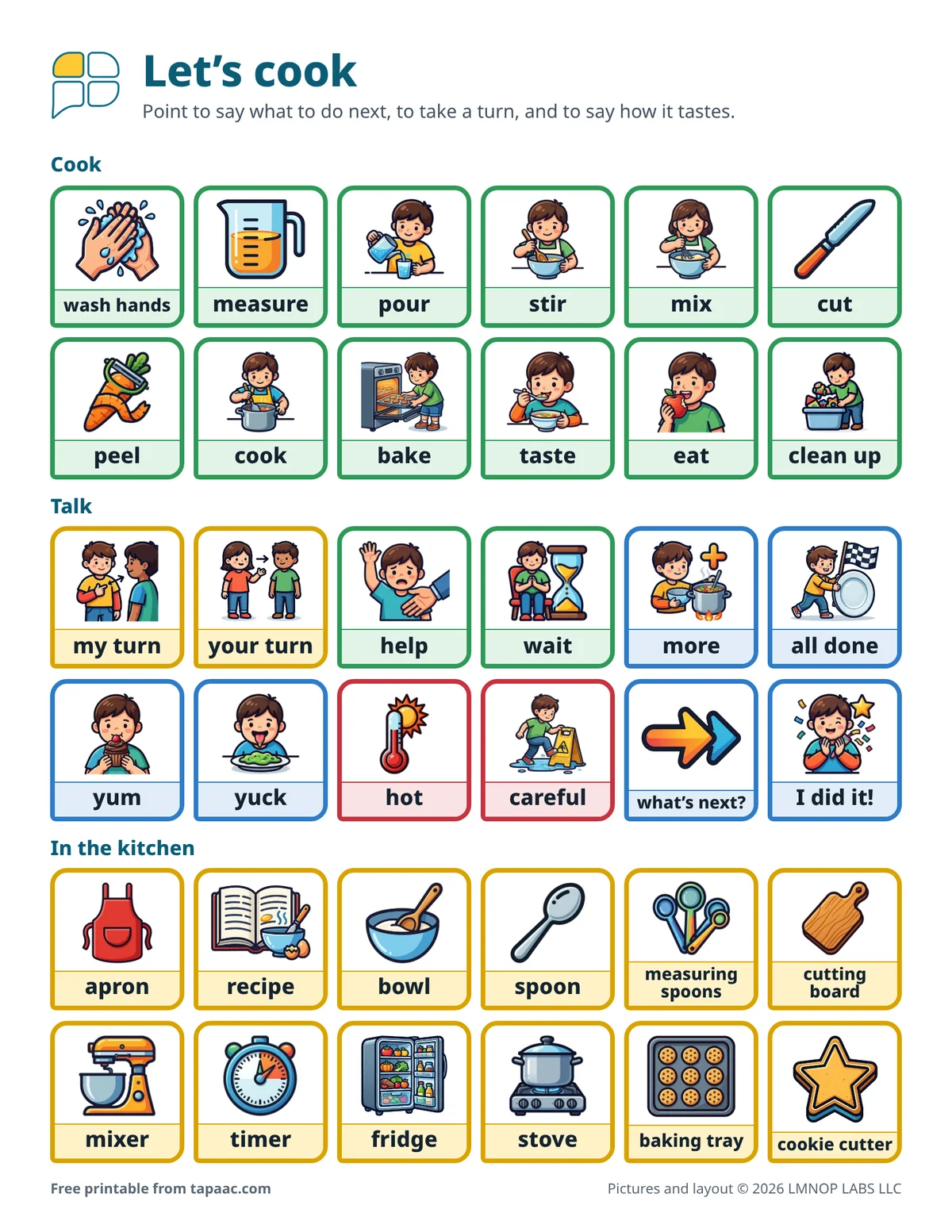
Edit this board in the free board maker: change the words and pictures, then print.
Have Tap AAC? Add to Tap AAC (.obz file, 1,348 KB) · How to add a board
- Free
- No sign-up
- Print as many as you need
Who it’s for
Children, teens and adults who use pictures or a speech device, cooking at home, in a classroom kitchen, in a life skills class or at a cooking club. Cooking is full of turns, choices and “what’s next?”, which makes it one of the best times of the day to talk. A visual recipe also lets a person follow the steps with less help, one picture at a time.
How to use it
- Lay the board next to the bowl, laminated, where spills can be wiped off.
- Take turns. “My turn to pour. Your turn to stir.” Point as you say it, then hand over the spoon.
- Leave gaps on purpose. Put the cereal out of reach, or stop before the next step, and wait. Help, more and what’s next? are the words you want to hear.
- Taste and talk. Ask how it is, and wait for yum or yuck. Both are real answers.
- Keep the dangerous jobs with the grown-up. The board has cut, cook, bake, hot and careful so the person can talk about them, not because they should do them alone.
Visual recipes
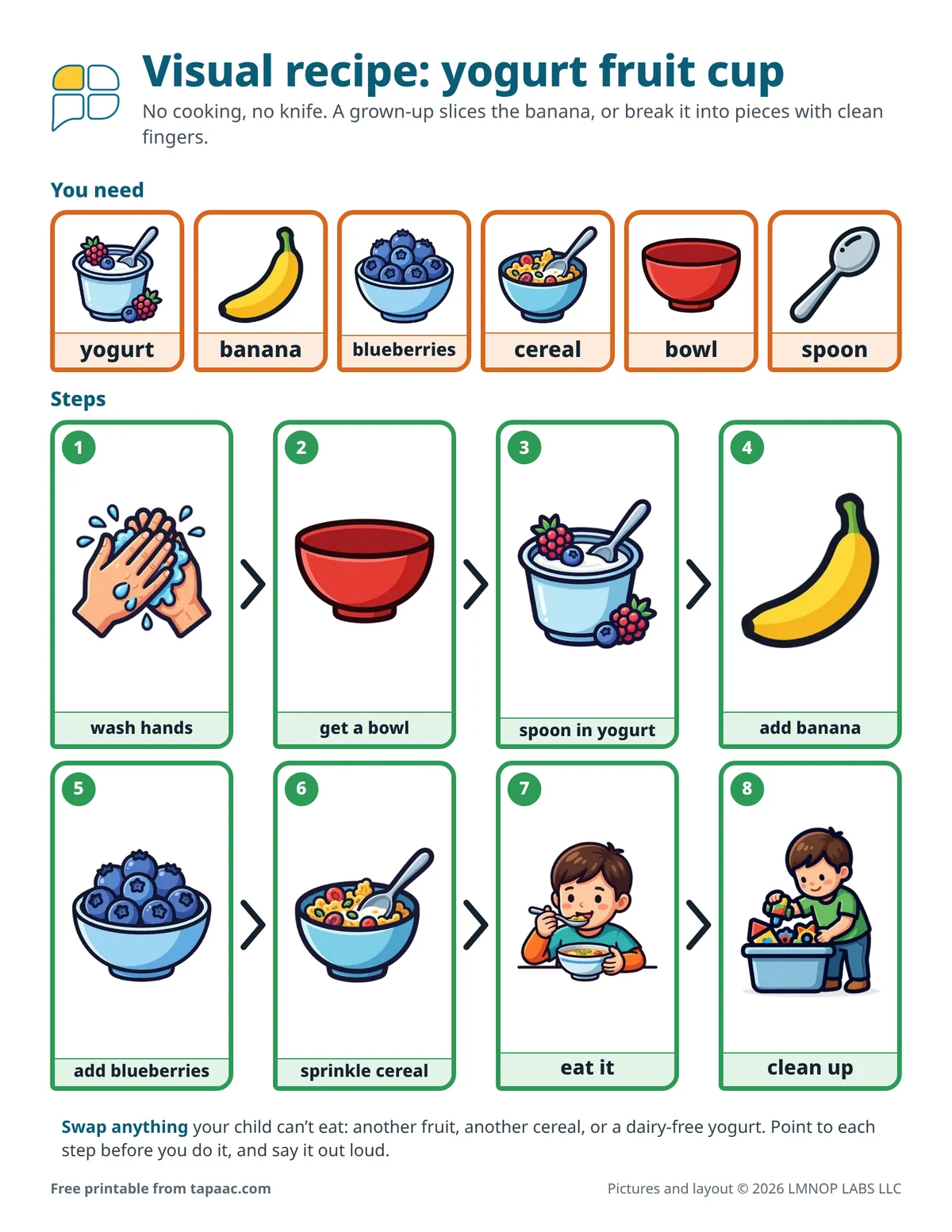
A visual recipe shows one step per picture, in order, with very few words. Page 2 is a ready-made one for a yogurt fruit cup: no stove, no oven and no knife (a grown-up slices the banana, or the person breaks it into pieces with clean fingers). Swap any food the person can’t eat, and check every ingredient for allergies. Point to each step before you do it, and say it out loud; after a few times, let the person point to the step and tell you what to do.
Make your own visual recipe
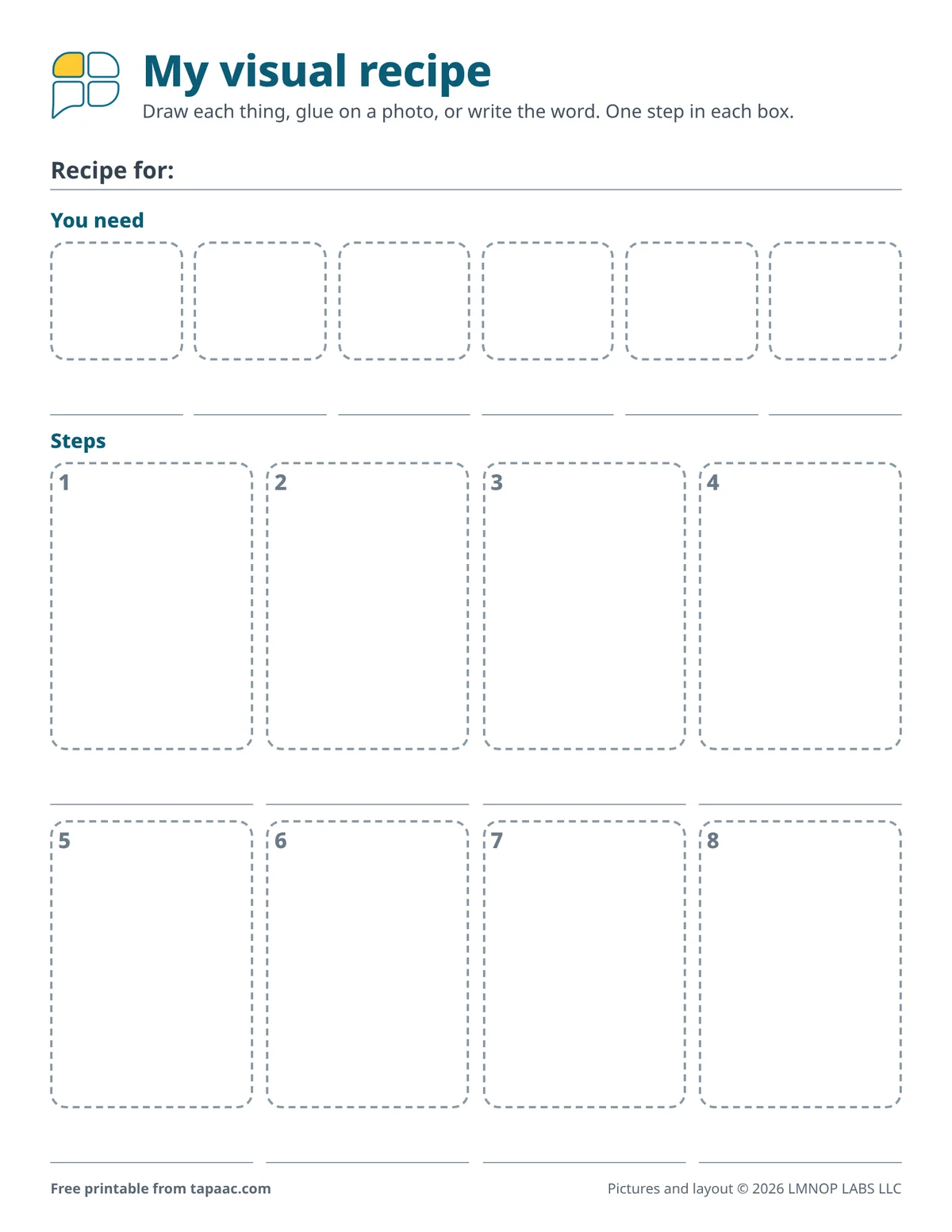
Page 3 is blank: a line for the name, six boxes for what you need, and eight numbered boxes for the steps. Take a photo of each step the first time you make a family favorite, print the photos small, and glue them in. Or draw them, or cut the pictures from page 1. Pick recipes with few steps to start (a sandwich, a smoothie, toast), and add harder ones as the person gets the idea.
On Sunday, Liam, who is twelve, makes snacks with his mom. The visual recipe is taped to the cupboard. He points to step 1, wash hands, and goes to the sink. At step 4 his mom slices the banana, and Liam points to my turn and adds it to the bowls. When the cereal box is empty, he points to help and more. At the end he points to yum, then I did it!, and carries a cup to his sister.
What’s on the PDF
Cook
- wash hands
- measure
- pour
- stir
- mix
- cut
- peel
- cook
- bake
- taste
- eat
- clean up
Talk
- my turn
- your turn
- help
- wait
- more
- all done
- yum
- yuck
- hot
- careful
- what’s next?
- I did it!
In the kitchen
- apron
- recipe
- bowl
- spoon
- measuring spoons
- cutting board
- mixer
- timer
- fridge
- stove
- baking tray
- cookie cutter
Yogurt fruit cup (page 2)
- yogurt
- banana
- blueberries
- cereal
- bowl
- spoon
- get a bowl
- spoon in yogurt
- add banana
- add blueberries
- sprinkle cereal
- eat it
Printing tips
- Laminate pages 1 and 2. Print page 3 on plain paper, so it’s easy to draw and glue on.
- Keep finished visual recipes in a binder with sheet protectors: a picture cookbook that grows.
- For eating the food, use the mealtime communication board; for buying it, the grocery store board and picture shopping list; and for step 1, the hand washing visual sequence.
- Modeling at home, in one page: our AAC modeling handout for parents.
- For more messy, hands-on fun, the art communication board has paints, glue and scissors, and words for messy hands.
More free boards
-
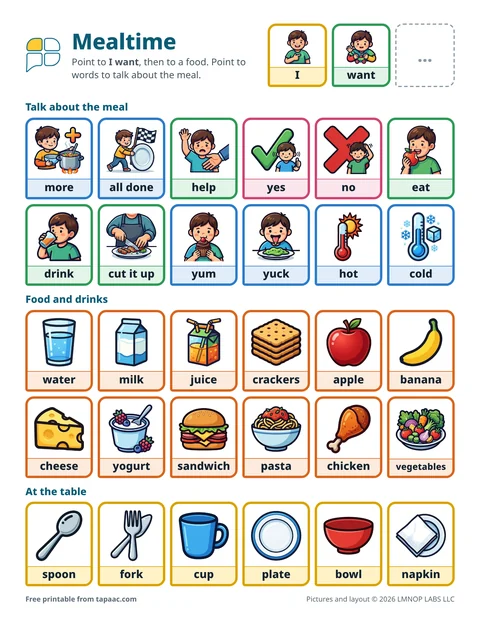 Mealtime communication boardMore, all done, yum, yuck, 12 foods and drinks, and the things on the table.
-
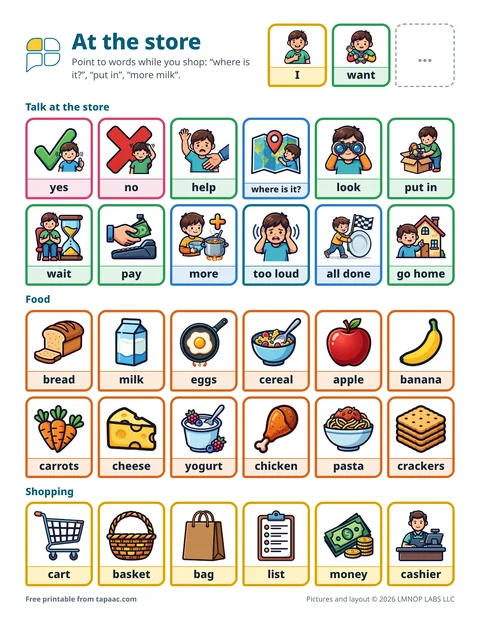 Grocery store board and shopping listWords for the store, 12 foods, and a picture shopping list with 18 cards.
-
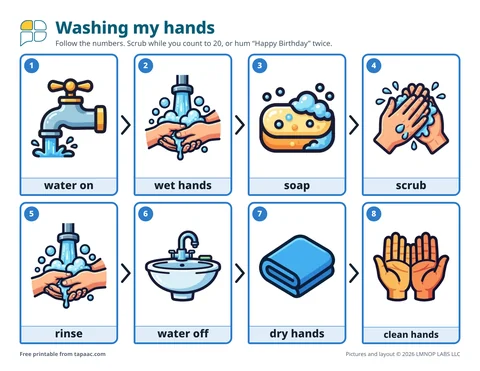 Hand washing visual sequenceEight steps from water on to clean hands, when to wash, and small strips for the sink.
-
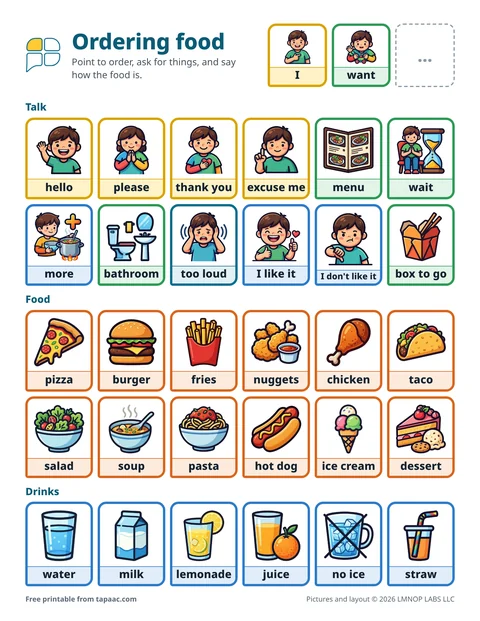 Restaurant communication boardWords for ordering, 12 foods and 6 drinks, and order cards to hand to the server.
Need a different board? Make your own with the free AAC board maker.
These boards and guides are general information, not therapy or medical advice, and they don’t replace a speech therapist. A speech therapist who knows the person can help choose the right words, pictures and layout. The boards are free to print and share; please don’t sell them (terms of use). Questions about the boards? Email support@lmnoplabs.fun.