 Tap AAC
Classroom rules with pictures: free printable visuals
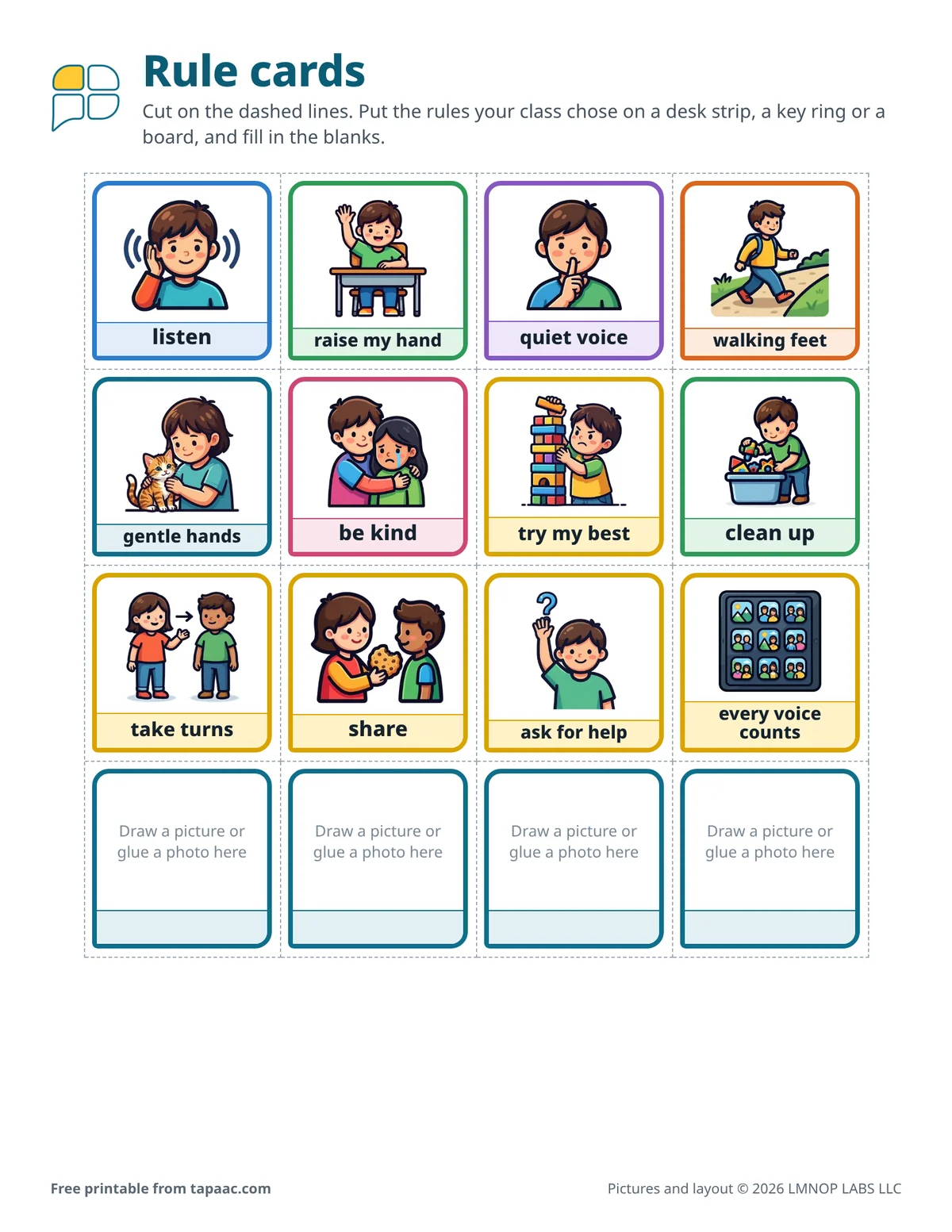
Classroom rules with pictures show each rule as a picture and a few plain words, so every student can see what the rules are, even before they can read: listen, raise my hand, quiet voice, walking feet, gentle hands, be kind, try my best and clean up. This free PDF has a poster of those eight rules, 12 rule cards for desks and key rings, and a talk board so students can ask for help, a break or the bathroom.
Download the free PDF US Letter, 3 pages, 1,526 KB
Portrait (tall page, 3 pages): US Letter PDF (1,526 KB) · A4 PDF (1,527 KB)
Landscape (wide page, 3 pages): US Letter PDF (1,531 KB) · A4 PDF (1,533 KB)
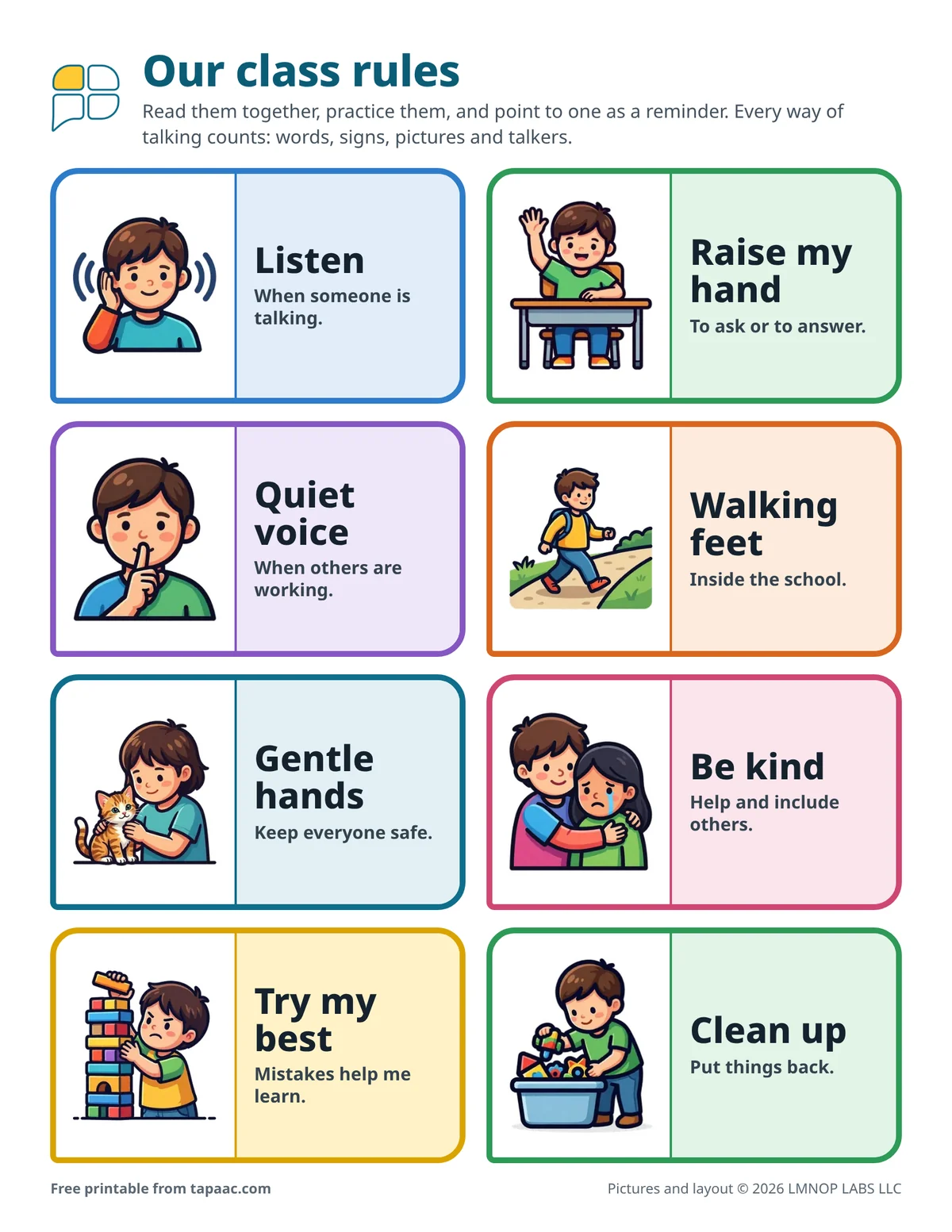
Edit this board in the free board maker: change the words and pictures, then print.
Have Tap AAC? Add to Tap AAC (.obz file, 1,405 KB) · How to add a board
- Free
- No sign-up
- Print as many as you need
Who it’s for
Preschool, kindergarten, elementary and special education teachers, and the aides and therapists who work in their rooms. Picture rules help students who don’t read yet, students learning English, autistic students, and students who don’t speak or don’t speak much, who also need a way to ask for what the rules don’t cover: help, a break, the bathroom.
How to use it
- Choose the rules with the class. Start with three to five. The cards on page 2 let you build your own set; the blanks are for rules of your own.
- Teach each rule on its own, by showing it: walk to the door, use a quiet voice, practice raising a hand. Point to the picture as you do.
- Hang the poster where everyone can see it, and put a strip of rule cards on the desks of students who need it close by.
- Point to the rule, not the student. A quiet point to walking feet is a reminder without a scolding in front of the class.
- Notice the rules being kept, and point to the picture then too: “You cleaned up. Thank you!”
Every way of talking counts
Rules about voices and hands can be hard on students who talk with a device, signs or a board, or who move their hands to stay calm. Make it clear that a student’s talker, board or signs are always allowed, at any volume the device needs, and that it’s their voice, not a toy. The card every voice counts on page 2 is there for that. Allow a raised hand to be any clear signal the student can make, and keep rules about safety, not about sitting still. Supports, not rules has more on using pictures kindly.
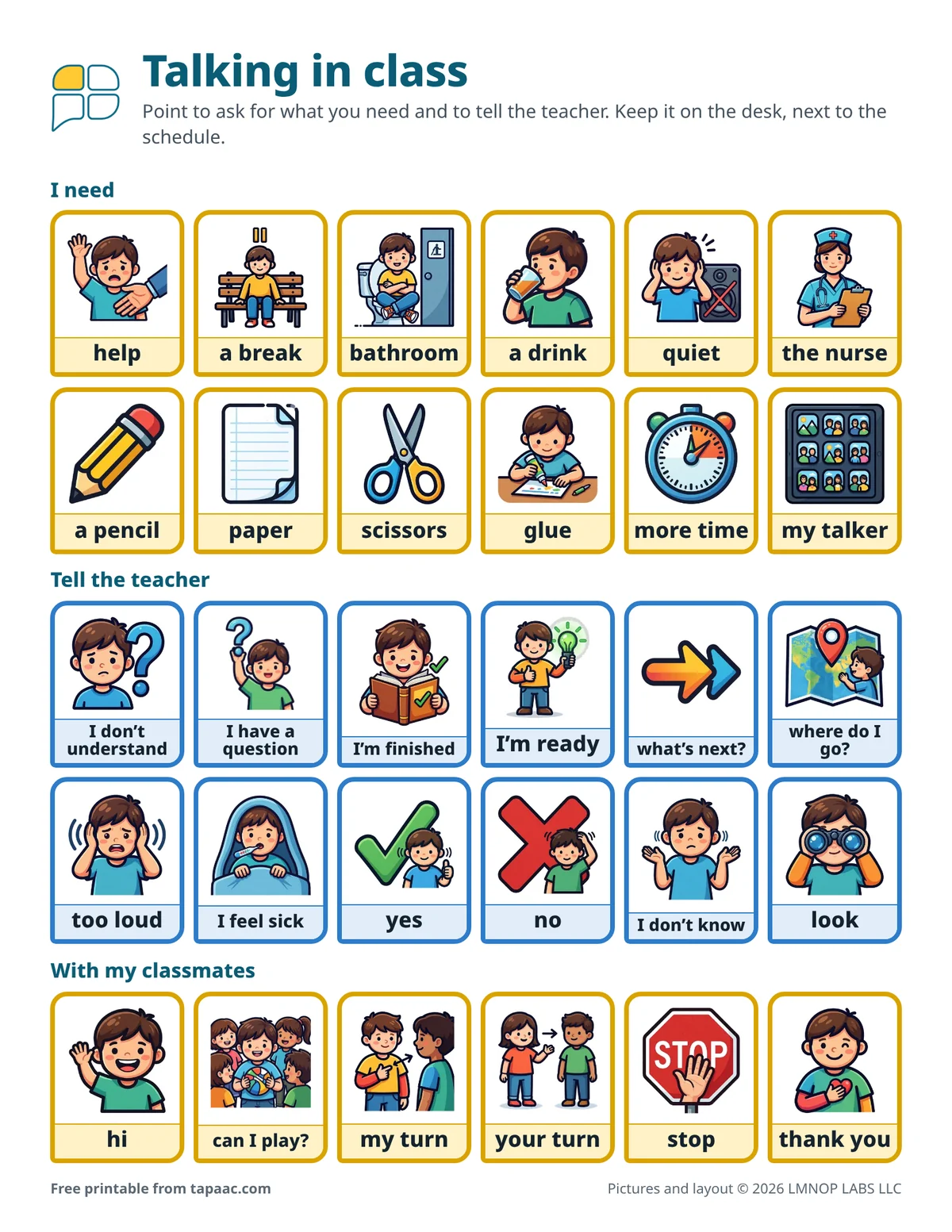
Asking and telling in class
Rules say what to do; page 3 gives the words for what a student needs. Keep it on the desk next to the class schedule. Model on it while you teach: point to what’s next? before a change, or I’m finished when you see a student stop. A student who can point to I don’t understand or a break has a better choice than shutting down or walking out.
Ms. Ortiz teaches a kindergarten class of 18. In the first week, the class chose five rules from the cards and practiced one each morning. Sam, who uses a talker, put the every voice counts card on the poster himself. Now, when the room gets loud, Ms. Ortiz points to quiet voice without a word. During math, Sam points to I don’t understand on his desk board, and she comes over with a second example.
What’s on the PDF
Class rules
- Listen
- Raise my hand
- Quiet voice
- Walking feet
- Gentle hands
- Be kind
- Try my best
- Clean up
More rule cards
- take turns
- share
- ask for help
- every voice counts
I need
- help
- a break
- bathroom
- a drink
- quiet
- the nurse
- a pencil
- paper
- scissors
- glue
- more time
- my talker
Tell the teacher
- I don’t understand
- I have a question
- I’m finished
- I’m ready
- what’s next?
- where do I go?
- too loud
- I feel sick
- yes
- no
- I don’t know
- look
With my classmates
- hi
- can I play?
- my turn
- your turn
- stop
- thank you
Printing tips
- Print the poster on card stock, or print it on A3 or tabloid paper at 141% for the classroom wall.
- For desk strips, cut out three to five rule cards and tape them in a row, or laminate them and add a hook-and-loop dot to each.
- For the school day, use the classroom visual schedule; for breaks and waiting, the break card and the wait card.
- Teachers: helping classmates talk with an AAC user, and keeping AAC with the student all day.
More free boards
-
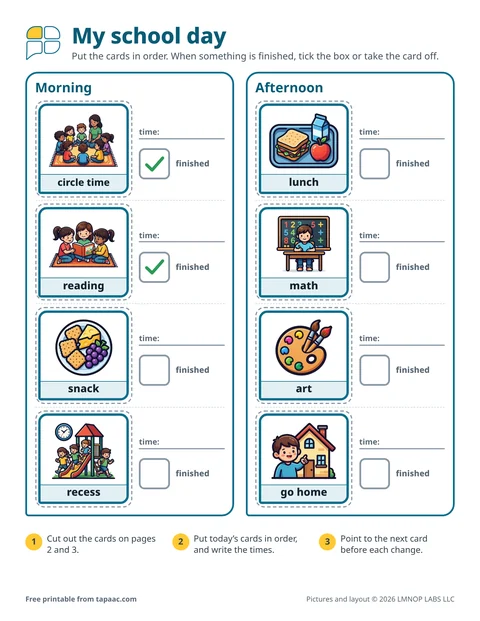 Classroom visual scheduleA school day schedule with times and tick boxes, and 38 picture cards from circle time to go home.
-
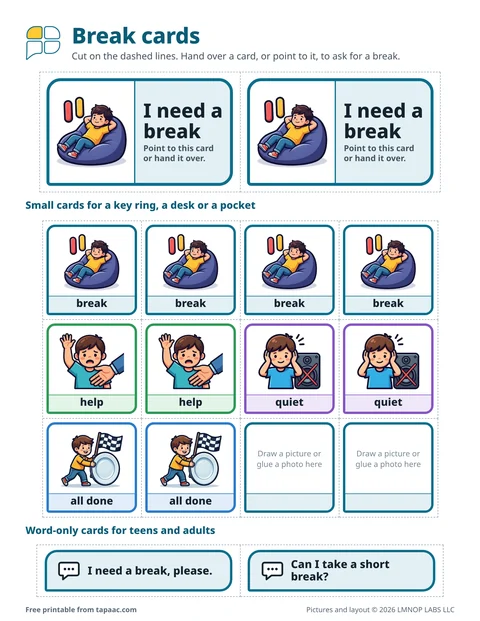 Break cards“I need a break” cards in three sizes, and a board of things to do on a break.
-
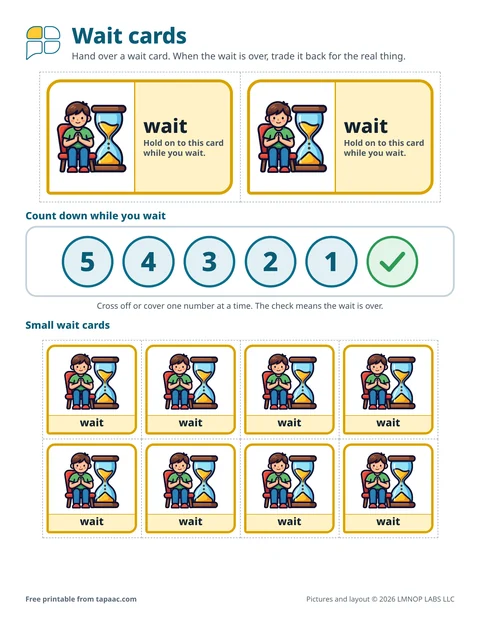 Wait cardsWait cards, a 5-to-1 countdown, and my turn and your turn cards with a Now and Next board.
-
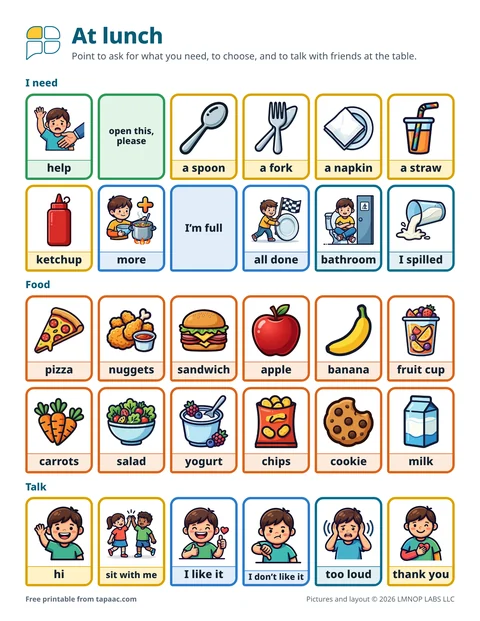 School lunch communication boardWords for the lunchroom, the steps of lunch at school, and cards for asking a lunch helper for help.
Need a different board? Make your own with the free AAC board maker.
More boards on this topic: question words, colors and numbers boards.
These boards and guides are general information, not therapy or medical advice, and they don’t replace a speech therapist. A speech therapist who knows the person can help choose the right words, pictures and layout. The boards are free to print and share; please don’t sell them (terms of use). Questions about the boards? Email support@lmnoplabs.fun.