 Tap AAC
Moving house visual schedule: free printable for kids
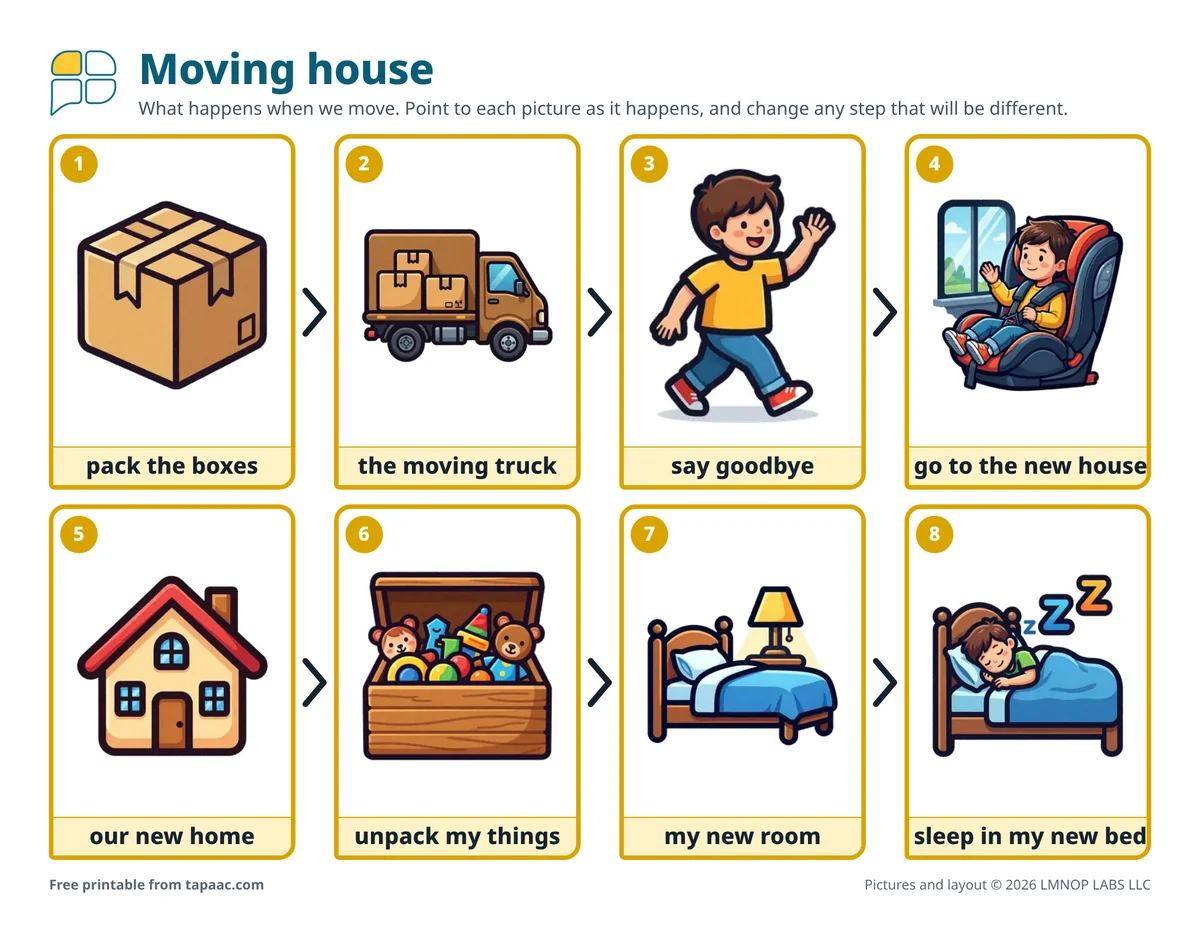
A moving house visual schedule shows a child, in pictures, what will happen when the family moves: pack the boxes, the moving truck, say goodbye, go to the new house, our new home, unpack my things, my new room, and sleep in my new bed. This free PDF has those eight steps, a board for saying how the move feels and asking about it, and a countdown to moving day with a page for photos of the new home.
Download the free PDF US Letter, 3 pages, 1,361 KB
Printing on A4 paper? Download the A4 PDF (3 pages, 1,363 KB). Or pick one page shape for every page:
Portrait (tall page, 3 pages): US Letter PDF (1,361 KB) · A4 PDF (1,363 KB)
Landscape (wide page, 3 pages): US Letter PDF (1,363 KB) · A4 PDF (1,361 KB)
Edit this board in the free board maker: change the words and pictures, then print.
Have Tap AAC? Add to Tap AAC (.obz file, 1,231 KB) · How to add a board
- Free
- No sign-up
- Print as many as you need
Who it’s for
Children who are moving house, to a new street, a new town or a new country, and find change hard. A move changes nearly everything at once: the bedroom, the way to school, sometimes the school and the friends. The schedule suits children who use pictures to know what comes next, including autistic children and children who don’t speak or don’t speak much.
How to use it
- Tell your child about the move early enough to get used to the idea, and show page 1: “First we pack the boxes. Then the moving truck comes.”
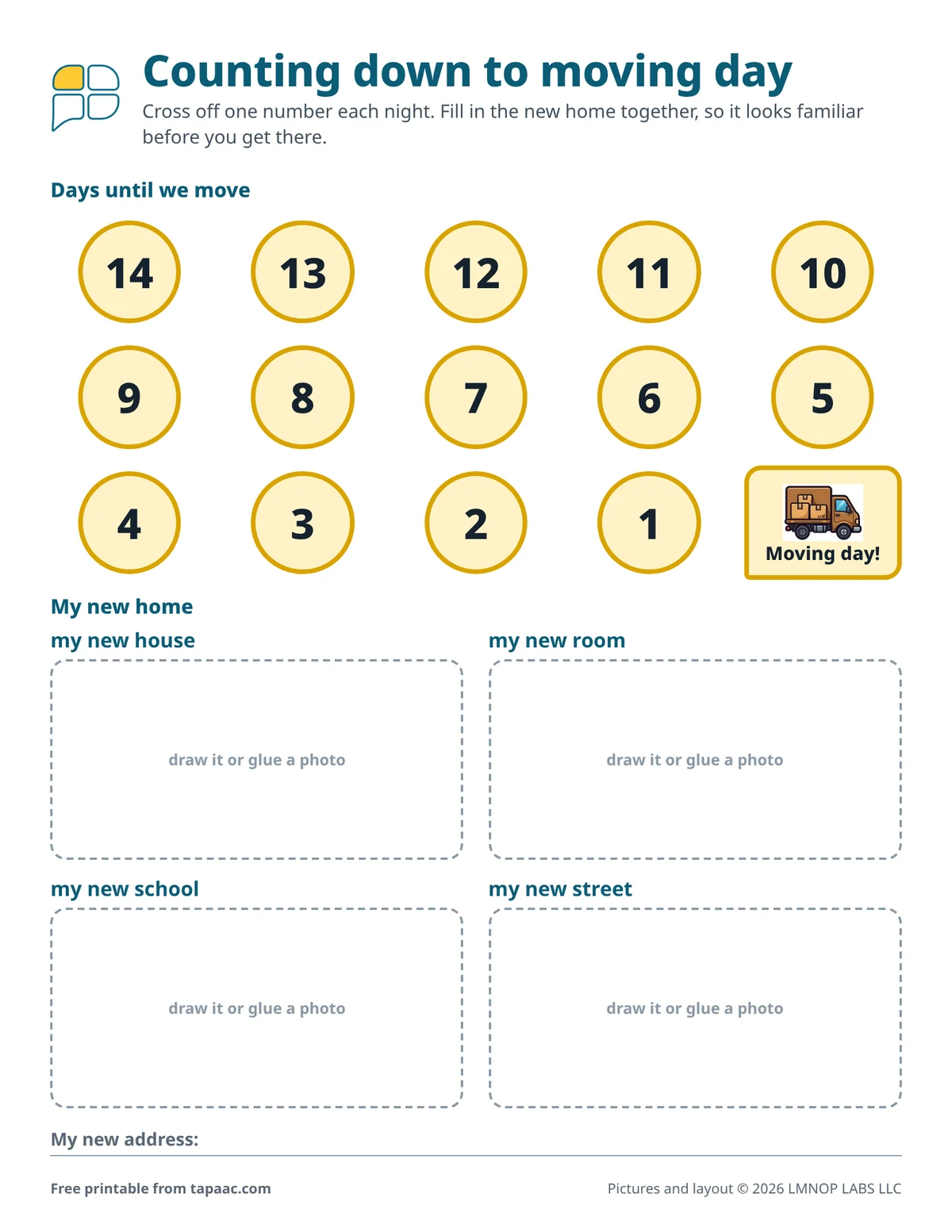
- Start the countdown on page 3 two weeks before moving day, or cut off the top row for a shorter one. Cross off one number each night.
- Pack your child’s things last, and unpack them first. Let them pack one box of their own, with the teddy and the favorite things, and keep it in the car rather than the truck.
- Fill in the new home together: photos of the new house, the new room, the new school and the street, from a visit or from an online map’s street view.
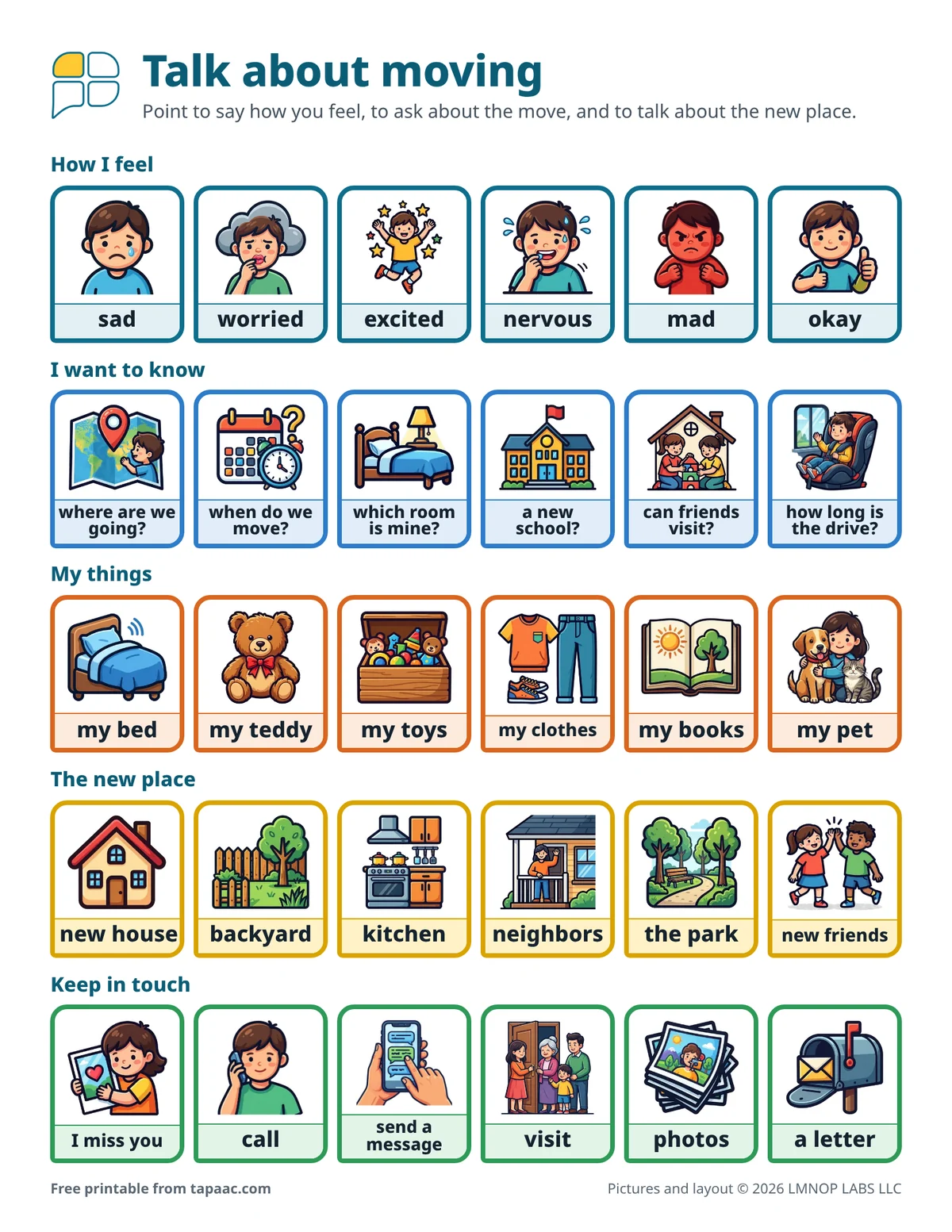
- Keep page 2 out during the whole move, and model the words: “I feel sad. I feel excited too.”
Feelings and questions
A child who doesn’t speak may have the same questions as anyone who is moving: Which room is mine? Will my things come too? Can my friends visit? Page 2 has those questions, and room for honest answers. Every feeling on it is allowed, including mad. Point to your own feelings too, so your child sees that grown-ups can be sad and excited at the same time. The keep in touch row is for the friends and neighbors left behind: a call, a message, a letter, a visit.
Keep the steps true
Not every move looks like this one. If movers come, or your child stays with grandparents on moving day, cross out a step and draw or write what will happen; a step that turns out wrong makes the whole schedule harder to trust. Moving by plane? Add the airport visual schedule for that part. The steps also open in the free visual schedule maker, where you can change any step and add photos of your own house.
Ava is nine and uses a talker. Her family is moving across town. Two weeks before, her dad starts the countdown, and they cross off a number every night. They visit the new house, take photos of Ava’s room and glue them on page 3. On moving day, Ava packs her own box with her teddy and her books, and it rides in the car. On the way, she points to how long is the drive? and then which room is mine? That night, she points to the last step herself: sleep in my new bed.
What’s on the PDF
Moving steps
- pack the boxes
- the moving truck
- say goodbye
- go to the new house
- our new home
- unpack my things
- my new room
- sleep in my new bed
How I feel
- sad
- worried
- excited
- nervous
- mad
- okay
I want to know
- where are we going?
- when do we move?
- which room is mine?
- a new school?
- can friends visit?
- how long is the drive?
My things
- my bed
- my teddy
- my toys
- my clothes
- my books
- my pet
The new place
- new house
- backyard
- kitchen
- neighbors
- the park
- new friends
Keep in touch
- I miss you
- call
- send a message
- visit
- photos
- a letter
Printing tips
- Keep page 1 in the car on moving day, where your child can see it.
- Print two countdowns: one for the fridge, and one for your child’s room.
- For big feelings, the feelings board and the calm down choices board. A new baby coming too? There’s a new baby board for big brothers and sisters.
- Starting a new school? AAC in the classroom: at the start of the year has what to share with a new teacher. Getting ready for changes has more ways to prepare for a big one.
More free boards
-
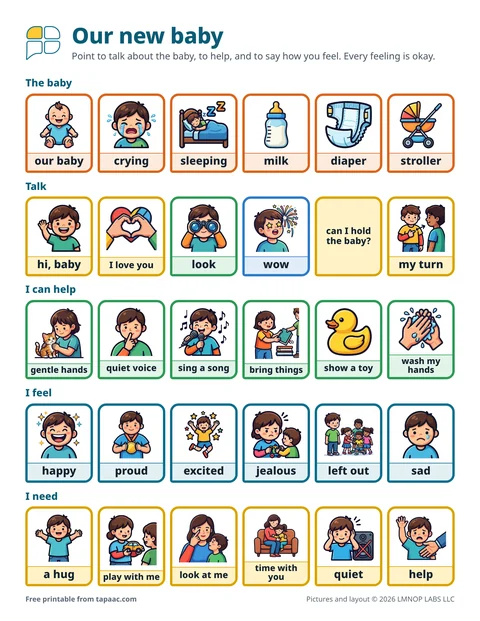 New baby board for big siblingsWords for big brothers and sisters about the new baby, the steps of meeting the baby, badges and time-with-me cards.
-
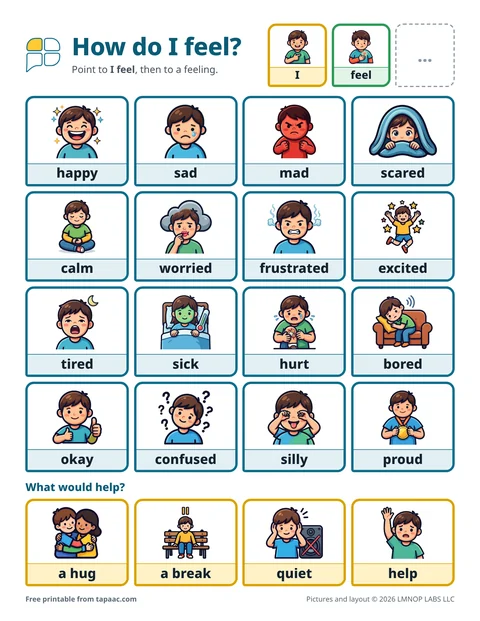 Feelings board16 feelings, from happy and calm to mad and worried, plus what would help.
-
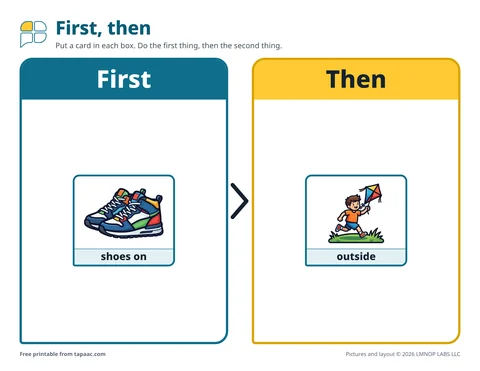 First-then boardShows what happens first and what comes next. With 12 picture cards to cut out.
-
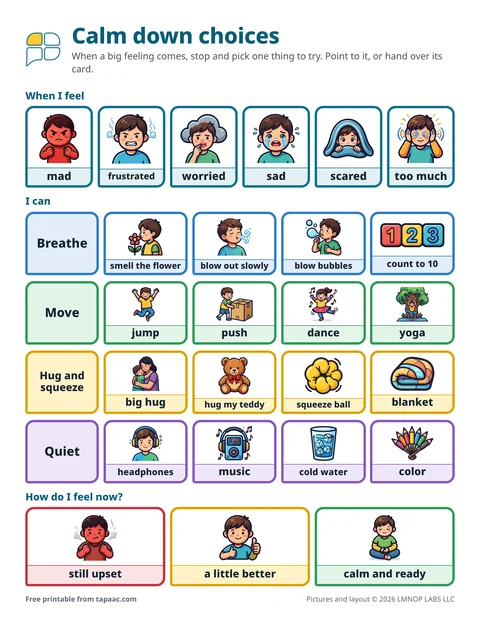 Calm down choices board16 calm down choices in four groups, a breathing square to trace, and calm down cards to cut out.
Need a different board? Make your own with the free AAC board maker.
Making a schedule? Use the free visual schedule maker: routines ready to open and change.
These boards and guides are general information, not therapy or medical advice, and they don’t replace a speech therapist. A speech therapist who knows the person can help choose the right words, pictures and layout. The boards are free to print and share; please don’t sell them (terms of use). Questions about the boards? Email support@lmnoplabs.fun.