 Tap AAC
Car ride communication board, with car ride bingo
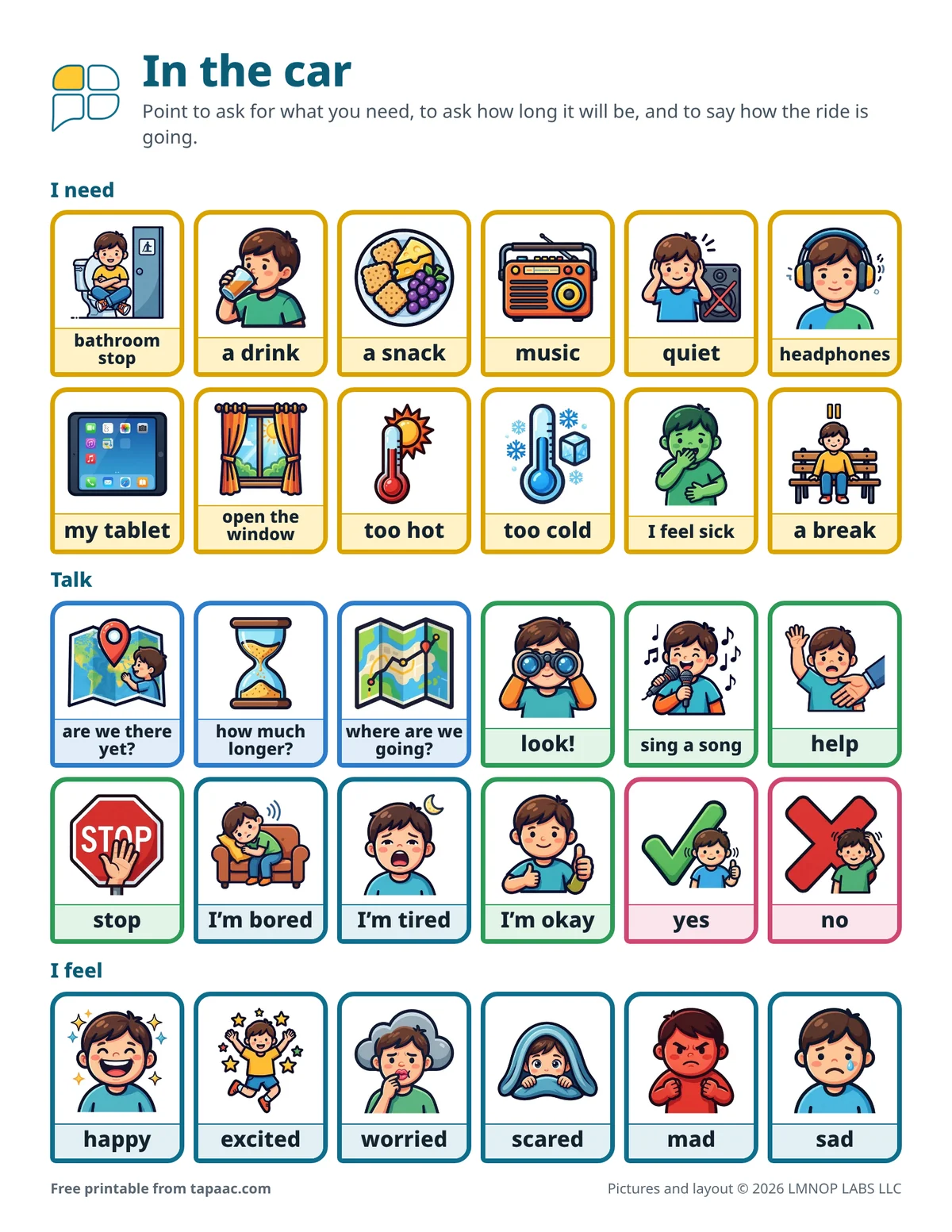
In the back seat, a child can’t lean forward and show you what’s wrong, and the driver can’t look away from the road. A car ride communication board puts the things that come up on every drive, are we there yet?, bathroom stop, I feel sick, too hot, in pictures a child can point to, for whoever sits beside them, or for the driver once the car has stopped. This free PDF has that board, the steps of a car ride with stops on a long trip, and a car ride bingo card.
Download the free PDF US Letter, 3 pages, 2,269 KB
Portrait (tall page, 3 pages): US Letter PDF (2,269 KB) · A4 PDF (2,269 KB)
Landscape (wide page, 3 pages): US Letter PDF (2,270 KB) · A4 PDF (2,272 KB)
Edit this board in the free board maker: change the words and pictures, then print.
Have Tap AAC? Add to Tap AAC (.obz file, 1,555 KB) · How to add a board
- Free
- No sign-up
- Print as many as you need
Why the car is a hard place to talk
Everyone faces forward, the road is noisy, and the person who could help is often the one driving. A child who can’t say “I need the bathroom” may kick the seat or cry instead, and a teen’s talker may be packed in a bag in the trunk. This board is for children and teens who don’t speak, or don’t speak much, and for anyone who finds car rides hard: long ones, new ones, or the daily drive to school. It works for an adult passenger too, with grown-up pictures swapped in from the board maker.
Before you set off
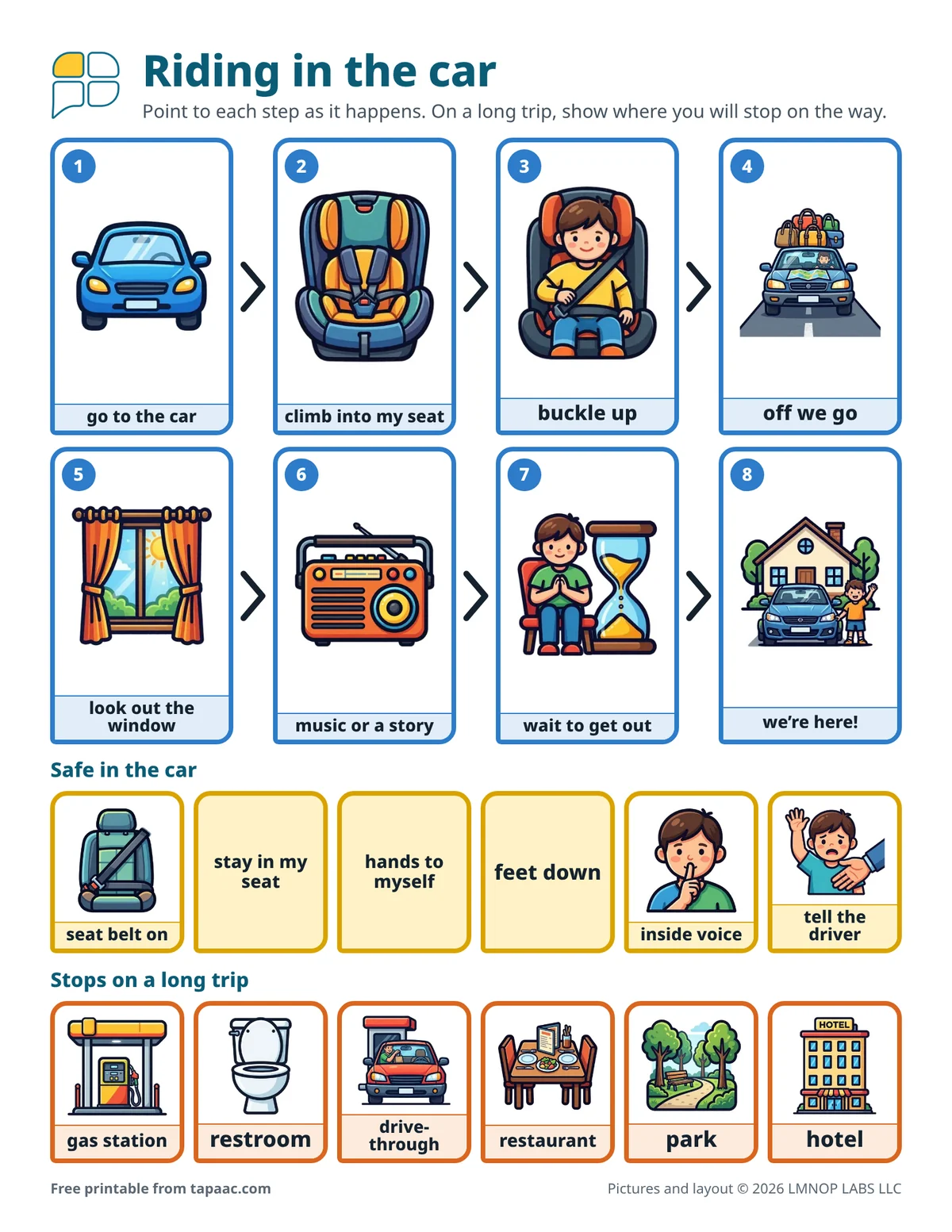
- Show page 2 at home before a new or long trip, and point through the steps together. For a long drive, circle the stops you plan to make.
- Practice two or three words from page 1 in the driveway: bathroom stop, how much longer?, I feel sick. Point to them yourself as you say them.
- Put the board where the child can reach it: clipped to the back of the front seat, in a seat-back pocket, or on a clipboard on their lap.
- Agree on a signal for anything urgent, like holding the board up, so a passenger, or the driver at the next stop, knows to look.
- Let a passenger answer while the car is moving. The driver keeps their eyes on the road and answers at a stop.
On the road
Use the words yourself during the ride, without asking for anything back: “Look, a tractor!” as you point to look!, or “I’m bored too, five more minutes” as you point to I’m bored and how much longer?. That’s modeling, the first step in teaching a child to use AAC. When the child points, answer what they said. If they point to bathroom stop, take it seriously, even if you just stopped, so the word keeps working. Are we there yet? is a real question: answer it with something they can picture, like “two more songs” or “after the bridge”.
For a drive that’s hard every day, like the one to school, the steps on page 2 can go on a strip by the car door, and the free visual schedule maker can make a version with photos of your own car and your own stops.
Car ride bingo
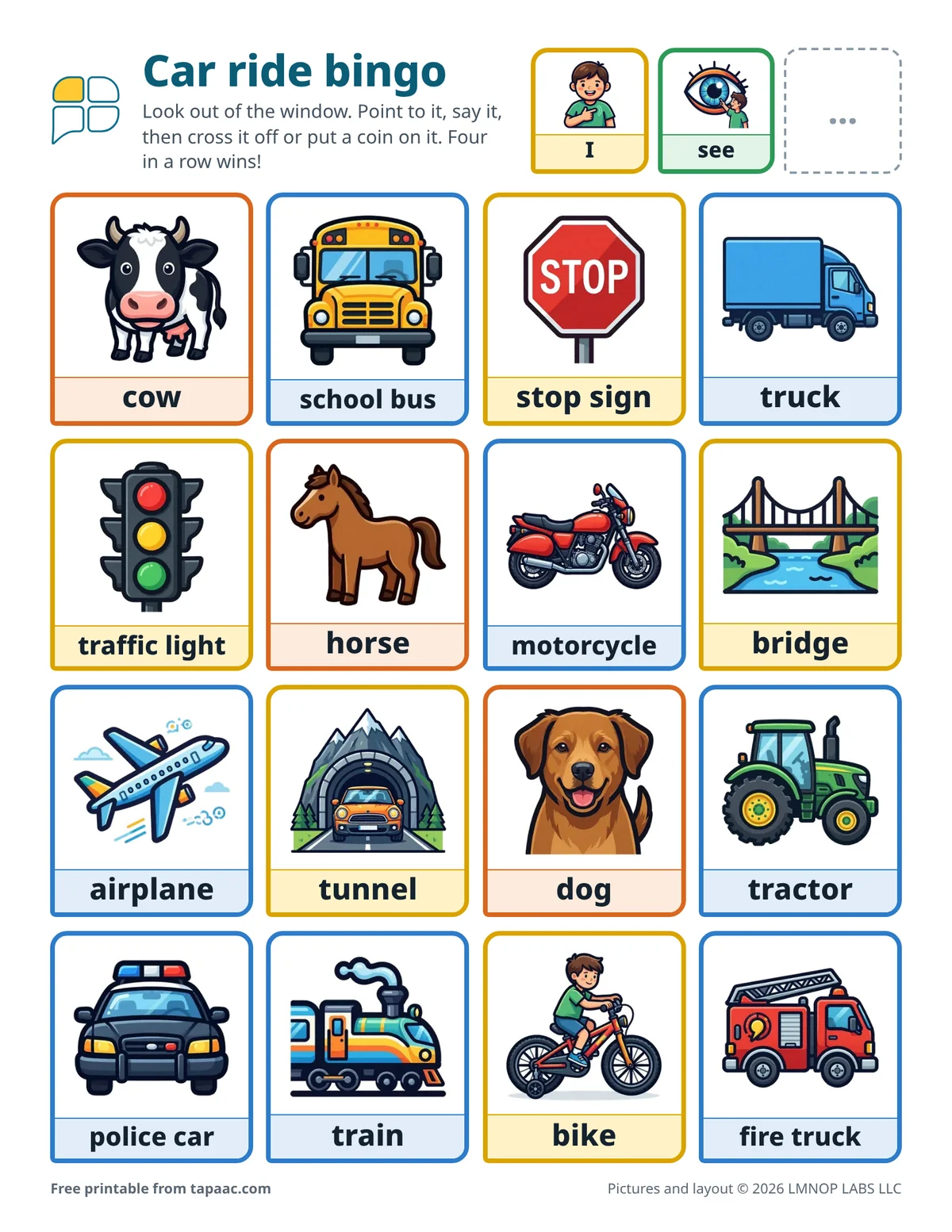
Page 3 is a bingo card of 16 things to spot from the window: animals, things on wheels, and things by the road. Point to I see, then to what you spotted, and say it together; cross it off with a dry-erase marker, or put a coin on it. Four in a row wins, or keep going until the card is full. On a highway with no cows in sight, change the card in the board maker. For a child who can’t point quickly, a passenger can read a row out and wait for a nod or a look.
When the ride gets hard
I feel sick, too hot and open the window are on page 1 because they’re easy to miss from the front seat. If a child often feels sick in the car, ask their doctor what helps. For a ride that brings on big feelings, the calm down choices board fits in the same seat pocket, and the wait card helps in a traffic jam.
Noor is eight, and the drive to her grandparents’ house takes two hours. Her dad clipped the board to the back of his seat and showed her page 2 at breakfast, with the gas station circled. Half an hour in, Noor taps how much longer? and her brother reads it out. “One more song, then the gas station,” her dad says. At the gas station she points to I see and truck on her bingo card, and crosses it off.
Every word on the sheets
I need
- bathroom stop
- a drink
- a snack
- music
- quiet
- headphones
- my tablet
- open the window
- too hot
- too cold
- I feel sick
- a break
Talk
- are we there yet?
- how much longer?
- where are we going?
- look!
- sing a song
- help
- stop
- I’m bored
- I’m tired
- I’m okay
- yes
- no
I feel
- happy
- excited
- worried
- scared
- mad
- sad
Riding in the car
- go to the car
- climb into my seat
- buckle up
- off we go
- look out the window
- music or a story
- wait to get out
- we’re here!
Safe in the car
- seat belt on
- stay in my seat
- hands to myself
- feet down
- inside voice
- tell the driver
Stops on a long trip
- gas station
- restroom
- drive-through
- restaurant
- park
- hotel
Car ride bingo
- cow
- school bus
- stop sign
- truck
- traffic light
- horse
- motorcycle
- bridge
- airplane
- tunnel
- dog
- tractor
- police car
- train
- bike
- fire truck
Printing it for the car
- Laminate page 1 or slide it into a sheet protector: car boards meet juice and crumbs.
- Print a bingo card for each child, so nobody has to wait for a turn.
- Keep a spare copy in the glove box, so there’s a board even when the bag stays at home.
- Going further? The airport visual schedule covers a plane trip, and the school bus visual schedule the other ride to school. For outings of every kind, see out and about in our guide to AAC at home.
More free boards
-
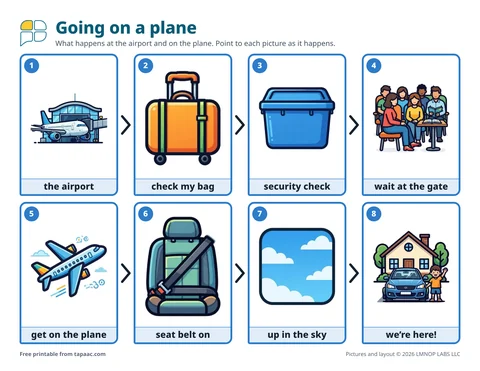 Airport visual scheduleThe steps of a plane trip, a board for the flight, and a travel bag list with pictures to tick.
-
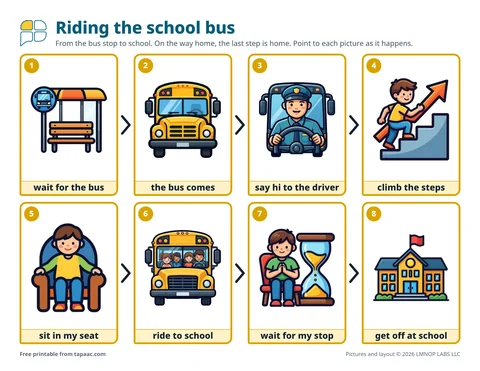 School bus visual scheduleThe steps of riding the school bus, bus rules and words for the ride, and a note to fill in for the bus driver.
-
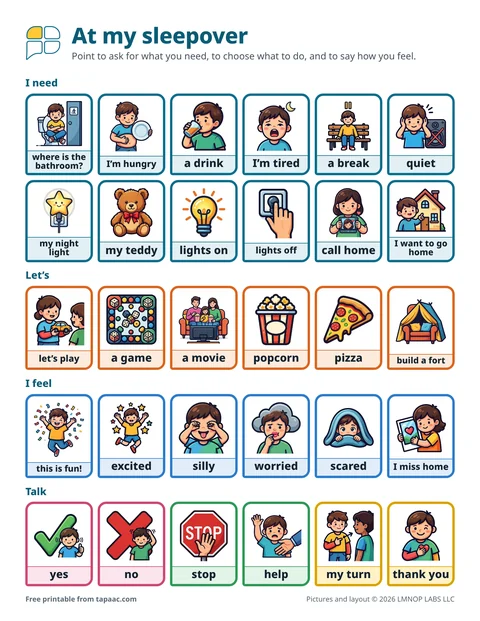 Sleepover communication boardWords for a sleepover or a night at a relative’s, bedtime away from home with a packing list, and an About me note for the host.
-
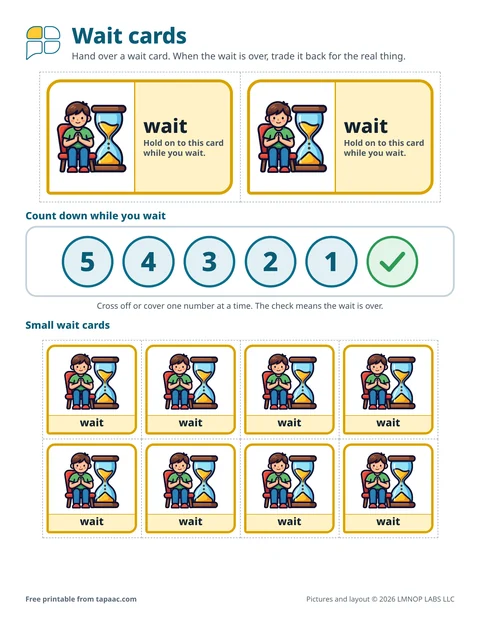 Wait cardsWait cards, a 5-to-1 countdown, and my turn and your turn cards with a Now and Next board.
Need a different board? Make your own with the free AAC board maker.
More boards on this topic: travel communication boards.
These boards and guides are general information, not therapy or medical advice, and they don’t replace a speech therapist. A speech therapist who knows the person can help choose the right words, pictures and layout. The boards are free to print and share; please don’t sell them (terms of use). Questions about the boards? Email support@lmnoplabs.fun.