 Tap AAC
Sleepover communication board: a night away from home
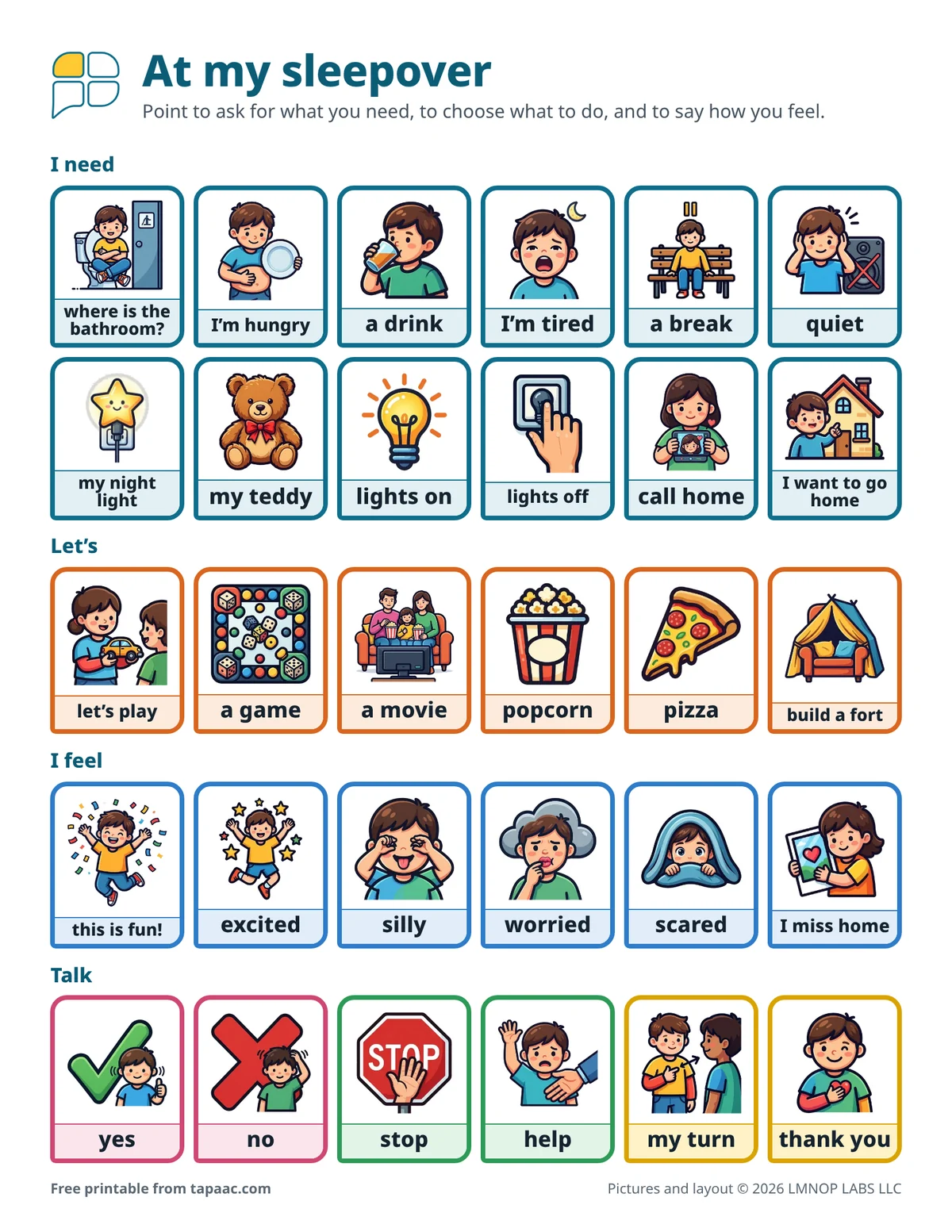
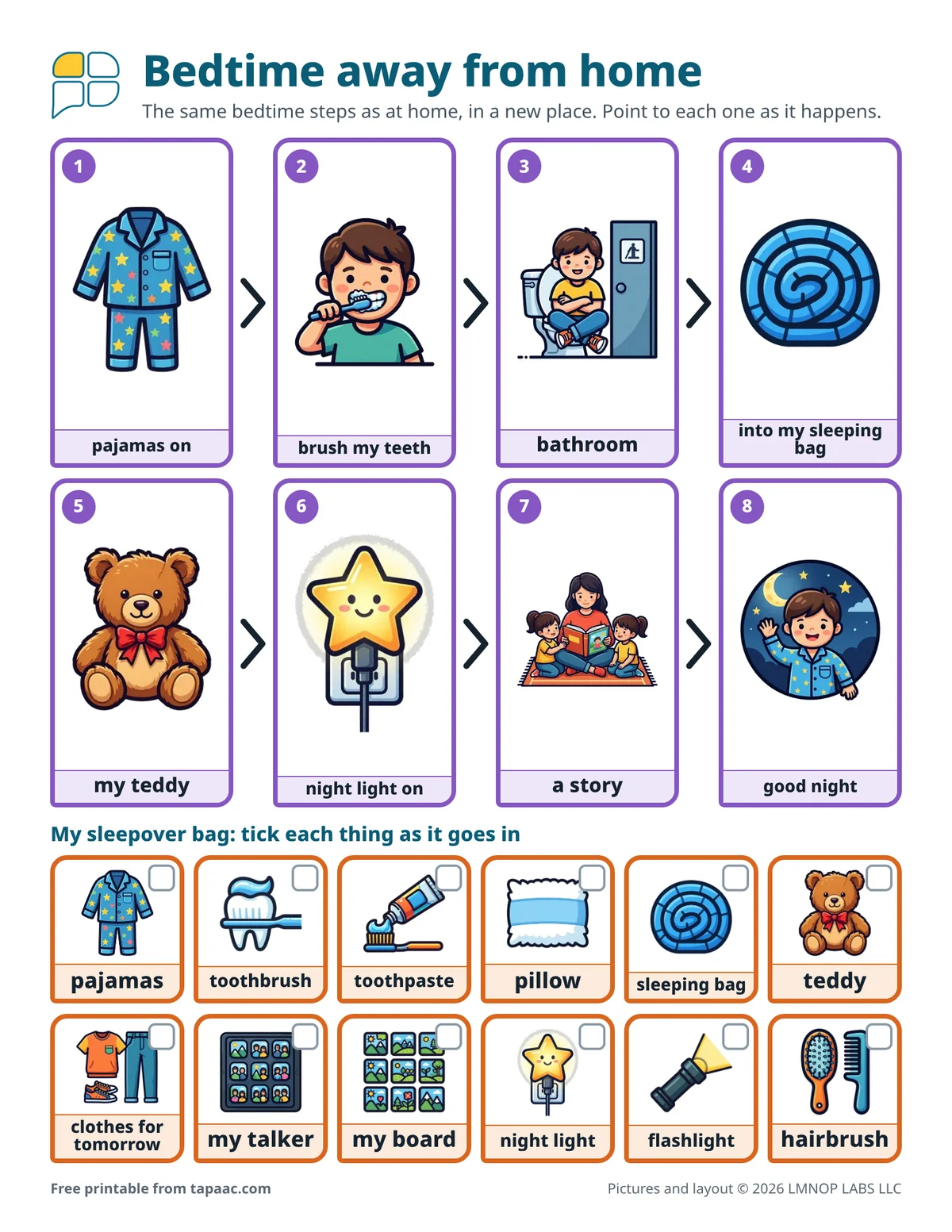
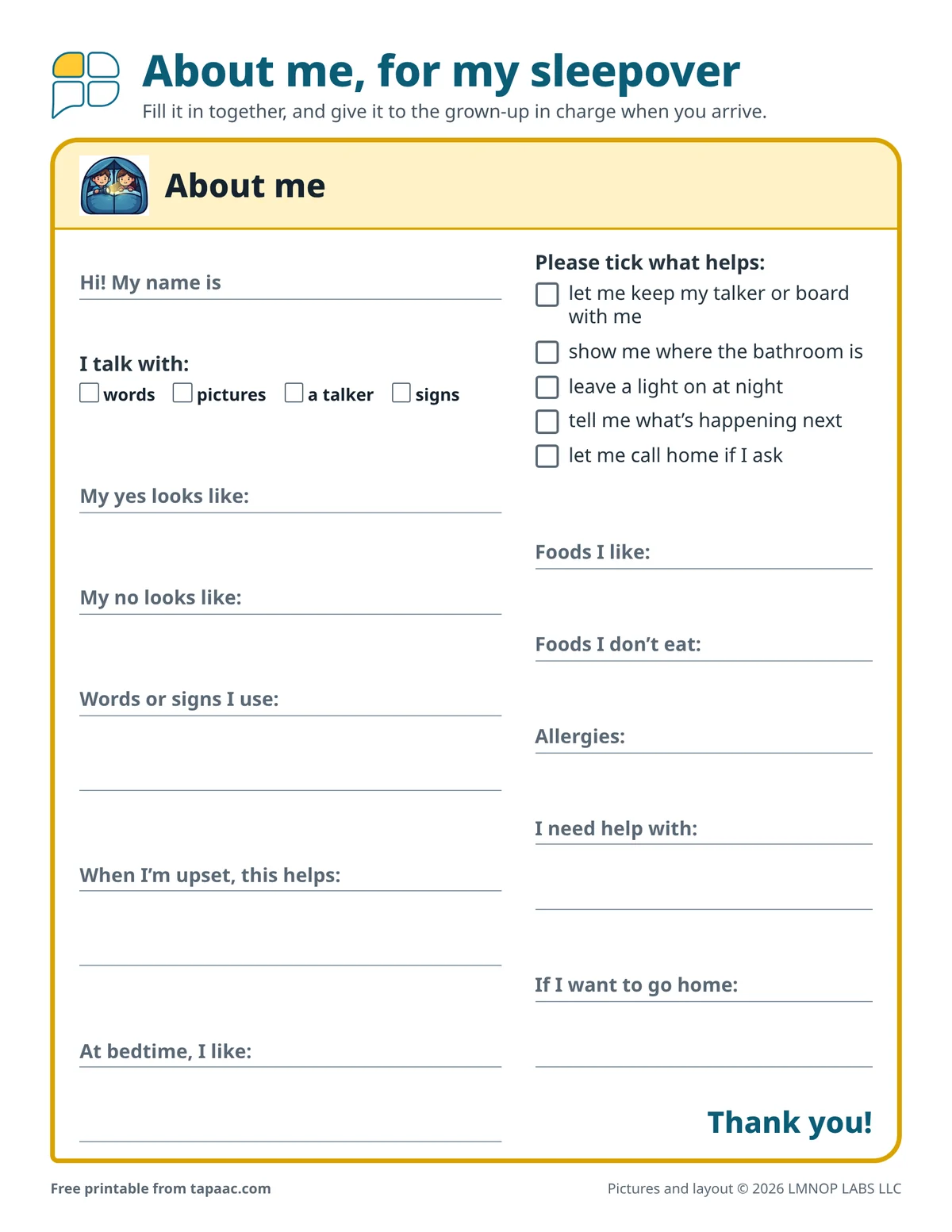
A first night away, at a friend’s house, a cousin’s or a grandparent’s, means a new bathroom, a new bed and grown-ups who don’t know how a child talks. This free sleepover board gives the child the words they’ll need after dark, where is the bathroom?, my night light, I miss home, call home, and the fun parts too. Page 2 has the bedtime steps for a new place and a packing list to tick, and page 3 is an About me note for the grown-up in charge.
Download the free PDF US Letter, 3 pages, 1,708 KB
Portrait (tall page, 3 pages): US Letter PDF (1,708 KB) · A4 PDF (1,708 KB)
Landscape (wide page, 3 pages): US Letter PDF (1,709 KB) · A4 PDF (1,708 KB)
Edit this board in the free board maker: change the words and pictures, then print.
Have Tap AAC? Add to Tap AAC (.obz file, 1,271 KB) · How to add a board
- Free
- No sign-up
- Print as many as you need
First nights away
For children who don’t speak or don’t speak much, autistic children, and any child who is nervous about a night away: a sleepover with a friend, a night at a grandparent’s or a cousin’s, a respite stay, or a camp or school trip. It’s for the host family too, who may never have met a child who talks with a board. Teens can use it with older pictures swapped in from the board maker.
Getting ready together
- Talk about it a few days before. Show page 1 and point: “At Maya’s house, you can say let’s play, or I want to go home.”
- Pack together with the list on page 2, ticking each thing as it goes in. The talker and the board go in first.
- Fill in the note on page 3 together, so the child has a say in what it tells the host.
- Agree on call home and I want to go home with the host before the night, and mean it: if the child asks, the grown-up calls. Knowing there’s a way home makes it easier to stay.
- Start small, with an evening visit that ends before bed, if a whole night is too big a step.
At the sleepover
Page 1 has the things children often can’t ask a grown-up they don’t know well: where is the bathroom?, I’m hungry, lights on, my night light. The Let’s row is for the fun, so the board isn’t only for problems: a game, a movie, popcorn, pizza, building a fort. Keep it where the child can reach it at night, not packed away in the bag.
Bedtime in a new place
The bedtime steps on page 2 are the same as at home, in the same order, and that’s the point: a familiar routine makes a strange room easier. If the child’s own routine is different, make it match, with the bedtime routine chart as a guide. For a worried moment, the calm down choices board and a quick call home can help.
For the grown-up in charge
The note on page 3 tells the host what they need to know: how the child talks, what yes and no look like, foods, allergies, what helps when they’re upset, and what to do if they want to go home. Ask one question at a time and wait for the answer. If the child points to I want to go home, believe it, and do what the note says. Any medicine or allergy plan comes from the child’s parents, in writing; this board is only for talking.
Ellie is seven, and it’s her first night at her cousin Grace’s house. She packed her bag with her mom, ticking each picture, talker first. At bedtime her aunt reads the note: night light on, teddy, one story. Ellie points to where is the bathroom? and her aunt shows her the way. Later she points to I miss home; they call her mom, who says good night, and Ellie points to good night on page 2 and goes to sleep.
What’s on the PDF
I need
- where is the bathroom?
- I’m hungry
- a drink
- I’m tired
- a break
- quiet
- my night light
- my teddy
- lights on
- lights off
- call home
- I want to go home
Let’s
- let’s play
- a game
- a movie
- popcorn
- pizza
- build a fort
I feel
- this is fun!
- excited
- silly
- worried
- scared
- I miss home
Talk
- yes
- no
- stop
- help
- my turn
- thank you
Bedtime away from home
- pajamas on
- brush my teeth
- bathroom
- into my sleeping bag
- my teddy
- night light on
- a story
- good night
My sleepover bag
- pajamas
- toothbrush
- toothpaste
- pillow
- sleeping bag
- teddy
- clothes for tomorrow
- my talker
- my board
- night light
- flashlight
- hairbrush
On the note: please tick what helps
- let me keep my talker or board with me
- show me where the bathroom is
- leave a light on at night
- tell me what’s happening next
- let me call home if I ask
Printing tips
- Print page 3 on brightly colored paper, so it’s easy to spot on someone else’s fridge.
- Laminate page 1 and clip it to the sleeping bag with a clothespin or a key ring.
- For the drive there, the car ride communication board; for saying good night to family far away, the video call communication board.
- Preparing for something new: getting ready for changes.
More free boards
-
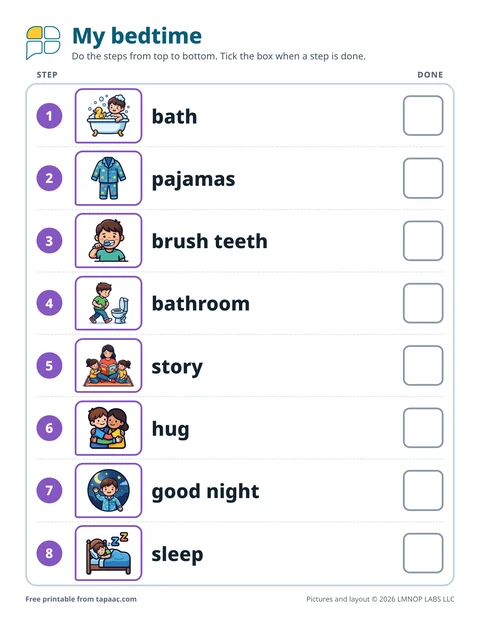 Bedtime routine chartBath, pajamas, teeth, story and sleep, as a checklist or as picture cards.
-
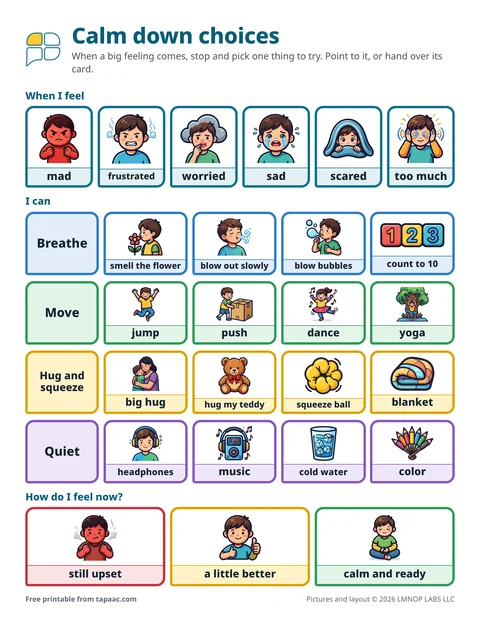 Calm down choices board16 calm down choices in four groups, a breathing square to trace, and calm down cards to cut out.
-
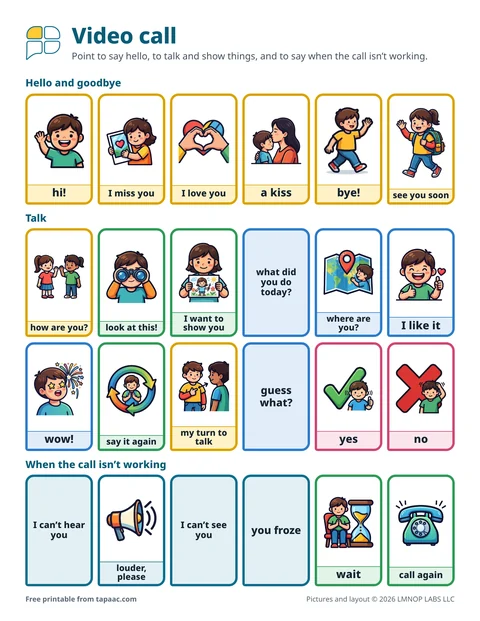 Video call communication boardWords for video calls with family and friends, a who-do-I-call board with room for photos, and the steps of a call.
-
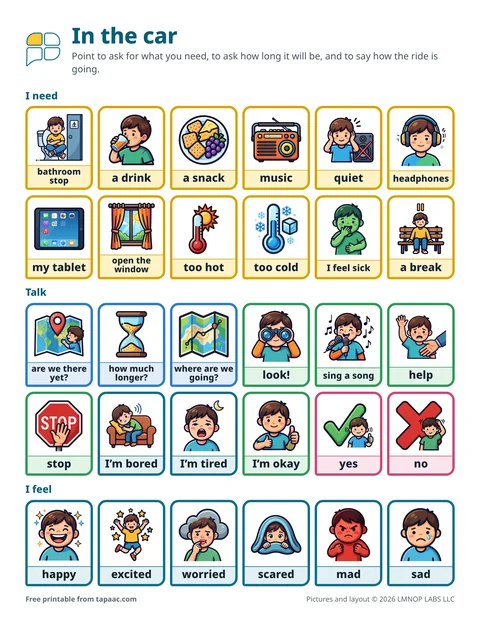 Car ride communication boardWords for the car, the steps of a car ride with stops on a long trip, and a car ride bingo card.
Need a different board? Make your own with the free AAC board maker.
More boards on this topic: travel communication boards.
These boards and guides are general information, not therapy or medical advice, and they don’t replace a speech therapist. A speech therapist who knows the person can help choose the right words, pictures and layout. The boards are free to print and share; please don’t sell them (terms of use). Questions about the boards? Email support@lmnoplabs.fun.