 Tap AAC
Winter clothes visual schedule and snow day board
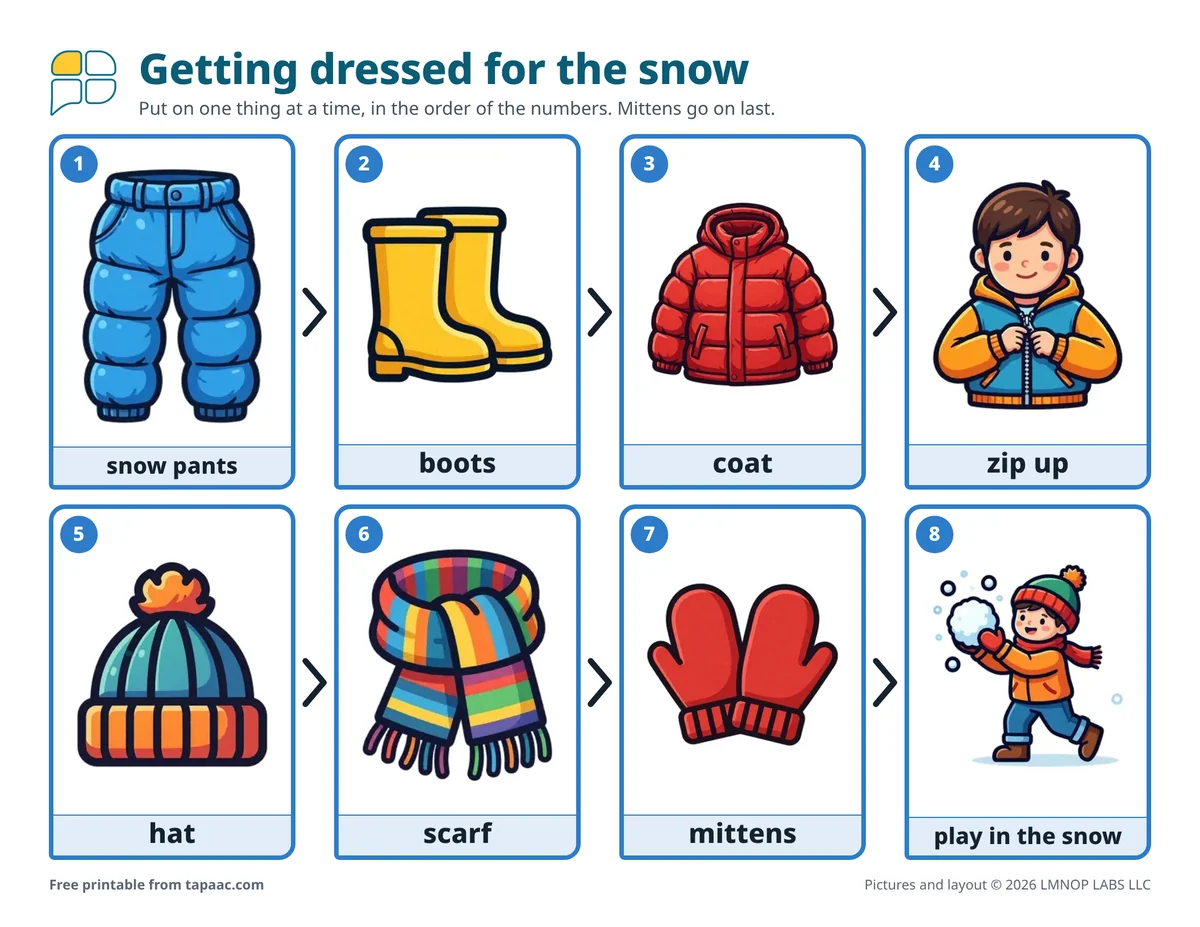
A winter clothes visual schedule shows, in order, what goes on before going out in the snow: snow pants, boots, coat, zip up, hat, scarf, mittens, then play in the snow. This free PDF has those eight steps, eight more for coming inside (from mittens off to warm up), and a snow day board with words for playing in the snow, for saying too cold or wet, and for the weather.
Download the free PDF US Letter, 3 pages, 1,360 KB
Printing on A4 paper? Download the A4 PDF (3 pages, 1,361 KB). Or pick one page shape for every page:
Portrait (tall page, 3 pages): US Letter PDF (1,361 KB) · A4 PDF (1,361 KB)
Landscape (wide page, 3 pages): US Letter PDF (1,360 KB) · A4 PDF (1,363 KB)
Edit this board in the free board maker: change the words and pictures, then print.
Have Tap AAC? Add to Tap AAC (.obz file, 1,256 KB) · How to add a board
- Free
- No sign-up
- Print as many as you need
Who it’s for
Children for whom getting ready for the cold is a battle: lots of layers, in an order that matters, with fingers that get clumsy in mittens. It suits preschool and school-age children who use pictures to follow a routine, and children who don’t speak or don’t speak much and need a way to say too cold or wet. Classrooms can post it by the coat hooks for winter recess.
How to use it
- Lay the clothes out in the order of the steps, left to right, before you start.
- Point to step 1 and hand over the snow pants. Point, wait, and help only with the part that’s hard, like the zip.
- Pull the snow pant legs over the boots, so the snow stays out.
- Take page 3 outside in a sheet protector, or tape it to the door, and model the words as you play: “More snowballs!” “Too cold? Let’s go inside.”
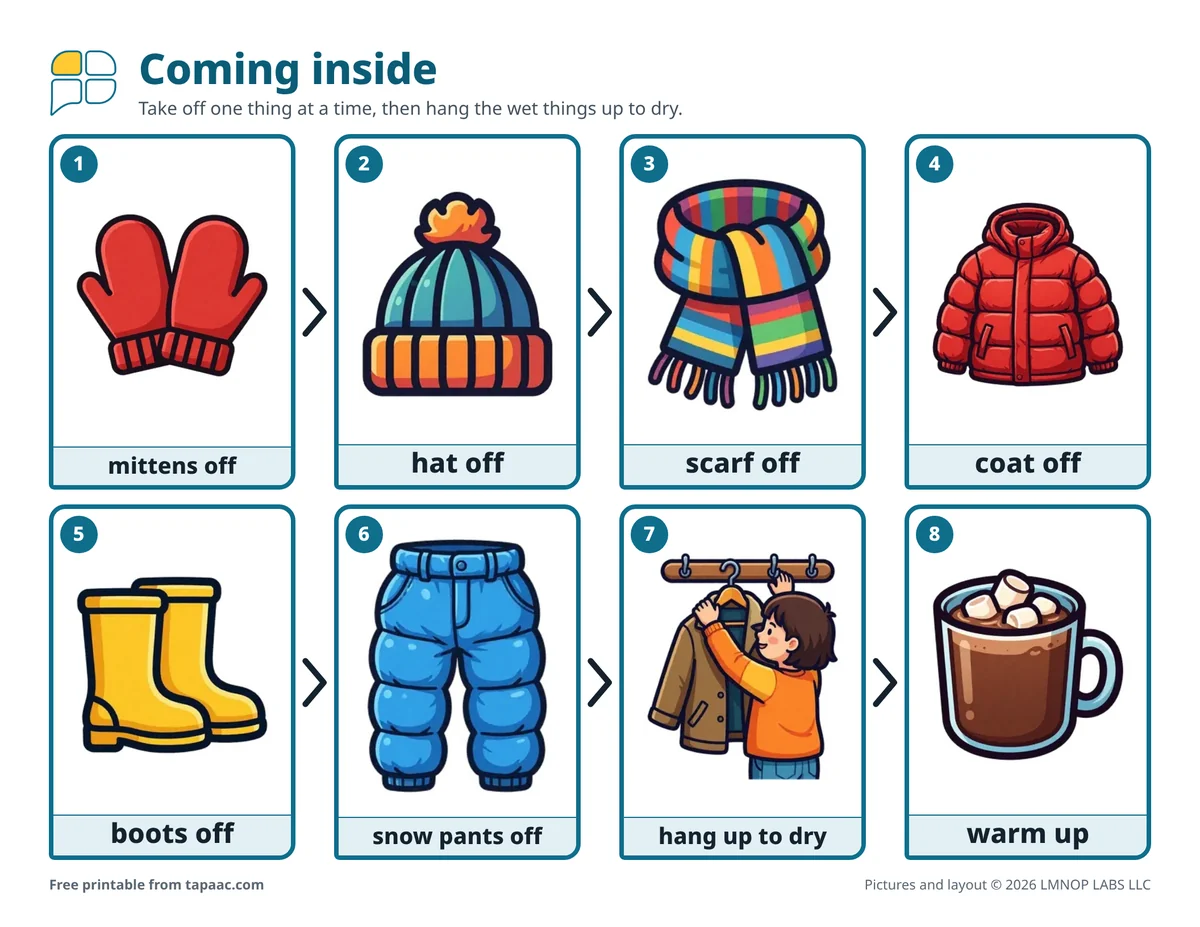
- Coming in, follow page 2: mittens first, snow pants last, then hang the wet things up before the warm-up.
Why the order matters
Snow pants before boots, coat before hat, mittens last: the order on page 1 keeps the snow out and leaves the fingers free for the zip and the hat. It also means a child who can do steps 1 and 2 alone gets to do them, and help only comes in at the hard part. If your child wears a one-piece snowsuit, write snowsuit on step 1 and cross out step 3.
Words for a snow day
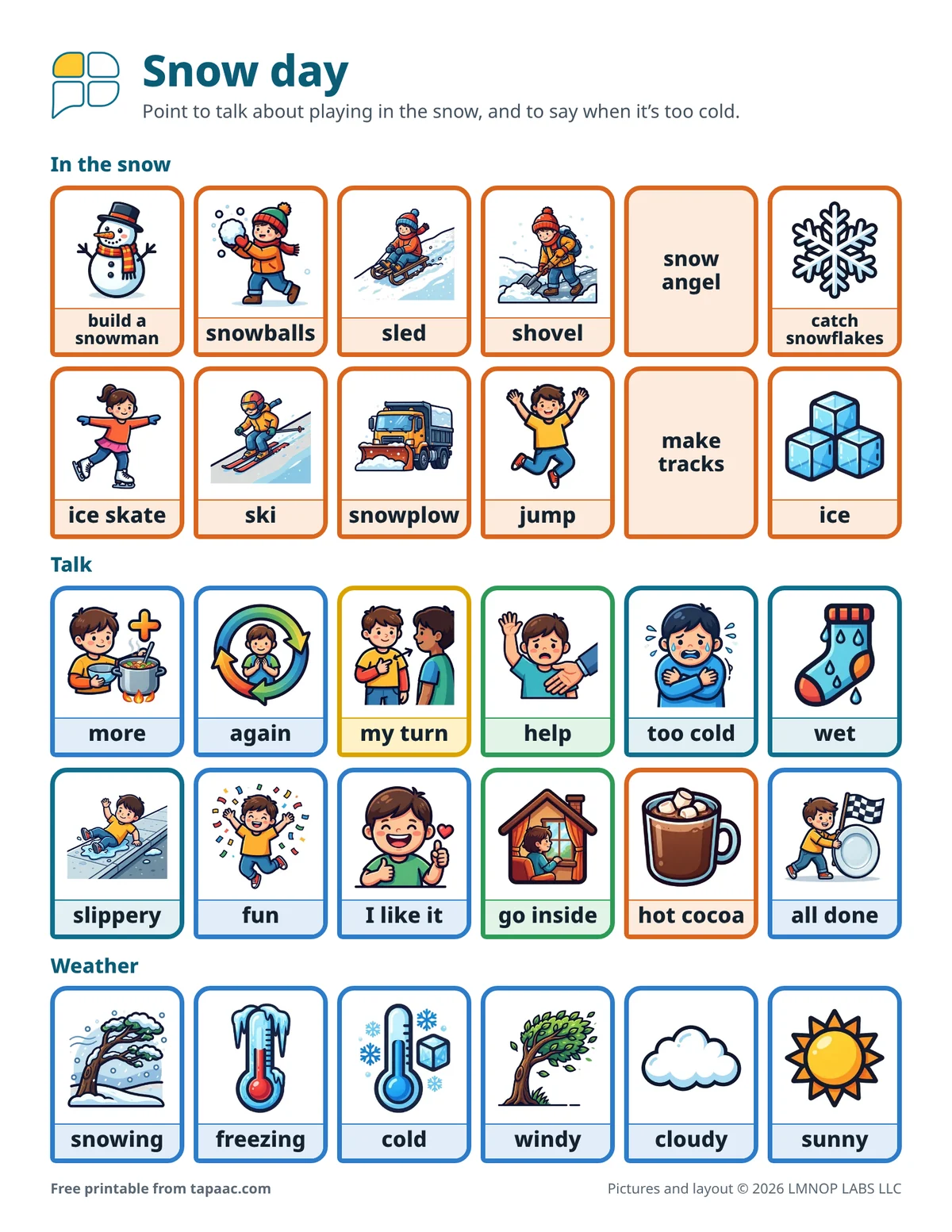
A snow day is full of things to talk about: a snowman, a sled, a snowplow going by, catching snowflakes. Page 3 has twelve things to do in the snow, words for playing together, and the weather. Too cold, wet and slippery are there on purpose: a child who can say too cold can come in before it gets too much. On days you stay inside, the weather row works just as well at the window.
Owen is four, and getting dressed for recess used to take forever. His teacher puts page 1 by the coat hooks and lays his clothes out in order. Owen points to snow pants, and she helps with one leg. He does his boots on his own. At step 4 she does the zip, and Owen pulls on his mittens last. Outside, he points to snowballs and my turn. After a while he points to too cold, then go inside, and they follow page 2 together, all the way to warm up.
What’s on the PDF
Getting dressed for the snow
- snow pants
- boots
- coat
- zip up
- hat
- scarf
- mittens
- play in the snow
Coming inside
- mittens off
- hat off
- scarf off
- coat off
- boots off
- snow pants off
- hang up to dry
- warm up
In the snow
- build a snowman
- snowballs
- sled
- shovel
- snow angel
- catch snowflakes
- ice skate
- ski
- snowplow
- jump
- make tracks
- ice
Talk
- more
- again
- my turn
- help
- too cold
- wet
- slippery
- fun
- I like it
- go inside
- hot cocoa
- all done
Weather
- snowing
- freezing
- cold
- windy
- cloudy
- sunny
Printing tips
- Laminate page 1 and tape it at child height by the coat hooks or the door you go out of.
- Print a second copy, cut out the eight steps, and tape each one to the hook or bin where that piece of clothing lives.
- For everyday clothes, the getting dressed visual schedule; for the weather at circle time, the weather and calendar board; and for December, the holiday board.
- Just starting with pictures? Start with one routine: getting ready to go out happens every day, which makes it a good one to practice. Visual supports for everyday routines has more.
More free boards
-
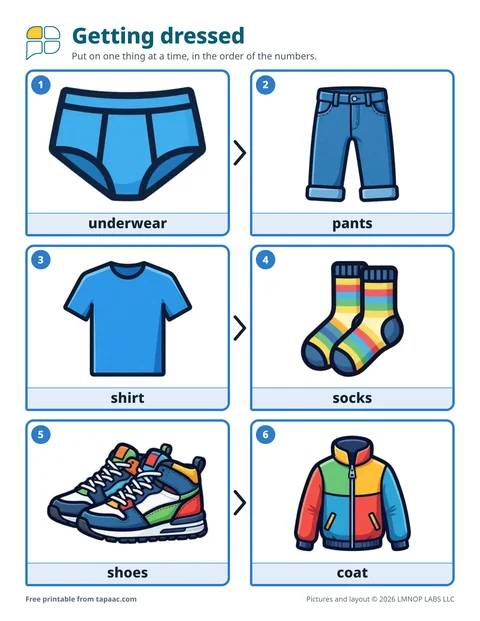 Getting dressed visual scheduleUnderwear to coat, one step at a time, plus clothes cards for any weather.
-
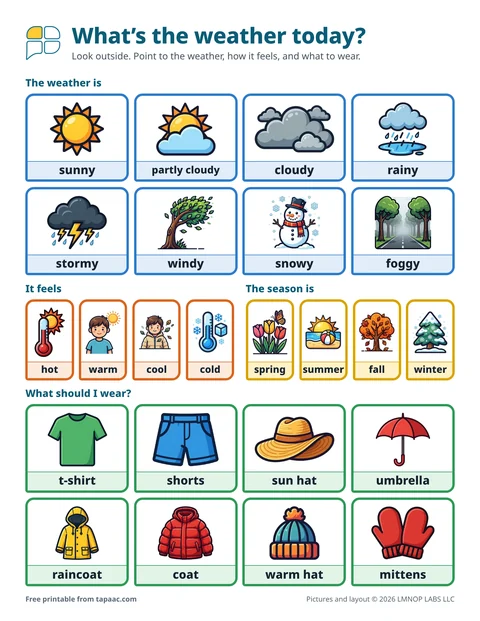 Weather and calendar boardToday’s weather, how it feels, what to wear and the season, plus a calendar page.
-
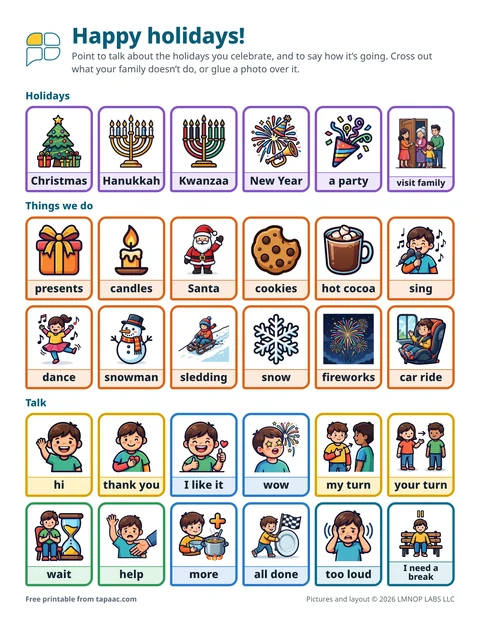 Christmas and holiday boardChristmas, Hanukkah, Kwanzaa and New Year, winter fun, opening presents and gift tags.
-
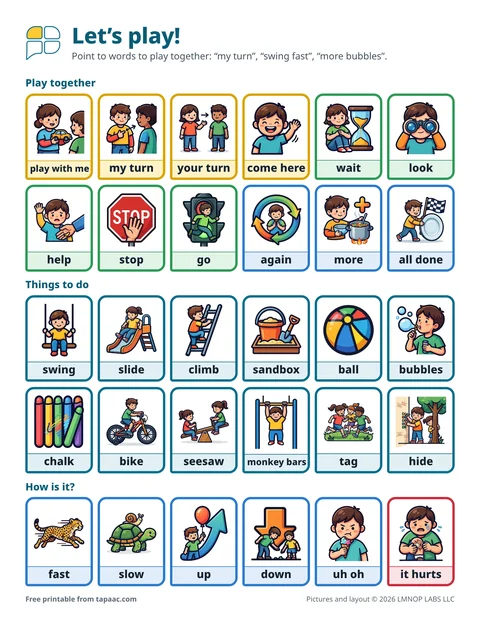 Playground communication boardMy turn, your turn, swing, slide, fast, again and more, for playing together.
Need a different board? Make your own with the free AAC board maker.
Making a schedule? Use the free visual schedule maker: routines ready to open and change.
These boards and guides are general information, not therapy or medical advice, and they don’t replace a speech therapist. A speech therapist who knows the person can help choose the right words, pictures and layout. The boards are free to print and share; please don’t sell them (terms of use). Questions about the boards? Email support@lmnoplabs.fun.